TL;DR. Chroma announced Foundation, its agent-memory product, on August 20, and followed it with an engineering post, Agent Swarms are a Distributed Systems Problem, that deserves more attention than the launch. It describes Fission, the concurrency control protocol behind Foundation's shared wiki. The protocol is classical pessimistic locking with wound-wait, with one deliberate break from decades of database practice: there is no rollback. A killed task's partial work commits. Chroma's argument is economic, that agent reasoning is too expensive to throw away and redo. The argument is worth taking seriously, and it has a cost the announcement does not dwell on: atomicity does not disappear quietly. It moves into the state every later agent reads.
Chroma spent three years as the vector database underneath everyone else's retrieval stack. On August 20 it announced Foundation, a research preview that turns agent sessions into what it calls self-improving memory: a hyperlinked, tagged, versioned wiki, built on ChromaDB and on Context-1, the 20B search model it released in March. The launch pitch, that memory is the largest unsolved problem in AI, is the part every memory vendor says. The part no one else is saying sits in the companion engineering post: once memory is shared, a swarm of agents editing it concurrently is a distributed systems problem, and Chroma built a transaction protocol, Fission, whose defining move is that aborted transactions never roll back.
The protocol is textbook until the last step
Strip away the vocabulary and most of Fission is recognizable from a graduate database course. Workers take locks before editing. Conflicts between tasks resolve by seniority using wound-wait, the deadlock-avoidance scheme Rosenkrantz, Stearns, and Lewis published in 1978: an older task that needs a lock a younger task holds wounds the younger task, which aborts; a younger task wanting an older task's lock simply waits. No cycle detection, no deadlock. Each page of the wiki updates atomically, backed by optimistic concurrency control transactions in Chroma Cloud. Chroma's post calls the isolation property it wants "isolation while reasoning": an agent can read a page, think about it for minutes, and apply its patch without a conflict surfacing mid-thought.
Every one of those design choices has decades of production history behind it, and in that history they all share one companion mechanism. When a transaction is wounded, the system rolls its partial work back, restoring the state the transaction found. Rollback is what makes two-phase locking safe to run aggressively. Kill anything, retry later, the ledger never shows the casualties.
Fission keeps the wounding and deletes the rollback. Killing a task leaves behind exactly what the task had already done, committed. Chroma is explicit that this breaks atomicity: transactions never roll back, aborts become early commits, and a half-finished patch set becomes durable state that the next agent finds and, the design assumes, picks up.
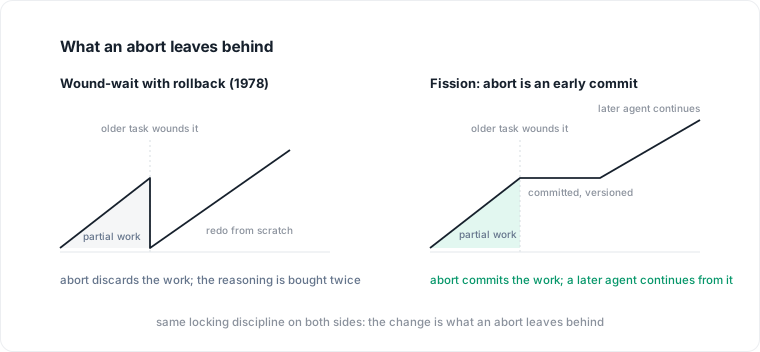
The locking discipline is identical on both sides. The 2026 change is what an abort leaves behind.
What rollback actually costs when the worker is a model
The economic argument underneath the design is the genuinely new part, and it is correct as far as it goes. In a conventional database, the work inside a transaction is cheap. A retried transaction re-executes some reads and arithmetic in milliseconds, which is why the optimistic pattern, run it, abort on conflict, retry, became the default posture for everything from Postgres serializable mode to web-app compare-and-swap loops. Rollback is affordable because redo is affordable.
An agent task inverts the ratio. The work between the read and the write is a reasoning loop that runs for minutes and is billed by the token. Chroma frames Foundation's objective as goodput, the share of paid reasoning that survives into committed state rather than being discarded and bought a second time. Under that objective, classical abort-and-retry stops looking safe and starts looking like a mechanism that deletes dollars.
| Database transaction | Agent task | |
|---|---|---|
| Work between read and write | Milliseconds of CPU | Minutes of model reasoning |
| Cost to redo after abort | Negligible | The full reasoning spend, again |
| What rollback discards | A few buffer writes | A possibly valid, expensive edit |
Postgres users building agent systems already meet this inversion, usually without naming it. Wrap an agent's read-reason-write cycle in a SERIALIZABLE transaction and every serialization failure re-runs the reasoning; put a version column on the row and do compare-and-swap at write time and the conflict path still re-prompts the model. The redo cost is real either way, in the same way that lock queues cost you in whatever currency the waiting work is denominated in. Chroma looked at that bill and concluded the edit being thrown away is usually worth more than the clean history rollback buys. Hence: commit the casualty's progress and let the swarm sort it out.
Atomicity does not disappear. It moves to the reader.
Here is the accounting the launch coverage skips. Rollback is the mechanism that makes an abort invisible. Remove it and every abort becomes a committed partial transaction. Fission guarantees each individual page update lands atomically, so what leaks is everything an agent meant to do across pages. A refactor that was renaming a concept across seven pages, wounded after three, stays three-sevenths applied. Nothing in the protocol will finish it or revert it. The design's answer is that a later agent, or the wounded task rescheduled, reads the half-done state and continues.
Database theory has a name for handling long-lived work without holding transactions open: sagas, from Garcia-Molina and Salem in 1987. A saga splits long work into steps and, crucially, requires the developer to define a compensating action for every step in advance, so an interrupted chain can be unwound deliberately. Fission is a saga that declines to write the compensations. In their place stands a bet that would have been unavailable to 1987: the reader is intelligent. The entity encountering your half-finished rename is a model that can notice, infer intent, and repair, rather than a stored procedure that corrupts itself on unexpected state.
That bet is not crazy for this workload, and two properties of Foundation's design do real load-bearing work. The wiki is versioned, so an early-committed mess is recoverable in a way an unlogged overwrite never is; history holds who wrote what, when, and what came before. And a wiki is a forgiving data model, as anyone who maintains a CLAUDE.md file at scale has learned the hard way: a stale or half-edited paragraph degrades answer quality, it does not corrupt a ledger. Chroma says Fission imposes no structure except the emergent structure of the wiki itself, which is an honest description of both the freedom and the exposure.
The exposure is that consistency stops being a system property and becomes a statistical one. Whether cross-page invariants hold now depends on how reliably the next reader notices and completes partial work. That reliability is unmeasured, model-dependent, and changes every time the underlying model does. For shared memory this may be an acceptable trade. It should be a monitored one, and the write conflicts themselves, who wounded whom over which page, are exactly the kind of record worth keeping, for the same reason shared agent memory needed write-time provenance rather than read-time filtering.
The line this draws for agents on databases
The sharpest use of Fission is as a boundary marker. The protocol is defensible precisely because of what Foundation is: versioned, semantically forgiving, read by tolerant readers, holding no invariant whose violation costs money in the next five minutes. Change any of those properties and the same design becomes indefensible. An inventory table is not semantically forgiving. An access-grant table is read by enforcement code, not by a model that infers intent. A payment ledger's invariants are exactly the cross-row kind that per-page atomicity lets bleed.
This matters now because the same agents are increasingly wired to both kinds of store in the same afternoon, and the write path rarely announces which semantics it is operating under. A team can already compare memory backends on recall benchmarks; almost nobody's stack records that the memory write goes to an early-commit store while the migration the agent proposes goes to a system that must stay atomic. The transaction guarantees behind each write surface an agent touches are becoming a governance fact, as load-bearing as the credentials, and most stacks track neither in one place.
The database people have watched this movie before
One prediction, offered with its falsifier. Per-unit atomicity with cross-unit consistency left to the application is the position the document databases started from. MongoDB held per-document atomicity as sufficient for a decade, then shipped multi-document ACID transactions in 4.0 because real applications kept discovering invariants that spanned documents. Agent memory will run the same curve faster, because agents generate cross-page structure automatically and relentlessly. Expect a future Fission revision to grow something shaped like a multi-page commit, scoped saga, or invariant pin, once enough swarms lose enough renames in the middle. If instead the intelligent-reader bet holds at scale and no such mechanism appears within a couple of years, that will be the more interesting result, evidence that a sufficiently capable reader really can replace a coordinator, and the textbook chapter on concurrency control gets an asterisk.
Either way, the protocol's real contribution stands: it is the first production system to price reasoning into concurrency control. Goodput, the fraction of paid model work that survives contention, is a metric every team running agent swarms against shared state will eventually track, whatever their rollback semantics.
Where Datapace fits
Datapace is building the context layer between your databases and your AI: the resolved meaning of your schemas, validated by the people who own the data, the workload evidence beside it (cost, performance, usage and freshness, lineage), and a policy gate over what an agent may do and access, served over MCP. Fission is a preview of a question that policy layer has to answer per write, not per agent: the same swarm may hold one store where an abort is a commit and another where a commit needs an approval, and treating those two writes as the same kind of action is how a memory-layer convenience becomes a ledger incident. If you are mapping which of your stores an agent may touch under which guarantees, book a call.
Sources
- Chroma, Agent Swarms are a Distributed Systems Problem, August 2026 (Fission protocol, wound-wait, early commit on abort, per-page OCC atomicity, goodput).
- Chroma, Foundation, August 2026 (wiki data model, ChromaDB and Context-1 foundation, research preview).
- Jeff Huber, Foundation announcement, X, August 20, 2026.
- Chroma, Introducing Foundation, X, August 20, 2026.
- D. J. Rosenkrantz, R. E. Stearns, P. M. Lewis, System Level Concurrency Control for Distributed Database Systems, ACM Transactions on Database Systems 3(2), 1978 (wound-wait).
- H. Garcia-Molina, K. Salem, Sagas, ACM SIGMOD 1987 (compensating transactions for long-lived work).
- MongoDB, Multi-document ACID transactions general availability, 2018.
- MarkTechPost, Chroma releases Context-1, a 20B agentic search model, March 29, 2026.