TL;DR. OpenMetadata vs DataHub used to be a catalog feature shootout. In 2026 it stopped being one: OpenMetadata's repository now reads "The Open Context Layer for Data and AI" and DataHub's reads "The Context Platform for your Data and AI Stack". Both are Apache 2.0, both ship MCP servers, both claim the same buyer. What still separates them is the machine underneath. OpenMetadata is one Java server writing a relational database and a search cluster; DataHub is a metadata service whose search and graph indexes are fed by a Kafka change log. Pick by the operational footprint you can run and by whether you need metadata changes as an event stream, because the taglines no longer pick for you.
OpenMetadata vs DataHub is the standing comparison of open-source metadata platforms, and nearly every page answering it predates the year both projects changed what they claim to be. As of mid October 2026, the OpenMetadata repository describes itself as "The Open Context Layer for Data and AI" (15.5k stars, 130+ connectors), and the DataHub repository describes itself as "The Context Platform for your Data and AI Stack" (12.8k stars, 150+ integrations). Neither leads with the word catalog. Both lead with AI agents as the consumer, and both ship an MCP server to serve them. The feature matrices that used to decide this comparison, connector counts and lineage screenshots, now read almost interchangeably, which moves the real differences down a level: what each system runs in production, and what an agent actually gets from it.
We watched OpenMetadata make this turn in August, when the 2.0 release arrived under the context-layer identity. DataHub's repositioning lands on the same square from the LinkedIn lineage: the project started there in 2019, and its README now states the goal as transforming enterprise data into "trusted context" for humans and AI agents. When the two leading open-source projects in a category rename themselves onto the same phrase in the same year, the phrase is settled. The choice between them is what this page is about.
The positioning converged; the architecture did not
Strip the shared vocabulary and two different machines remain.
OpenMetadata's deployment requirements are short enough to quote as an architecture. The bare-metal guide asks for Java 21, one relational database (MySQL 8.0.42 or higher, or Postgres 15 or higher), and one search engine (Elasticsearch 9.x or OpenSearch 3.x). The API server writes the database and the search index itself, and metadata ingestion runs through its ingestion framework, commonly scheduled on Airflow. Three services, and one of them is the Postgres you already operate.
DataHub describes itself as streaming-first, and the serving docs make that concrete. The metadata service (GMS) persists metadata in a document store, which can be MySQL, Postgres or Cassandra. After a change commits durably, GMS emits a Metadata Change Log event, and that event "is sent over Kafka". A dedicated consumer job reads the stream and updates the search index and the graph index, with events keyed by entity URN so each entity's changes apply in order. Reads route by shape: primary-key lookups hit the store, full-text search hits the search index, lineage traversals hit the graph index.
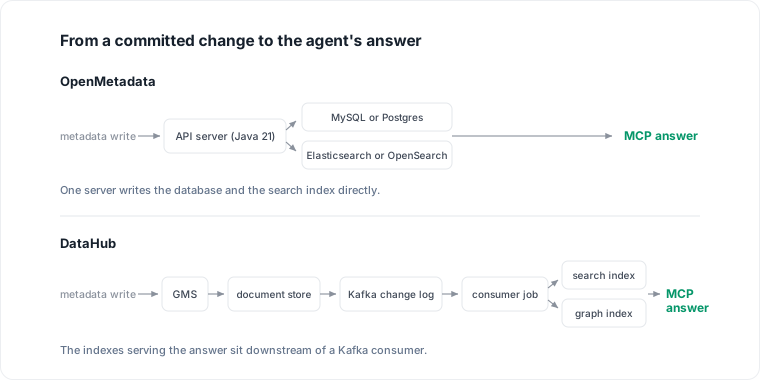
The Kafka hop is a cost and a feature at the same time, and which one dominates depends on your team. The cost is operational: the path between a committed change and the indexes that answer search and lineage queries runs through a broker and a consumer job, and every component on that path is yours to run, monitor and upgrade. The feature is that DataHub treats the change log as a public API. External systems subscribe to the stream, the Actions Framework builds on it, and the architecture docs describe federated metadata services communicating with the central index and graph over Kafka. If your platform needs to react to metadata changes as ordered events, access revocations propagating, downstream caches invalidating, a control plane keeping pace with schema drift, that stream is the product, and OpenMetadata has no equivalent primitive. If you just need governed metadata served to people and agents, the stream is overhead with its own on-call rotation.
What an agent gets from each
Both projects now treat the agent as the first-class reader, ahead of the browsing human, and both chose MCP as the serving protocol.
OpenMetadata's MCP server exposes tools for search and semantic search, entity details, lineage, data contracts, glossary terms, quality tests, metadata updates, and memory retrieval. The memory tool is the distinctive entry: 2.0 introduced memories as governed entities in the metadata graph, decisions and assumptions preserved alongside lineage and quality signals, so an agent can read why a table is shaped the way it is and under the same governance as the rest of the graph. An AI SDK (Python, TypeScript and Java) converts the MCP tools to LangChain format and works with OpenAI function calling, for teams wiring the catalog into their own agents rather than pointing a desktop client at it.
DataHub groups its answer under Context Activation: context served to agents via MCP, GraphQL, API or SDK, with an official MCP server started with uvx mcp-server-datahub@latest. Around it sit DataHub Skills, which help AI coding assistants plan and review connector work, and an open-source Analytics Agent that answers plain-English questions with SQL, results and charts. The README cites a customer-reported text-to-SQL accuracy jump from 50 percent to 90 percent, attributed to an IDC study from March 2026; treat that as a vendor-relayed number until you can read the study's setup, because context-quality claims measured on someone else's estate transfer badly.
The honest summary is that the agent-facing surfaces are converging as fast as the taglines did. Both serve search, lineage and glossary context over MCP today. The differences worth weighing are one level down: OpenMetadata is further along on agent-written context as a governed object (memories in the graph), while DataHub's event stream gives agent infrastructure something to subscribe to rather than poll.
Release lines, and the checks before you commit
Both projects are shipping actively, which this comparison's older competitors miss entirely.
OpenMetadata's 2.0.0 went stable on August 24, and the line has iterated quickly since: 2.0.3 on September 30, 2.0.4 on October 6, 2.0.5 on October 8. The move onto 2.0 is not a no-op from the 1.x line; we cataloged the breaking changes and silent default flips separately. Note the search-engine floor in the current requirements: Elasticsearch 9.x (the client is incompatible with 8.x servers) or OpenSearch 3.x. If your platform standardized on an older shared cluster, that constraint surfaces at deployment time, so surface it at decision time instead.
DataHub's latest full release is v1.6.0.3 from September 25, with v1.8.0 in release candidates as of October 8. The pre-1.0-style version number undersells the project's age; the codebase has been in production at LinkedIn scale for years, and the docs claim deployments past ten million assets. For either platform, the version check that matters is less the number and more the cadence: both cut releases within the last three weeks, which is what you want from the component you are about to make load-bearing for agent context.
One procurement note that the matching taglines make easy to miss: both projects have commercial companies behind them founded by their creators, and the open-core boundary is a moving line at both. Features announced at the positioning level, context centers, AI studios, hosted gateways, do not always land in the Apache 2.0 repo. Verify any feature you are buying the platform for against the open-source docs, not the launch post.
How to actually decide
The decision rule that survives the rebrand is operational.
- Run OpenMetadata when the goal is governed context over MCP at the smallest footprint. One Java server, a Postgres you already know how to back up, one search cluster. The memories model gives agent-written context a governed home, and 130+ connectors cover ingestion breadth.
- Run DataHub when metadata changes need to be events. The Kafka change log with ordered per-entity delivery and a public subscription surface is the capability the simpler architecture cannot fake. Accept the broader operational surface as the price of the stream.
- Run neither as a governance enforcement point. A context platform can tell an agent what a column means and where it came from. Whether the agent's next query should be allowed to touch that column is a different question, answered at execution time or not at all. We made the same point about semantic definitions and the tools that enforce them: a definition's home and its enforcement point are separate design decisions.
That last line is where this comparison runs out, because it is where both platforms run out by design. A catalog, however it rebrands, describes.
Where Datapace fits
Choosing between OpenMetadata and DataHub settles where your metadata lives and how agents read it. It does not settle what those agents may do with what they learn. Datapace is building the context layer between your databases and your AI: resolved meaning validated by the people who own the data, the workload evidence beside it (cost, performance, usage and freshness, lineage), and a policy gate over what an agent may do and access, served over MCP. Postgres first in depth, other engines through OpenMetadata connectors, which is one reason this comparison gets read closely here. If your agents are about to get a catalog's worth of context, what they are allowed to do with it is the conversation to have next.
Sources
- OpenMetadata repository (tagline, Apache 2.0 license, 15.5k stars, 130+ connectors, MCP server tool list, memories as governed entities, AI SDK packages).
- DataHub repository (tagline, positioning line, Apache 2.0 license, 12.8k stars, 150+ integrations, LinkedIn 2019 origin, Context Activation, mcp-server-datahub, the IDC-attributed accuracy claim).
- DataHub architecture overview (streaming-first, model-first and API-first principles, Kafka as the metadata change transport, federated serving, the 10M+ assets claim).
- DataHub serving architecture (document store options, Metadata Change Log over Kafka, the consumer job updating search and graph indexes, per-URN ordering, the stream as public API).
- OpenMetadata bare-metal deployment requirements (Java 21, MySQL 8.0.42+ or Postgres 15+, Elasticsearch 9.x or OpenSearch 3.x, ingestion framework and Airflow compatibility).
- OpenMetadata releases (2.0.0 on August 24; 2.0.3, 2.0.4 and 2.0.5 dates).
- DataHub releases (v1.6.0.3 on September 25, v1.8.0 release candidates in October).