TL;DR. SAPinsider's 2026 benchmark, fielded December 2025 to March 2026 across 296 organizations, found a record 55% have deployed S/4HANA in some form, but only 34% have completed their transformation. ISG puts nearly 60% of SAP migration projects behind schedule and over budget. Mainstream ECC maintenance ends December 31, 2027, and Gartner projects nearly half the installed base will miss it. The bottleneck is not license procurement or infrastructure. It is that S/4HANA deleted the tables the legacy data lives in: financial line items and aggregates collapse into ACDOCA, inventory documents and stock aggregates into MATDOC, customer and vendor masters into the Business Partner. That makes ERP data migration a semantic transformation of twenty years of accumulated meaning, on a deadline.
SAPinsider surveyed 296 organizations between December 2025 and March 2026 for its ERP Migration and Transformation benchmark. Two numbers from it describe the entire situation. A record 55% of organizations have deployed S/4HANA or S/4HANA Cloud. Only 34% have completed their transformation. The 21-point gap between deployed and done is where ERP data migration lives: parallel landscapes still running, instances not yet consolidated, history not yet moved, and mapping decisions still surfacing as defects. Mainstream maintenance for ECC ends on December 31, 2027, with extended maintenance to 2030 available at a premium.
Before the 2027 deadline, half the install base is not moving
The holdout numbers are stark. As reported by CIO, roughly 39% of the approximately 35,000 SAP ECC customers, about 14,000 organizations, had migrated to S/4HANA by the end of 2024, and at the observed rate Gartner projects around 17,000 holdouts, nearly half the base, when the deadline arrives, with 13,000 still on ECC in 2030. A DSAG survey of German-speaking SAP users found about half of ECC customers planning to keep investing in the legacy system beyond 2027.
The exits are priced accordingly. SAP offers extended maintenance to the end of 2030 at roughly a 2 percent premium on the maintenance base, for systems current on enhancement packages 6 to 8. Rimini Street advertises third-party ECC support stretching to 2040. Neither option moves any data; both buy time to do so.
The projects that are moving confirm why so many are not. ISG research from February 2026, reported by The Register, found nearly 60% of SAP migration projects delayed and over budget, with underestimated complexity and scope expansion as leading causes. The same research found fewer than one in five organizations reimplement their processes when they move, and nearly half carry out little or no re-engineering. Read those two findings together: most teams are attempting the most conservative migration available, moving what exists with minimal redesign, and even that version is late and over budget in a majority of cases. Something in the middle of the conservative path is harder than the plans assume. That something is the data.
The target model deleted the tables
An ECC system that has run for twenty years is not a database with a design. It is an accretion: tens of thousands of standard tables, custom Z-tables bolted on by every generation of consultants, and fields whose meaning drifted as the business changed. The instinct is to treat migration as bulk transfer, extract from old tables, load into matching new ones. S/4HANA forecloses that plan, because the matching new tables are not there.
Three examples carry most of the weight.
Finance collapsed into one journal. S/4HANA's universal journal, the ACDOCA table, is the single line-item store for general ledger, controlling, asset accounting, and material ledger postings. The ECC landscape it replaces, separate line items in BSEG and COEP, totals and index tables like GLT0 and BSIS, is gone as a set of physical tables; what remains are compatibility views that project the old structures so legacy reports keep running. Data that lived in five reconciled-but-separate stores has one destination whose grain and semantics differ from each source.
Inventory documents merged, aggregates evaporated. The material document pair MKPF and MSEG, plus roughly two dozen aggregate tables that stored precomputed stock levels, are replaced by a single MATDOC table, with stock quantities computed on read. Every integration, extract, and report that pointed at a stock aggregate table now points at a view over something structurally different, and every historical material document must be reshaped into the new store's form.
Customers and vendors became one thing. S/4HANA makes the Business Partner the leading master data object. The ECC customer master (KNA1) and vendor master (LFA1) must be synchronized into Business Partners through Customer-Vendor Integration before a system conversion can even proceed. This is the step where two decades of deferred data quality becomes a blocking dependency: duplicate records, one company entered as three customers and two vendors, conflicting addresses across modules. The merge forces a decision on every conflict, and each decision is a claim about the real world, not a technical operation.
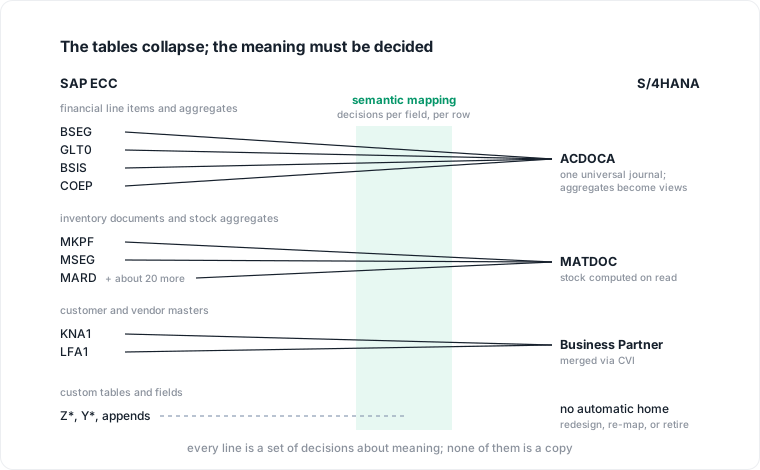
The mapping band in the middle is the project. Every arrow through it is a set of decisions about meaning.
And then there is everything SAP did not design: the Z-tables and appended fields that encode how this particular company actually runs. Precisely and ASUG's late-2025 research found 44% of organizations naming customizations among their top migration barriers, second only to business process change at 49%. Custom structures have no automatic home in the new model. Each one gets redesigned, re-mapped, or retired, and deciding which requires knowing what it meant, knowledge that frequently left the building with the consultant who built it. We wrote about that archaeology problem, and a discovery-first loop that improves on it, in our piece on mapping legacy databases in ERP projects.
Deployed is not done
The 21-point gap in the SAPinsider data deserves more attention than it gets. Deployment is the visible milestone: the new system exists, some business units transact on it. Completion is a different condition, and SAPinsider's own reading of its data explains the distance: complex legacy landscapes force parallel running, turning migrations into marathon, multi-instance projects rather than a switch flip.
Parallel running is a data condition, not a project-management preference. Two systems of record coexist; balances, open items, and master data must reconcile between them continuously; and every consolidation wave repeats the mapping exercise for another company code or region. The defects that stretch this phase are rarely infrastructure failures. They are meaning-level errors that were invisible while the data sat still: a tax code that covered two regimes in the source, a unit of measure that one plant used differently, a merge that folded two genuinely distinct parties into one Business Partner. Errors of that class pass every load validation and surface only when the business transacts on the result, which is why they are found in production, after go-live, during exactly the phase the benchmark shows stretching on.
This is also why the standard tooling, SAP's Migration Cockpit with its staging tables and predefined migration objects, solves less of the problem than its name suggests. It executes mappings reliably. It does not decide them. The deciding is the workstream that consumes scarce senior people, and it is the one workstream that cannot be de-scoped, which is how conservative, minimal-redesign projects still end up in ISG's 60%.
What does not move still has to answer audits
Not all the data goes. A common selective approach takes open items, active master data, and a few years of history into S/4HANA, and leaves the rest behind. Leaving it behind does not make it disappear: financial and tax records carry retention obligations that commonly run a decade or more, and auditors do not accept "it was in the old system" as an answer.
So decommissioned ECC data needs a queryable home, and teams increasingly park read-only extracts in an inexpensive relational store, often Postgres, rather than paying to keep a licensed ECC instance breathing. The trap is extracting rows without meaning. An MSEG extract is unreadable without the movement-type semantics that give each row its business sense; a pricing table without its condition-technique context is numbers. An archive that preserves tables but not what they meant is a landfill with a schema, and the difference between the two is exactly the metadata work that catalogs exist to hold. The catalog category is currently repositioning itself around that idea, selling resolved meaning to AI systems as a context layer, and a migration archive is among the clearest cases for it: the consumers of that data in 2032 will not have anyone left to ask.
What AI changes in a migration, and what it does not
The most surprising number in the SAPinsider benchmark is not about the deadline at all: SAP's AI announcements have overtaken the 2027 maintenance deadline as the top external factor shaping ERP strategy, cited by 43% of organizations against 39% for the deadline. Boards are no longer migrating only away from unsupported software; they are migrating toward wherever the vendor ships AI capabilities. That reframes the data workstream, because an AI feature reasoning over a freshly migrated system inherits every semantic defect the migration let through. A wrong Business Partner merge was an invoicing bug in 2020; in 2027 it is also what the AI layer confidently reports as fact.
Meanwhile the automation that was supposed to compress these projects has stalled: Precisely and ASUG measured SAP process automation adoption plateauing at 57%, with migration demands diverting the resources that would have extended it. The honest division of labor is narrower than the vendor decks suggest. Machines are genuinely good at the exhaustive reading, profiling every column, tracing every implicit join, surfacing which conventions the data actually follows, and at proposing candidate mappings with evidence attached. Ratifying those mappings is human work and should stay that way, for the same reason agent-run schema migrations need a human in the loop: the machine can establish what is there, but only someone who knows the business can say what it means.
There is one more thing worth salvaging from these projects. A completed migration has, as a byproduct, the most complete semantic model of the company's data that will ever exist: months of ratified decisions about what every field meant and where it went. In most projects that model dies in spreadsheets at cutover. Against a deadline, teams will not slow down to fix that. But the ones who keep the resolved meaning alive, as an operating asset rather than project exhaust, walk out of the migration with the foundation the next decade's AI systems will need.
Where Datapace sits
Datapace is building the context layer between your databases and your AI: resolved meaning validated by the people who own the data, the workload evidence beside it (cost, performance, usage and freshness, lineage), and a policy gate over what an agent may do and access, served over MCP. ERP migration is one of the workloads it is being built for, because a migration is semantic resolution under deadline pressure, and the resolved semantics should outlive the project. If that is the phase of your roadmap that worries you, see the ERP data migration use case or book a call.
Sources
- SAPinsider, ERP Migration and Transformation 2026 benchmark research and 5 Hard Truths About the 2026 SAP ERP Migration Landscape, 296 respondents, fielded December 2025 to March 2026.
- The Register, Most SAP migrations bust budgets and project timelines, research finds, on ISG research, February 5, 2026.
- CIO, Nearly half of SAP ECC customers may stick with legacy ERP beyond 2027, reporting Gartner projections and the DSAG survey.
- Precisely and ASUG, New Research Reveals SAP S/4HANA Migration Momentum, Despite Ongoing Automation Challenges, November 4, 2025.
- SAP PRESS, Key Differences Between SAP ECC and SAP S/4HANA, on ACDOCA, MATDOC, and the simplified data model.
- SAP Community, New MM tables in SAP S/4HANA, on MATDOC and the replaced inventory aggregates.
- CIO, Rimini Street extends SAP support until 2040.