Railway is an application hosting platform that deploys services, databases, and background workers straight from a Git repository, with minimal configuration. It is one of the best deploy-from-repo experiences shipped in the last five years. The UX is clean, the pricing is predictable, the team ships fast. This piece examines two of their incidents in close detail, and that reflects well on their engineering rather than poorly. Railway publishes post-mortems that are thorough, specific, and self-critical. That is rare. Incidents like these are almost never visible from outside the company that lived them. The only reason we can study these at all is that Railway chose to share. Every team that reads a Railway post-mortem is handed a lesson the company paid to learn.
On October 28, 2025, a schema change took down Railway's API for roughly 52 minutes. Six weeks later, on December 8, a second migration cascaded the same way through the same infrastructure, after the team had already shipped the fix they believed addressed the October incident. Both incidents are public. Both were documented in detail by Railway. What follows is a close reading of the two post-mortems, the lock mechanic that connected them, and the single check that would have flagged either migration at pull-request time.
October 28: the lock that locked out the operators
Railway's internal monitoring fired two minutes after the change went live. The on-call team got paged, declared an incident, and then lost their ability to intervene.
- 18:23Schema change introduced in the deploy pipeline.
- 18:34Change live in production.
- 18:36Internal monitoring fires, team paged.
- 18:41Incident declared.
- 18:56Root cause identified. Operators cannot connect.
- 19:00Gradual recovery as the index finishes on its own.
- 19:15Full service restored. Total duration: 52 minutes.
The change added a column and created a non-CONCURRENTLY index on a Postgres table containing roughly one billion rows. That table is touched by nearly every API operation Railway exposes. CREATE INDEX without CONCURRENTLY takes a SHARE lock that blocks writes for the duration of the build, and the build took about thirty minutes because the table has about a billion rows.
What made it an outage rather than a slow window was the cascade downstream of the lock. API servers kept accepting incoming requests. Each request that touched the locked table blocked, waiting. Each blocked request held a Postgres connection open while it waited. PgBouncer's connection pool drained. Railway had configured pg_use_reserved_connections to keep a handful of slots available for administrative access, but those were consumed too, because the reserved slots still count against the same pool when the waiting stack grows deep enough. At that point, an operator who opened a terminal to cancel the statement and end the outage was met with this:
FATAL:  remaining connection slots are reserved for
        roles with privileges of the "pg_use_reserved_connections" role
They could not get in. There was no administrative path back into the database from outside the saturated pool, and no way for the pool to drain while the lock was still held. The index finished on its own after about thirty minutes. The outage ended when the lock released, not when anyone intervened.
October's post-mortem fixes
Railway published a thorough post-mortem the following day. Three preventative measures were announced. First, CI enforcement of CONCURRENTLY on every index creation, implemented as a lint rule on migration files in the repository. Second, tighter PgBouncer connection pool limits to slow the drain the next time a cascade started. Third, a dedicated admin-only Postgres user with connection limits configured to sit above the application's saturation ceiling, so that even at full pool exhaustion an operator could still get in.
All three are correct fixes for the symptoms observed in October. All three are narrow. Only one of them, the CI rule, was a change to the system that merges code, and it targeted exactly the syntactic shape that caused the October migration to fail.
December 8: same cascade, different door
Six weeks later, the team merged a migration at 15:03 UTC. Applying began at 15:17. By 15:18, backend API replicas were failing their health checks and dropping out of rotation. At 15:26 the migration completed and replicas recovered. Eight minutes of degraded service, one nullable column added.
- 15:03Migration merged into main.
- 15:17Migration begins applying.
- 15:18Lock conflicts cause replicas to become unhealthy.
- 15:26Migration finishes, replicas recover. Impact duration: 8 minutes.
The change was ADD COLUMN on a nullable field with no default and no index. In Postgres 11 and later, this is a metadata-only operation. No table rewrite, no full scan, effectively instant. The DDL itself was not the problem.
The problem was that a long-running query was already holding an ACCESS SHARE lock on the same table when the migration arrived. Postgres received the migration's ACCESS EXCLUSIVE request and queued it behind the held ACCESS SHARE. That part is unavoidable. What happens next is the part that still surprises engineers who have not been through it: every subsequent lock request on that table, including trivial reads asking for ACCESS SHARE, queues behind the waiting ACCESS EXCLUSIVE. Postgres does not allow the new readers to jump ahead, even though ACCESS SHARE is compatible with ACCESS SHARE. Letting them jump would starve the waiting writer. So they wait. And while they wait they hold connections. PgBouncer saturates. Backend replicas that cannot obtain a connection fail their health checks and fall out of rotation.
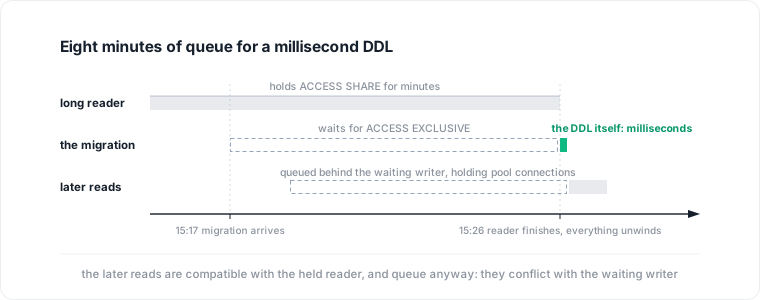
December 8, state of the lock queue shortly after the migration began applying. The DDL is not the slow thing. The held reader is. But the cost is paid by every query that arrives after the DDL and joins the back of a queue it did not cause.
When the long-running reader finally finished, the migration applied in a fraction of a second, and the cascade unwound in the order it had formed.
Why the October fix did not catch December
The October lint rule scanned migration files for a regex pattern: CREATE INDEX without CONCURRENTLY. The December migration did not create an index. It did not need CONCURRENTLY. It would have passed every syntactic rule a team could reasonably write about schema changes without also rejecting half of legitimate work.
What October and December share is a lock interaction, not a DDL shape. The October DDL needed an exclusive lock that Postgres could not release quickly because an index build was in progress. The December DDL needed an exclusive lock that Postgres could not grant because a reader was holding an incompatible share. Side by side, the two incidents line up on almost everything that matters:
Incident 1, October 28, 2025
- DDL
- CREATE INDEX (non-CONCURRENT)
- Lock held
- SHARE for ~30 min
- Trigger
- Non-CONCURRENT build on a 1B-row table
- Cascade
- Pool drain → reserved slots consumed → operators locked out
- Duration
- ~52 minutes
- End state
- Index finished on its own
Incident 2, December 8, 2025
- DDL
- ADD COLUMN (nullable, no index)
- Lock held
- ACCESS EXCLUSIVE queued behind ACCESS SHARE
- Trigger
- Long-running reader holding the target table
- Cascade
- Pool drain → replica health fails → replicas drop
- Duration
- ~8 minutes
- End state
- Reader finished, migration applied instantly
The rows that differ are in the top half. The rows that matter for downstream impact are in the bottom half, and they match. From Postgres's perspective, the two situations are the same failure: a waiting ACCESS EXCLUSIVE in a queue behind an existing lock, and every subsequent request joining the back of the queue. From the connection pool's perspective, identical: connections accumulating on waits, slots exhausting, admin access or replica health disappearing. Only the arrival path differs.
The symmetry is cleaner on paper than it was in the war room. Real incidents rarely reduce this neatly. Railway's own post-mortems credit several contributing factors that do not fit in either column of the table: the deploy timing landed during peak traffic, monitoring surfaced the pool saturation before it surfaced the underlying lock, and the team's rollback tooling assumed it could connect to the database to read state. None of that changes the argument that follows, which is about the mechanism shared between the two. It does mean that "one CI check would have caught both" is a claim about the highest-risk link in the chain, not a claim that the chain had only one link.
The only way a static lint rule catches both is if it rejects every migration that requires
ACCESS EXCLUSIVE. Which is virtually every schema change worth shipping.
This is not a rare edge case
Any team running continuous migrations against a hot table will hit a version of it. The arithmetic is not subtle. More migrations per week, more long-running queries in flight at any moment, more probability that a DDL arrives while a reader is holding. Railway is a public example because Railway writes careful post-mortems. The same pattern is running daily, unlabeled, inside dozens of other SaaS companies that will not publish the incident report because nobody paged outside the engineering org or because the duration fell under the SLA threshold that triggers external communication.
The reason this matters more in 2026 than it did when the lock mechanic was first written up at length is not that Postgres changed. It did not. What changed is the population on either side of the merge button. More teams ship more migrations per week. Fewer of those teams have a DBA in the review loop. And a growing share of schema changes is written, or at least drafted, by coding agents that do not know which tables are a billion rows and which are ten thousand, do not read pg_stat_activity, and have no model of the lock graph. The population of migrations that could trigger a cascade has grown. The population of humans positioned to notice before merge has shrunk.
What the check would have needed to see
What is realistic, and what would have flagged both, is a check that treats the migration as a plan rather than as text. Reading a migration as a plan takes three kinds of context, and none of them lives in the migration file. The lock class: CREATE INDEX without CONCURRENTLY holds SHARE for the full build, while a nullable ADD COLUMN needs ACCESS EXCLUSIVE for milliseconds but has to acquire it first. The table's hotness: its row count, its traffic, and whether long-running queries routinely hold locks on it, which is exactly the state pg_locks and pg_stat_activity expose. And the timeout policy on the migration itself: a DDL that carries lock_timeout = '3s' bounds its own worst case, while one without it inherits a session default that at most shops means wait forever.
Applied to October: the target table has ~1B rows, and CREATE INDEX without CONCURRENTLY takes SHARE for the full duration of the build, which at observed I/O rates on that instance lands somewhere between 20 and 40 minutes. That is the whole risk picture: a write freeze of tens of minutes on the hottest table in the fleet, visible before merge to anyone who has the lock class and the table profile side by side. The fix, adding CONCURRENTLY or scheduling the build for a window with writes paused, is a one-line decision once that picture exists.
Applied to December: the DDL needs ACCESS EXCLUSIVE on a table where a reader has been holding ACCESS SHARE for several minutes and is still active, and the migration sets no lock_timeout. Estimated queue time: unbounded, depending on when the reader finishes. Again the picture is decisive on its own. Wait for the reader to complete, or set an aggressive lock_timeout so that if the cascade begins, the migration aborts in seconds instead of minutes.
A rendering of what that context might look like, surfaced on the change itself rather than on a dashboard:
# migration context (illustrative)
PR #2843 (migrations/0147_add_archived_at.sql)

  DDL         ALTER TABLE sessions ADD COLUMN archived_at timestamptz
  Lock class  ACCESS EXCLUSIVE on sessions (1.04B rows, hot)
  Observed    1 reader holding ACCESS SHARE for 00:04:12 (pid 48213)
  Queue ETA   unbounded, depends on reader completion
  Timeout     no lock_timeout set on this migration
  Mitigation  SET lock_timeout = '3s'; SET statement_timeout = '30s';
              or wait for pid 48213 to complete
Nothing in that block is a rule about syntax. Every row is a statement about the interaction between the proposed statement, the live schema, and the live lock state. That interaction is what determined whether Railway had an outage on each of those days, and it is what any pre-merge review, human or automated, would have had to see to catch either.
The check is probabilistic, not deterministic
Production state shifts between PR time and deploy time. Long-running queries are stochastic. A simulation that reports "estimated queue 4 minutes" against the readers observed at 14:00 may be irrelevant by 14:15 when the merge button is clicked. The check will raise false positives on migrations that would have applied cleanly, and it will occasionally miss a cascade that formed between the review and the deploy.
What the check does well is rank. It consistently flags the highest-risk migrations at the earliest point in the workflow where a human can still reconsider, which is the point where the cost of reconsideration is close to zero. It does not replace lock_timeout on the DDL itself, it does not replace a tight deploy window, and it does not replace a rollback plan. It sits in front of those and filters down the volume they have to handle.
Complementary guardrails
The mitigations that would have shortened October and December, once the cascade started, already exist and are well understood. lock_timeout set to a few seconds on the DDL, so that if it finds itself at the back of a long wait it aborts itself instead of holding the queue open. statement_timeout as a backstop on application queries, so that a single slow reader cannot hold ACCESS SHARE for minutes. A deployment window that refuses to merge DDL when traffic on the target table is above a threshold. A Postgres admin role with reserved connections configured outside the pool the application uses. These are complements to a pre-merge check, not substitutes for it. The check informs the decision of whether the DDL should merge at all. The guardrails decide how bad it can get if it does. Neither layer replaces the other. The check without the guardrails still lets marginal migrations deploy without seatbelts. The guardrails without the check let every migration into production and rely on lock_timeout to bail out the bad ones at the cost of visible failed deploys.
Closing note
The reason the October and December incidents share one article, rather than one each, is that they are the same incident with different triggers. The first one taught Railway something specific. The second one taught them that what they learned was narrower than they thought. Both would have been flagged by the same check, because the check that flags either has to be about the lock graph at merge time, not the text of the SQL. That check needs the kind of context Datapace is building: what's there, what it means, how it connects, and what it costs to run, with a policy gate over what AI may do against it. Neither check nor guardrail is perfect on its own. Together, they shift the expected cost of the next migration from "we will see" to "we have seen, and the worst case is bounded." If you want to see this on your own schema, book a call and we will walk through what we are building.
Sources
- Railway, Incident report, October 28, 2025
- Railway, Incident report, December 8, 2025