Every LLM-for-databases system published in the last two years presents its output through a dashboard. D-Bot writes diagnosis reports in a DBA console. λ-Tune emits tuning configurations to an operator UI. AgentTune adds multi-agent knob search in a similar surface. GaussMaster is named a "Copilot System" by its authors and integrates DBMind's diagnostic toolchain behind a natural-language Q&A. ROMAS is role-based multi-agent monitoring shipping inside DB-GPT. The research consensus is clear and consistent: the LLM for databases belongs next to a chart, talking to a DBA. This post argues the consensus is wrong about the surface, for a specific workflow: the database regression caused by a pull request merged by a developer.
TL;DR. Dashboard copilots intercept the developer after the merge, which is after the commit that caused the regression is already in production. The DB signal they read is the same signal a repo-native agent can read. The differentiation is the surface. A verdict delivered as a PR comment reaches the developer at the merge button. A verdict in a dashboard requires a context switch the developer often does not make in time. For the regression-from-a-commit case, the dashboard is the wrong workflow.
What the research consensus ships
Five systems from the last two years, in the order they were published. Each gets one paragraph: what it does, where it lives, what surface the developer interacts with.
D-Bot (Zhou, Li, et al., VLDB 2024 and SIGMOD Companion 2025). An LLM-powered DBA copilot that "generates reasonable and well-founded diagnosis reports specifying root causes, solutions, and references." The surface is a natural-language report presented to a DBA. It is not in the PR.
λ-Tune (SIGMOD 2025). Generates entire configuration scripts from a large tuning-context document, uses a cost-based approach to choose among candidates, bounds LLM token spend. Evaluated against PostgreSQL and MySQL. The output is a config script applied by an operator, not a check on a developer's change.
AgentTune (SIGMOD 2025). Multi-agent framework for database knob tuning. Adds coordinated-agent reasoning to the knob-search loop. Same surface as λ-Tune: an operator workflow, not a PR workflow.
GaussMaster (Huawei, arXiv 2025). Explicitly named "An LLM-based Database Copilot System." Wraps DBMind's 25 diagnostic tools under a REST interface and codifies expert workflows into diagnosis trees. Deployed in banking, where the authors report zero human intervention for over 34 maintenance scenarios. The interaction pattern is Q&A and invoked diagnosis. The system lives next to the database operator, not next to the developer's pull request.
ROMAS (arXiv 2024, deployed in DB-GPT). Role-based multi-agent system for database monitoring and planning. Adds self-monitoring and collaborative roles to multi-agent LLM-for-DB. Ships as part of DB-GPT, an LLM-powered data-analytics dashboard. The surface is a dashboard.
Five systems. Five dashboards. The research group most visible in this lineage, the Tsinghua database group around Guoliang Li, has shipped multiple papers in this direction. The pattern is deliberate: the target user is a DBA or DB operator, the signal is DB-internal, and the output lives where a DBA or operator works. Inside that framing, the systems are well-designed. The framing itself is what this post is about.
Where the developer actually is
At a 15 to 60 engineer SaaS company without a dedicated DBA, the workflow that produces a database regression looks like this: a developer writes a migration file, opens a pull request, waits for CI, reads reviews, merges, the deploy pipeline ships it, and something breaks. The developer finds out because a Slack alert fires or an incident channel opens. None of the dashboards the five systems above target are the developer's daily surface. At best they are a surface the developer visits during an incident.
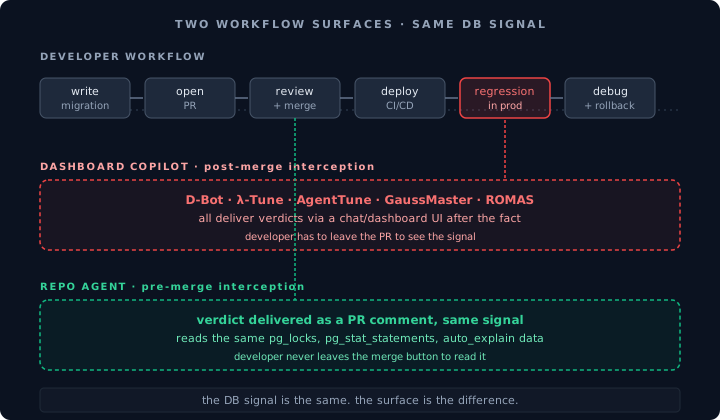
The DB signal both surfaces read is the same. The surface is what differs.
The dashboard is the wrong surface for three reasons that are specific to this workflow, not general critiques of dashboards.
The regression has already shipped by the time the dashboard has anything to say. D-Bot's diagnosis report is written after the regression is observable in production metrics. λ-Tune's configuration scripts are applied to a running database. ROMAS's monitoring fires after the thing it is monitoring has done the bad thing. The five systems above are post-hoc by design. That is fine for a DBA-style workflow where the database is the surface of responsibility. It is backwards for a workflow where the commit that caused the regression is the surface of responsibility.
The developer does not spend the day in a DBA dashboard. A backend engineer at a 30-engineer SaaS looks at GitHub, their IDE, Slack, the deploy pipeline, and Sentry. They do not have a DBA dashboard open. When they do open one, it is because an incident has been declared, which means the pager fired, which means the failure mode the research was supposed to help with already happened.
The dashboard requires the developer to translate a DB-internal explanation into a code change. D-Bot's output names a DB-internal cause: buffer-pool pressure, a wait pattern, a knob setting. The developer reads that and has to infer which line of their SQL change, or which migration file, caused it. The inference is nontrivial and the research lineage has explicitly not tried to close it. Covered in more depth in the earlier post on the attribution gap.
The repo-native alternative
A repo agent reads the same DB signals the dashboard systems read: pg_stat_statements, auto_explain, pg_locks, pg_stat_activity. It holds a connection to the running database. The difference is not the signal. It is the surface the verdict is delivered to, and the point in the workflow the verdict arrives.
Dashboard copilot
- Target user
- DBA, DB operator
- Surface
- DBA console, chat UI
- Interception
- post-deploy, post-regression
- Output
- NL diagnosis, config script
- Translation
- DB-internal → code, by the reader
- Workflow fit
- incident response, capacity planning
Repo agent
- Target user
- backend engineer, PR author
- Surface
- PR comment, commit check
- Interception
- pre-merge, pre-deploy
- Output
- block/pass verdict with diff suggestion
- Translation
- DB-internal → code, by the agent
- Workflow fit
- regression prevention at merge
These are not mutually exclusive systems. Dashboard copilots are the correct surface for live-incident triage and for configuration work that does not map to a commit. A DBA diagnosing a mystery regression on an OLTP system with no recent changes benefits from D-Bot's style of output. A repo agent would not help there. The point is that a migration caused a cascade is a different workflow, and the surface that fits it is the surface where migrations are authored, reviewed, and merged.
What a PR-surface agent verdict actually looks like
The output is the point. A PR-surface agent has to deliver a verdict that the developer can act on without leaving the review surface, and without having to translate DB-internal vocabulary into code changes themselves. The verdict has three pieces: what the DDL will do, why it is risky, and a concrete fix the developer can apply by committing a new diff.
# datapace-agent · schema-safety
BLOCK · PR #2843 (migrations/0147_add_archived_at.sql)

  DDL         ALTER TABLE sessions ADD COLUMN archived_at timestamptz
  Lock level  ACCESS EXCLUSIVE on sessions (840M rows, 61 GB)
  Observed    1 reader holding ACCESS SHARE for 00:04:12 (pid 48213)
              pg_stat_activity says the reader is an analytical COUNT
              running on the primary instead of a replica
  ETA         queue time indefinite, depends on reader completion
  Fix         wrap DDL with explicit short timeouts:
              SET lock_timeout = '3s';
              SET statement_timeout = '30s';
              ALTER TABLE sessions ADD COLUMN archived_at timestamptz;
  Alt. fix    move the analytical COUNT to a read replica
              and re-run this check
Three things about that output that a dashboard would not produce. It names the specific PR and file. It reports DB state in developer vocabulary (reader count, estimated queue, proposed diff). And it offers a fix as an editable diff rather than as a natural-language suggestion. None of those are novel capabilities. What is novel is assembling them against the PR, in the developer's surface, at the moment the developer is making the merge decision.
The position is not against the research
Everything the five systems above do is correct within its scope. λ-Tune's prompt-as-cost-optimization is a useful idea. ROMAS's role-based coordination produces better multi-agent reasoning. D-Bot's document-retrieval loop improves diagnosis quality over prior rule-based systems. GaussMaster's tool-invocation accuracy (95%+ selection, 99%+ parameter filling) is a real operational result. None of that is wrong. What is being contested is not the capability. It is the surface.
The assumption baked into the dashboard framing is that the customer is a DBA or DB operator. Ten years ago that was the right assumption at most companies. It no longer holds at the 15 to 60 engineer tier, where the DBA-specialist role has largely been absorbed into platform or SRE teams and, most often, into backend engineering, a shift the DORA State of DevOps reports have tracked through 2025. The commit that caused the regression is written by someone whose primary surface is the PR. The research that targets a DBA is targeting a user segment that has thinned out in exactly the companies that ship the most migrations per week.
The counter-framing
A reasonable counter is that the dashboard surface is valuable precisely because it consolidates views across systems, and the PR surface is too narrow to deliver the full picture. That is true for incident response and capacity planning. It is not true for regression-from-a-commit. The full picture the developer needs at merge time is narrow by design: one file, one lock level, one production reading, one verdict. Adding more context is noise. The dashboard's breadth is wrong for this workflow.
Another counter is that the research community is already heading toward repo-native through agentic DBA systems that can open PRs. That work is starting. It is not mature. The dashboards are shipping now. The dominant framing of 2024 and 2025 papers is still DBA-copilot-in-a-console. The reason to make this argument now, in 2026, is that the framing is entrenched enough to be worth contesting while the direction of the research is still moving.
Closing note
The dashboard copilot is a reasonable answer to the question "what tool should the DBA use." It is the wrong answer to the question "what tool catches the migration before it ships." Those are different questions, and the research community has been answering the first one, well, for several years. The second question is where the workflow of the backend engineer at the 30-engineer SaaS lives, and the tools that answer it have to meet the developer at the merge button, not at the dashboard.
That is what we are building at Datapace: the context layer and security gateway that lets teams run AI operations on production databases safely, with a human reviewer in control. It reads the same DB signals D-Bot and its successors read, and delivers the verdict as a PR comment. The research lineage is how we know what signals to trust. The surface is what we disagree with. If you are weighing a repo-native agent against the dashboard copilots above, the comparison pages lay out the differences tool by tool, and the use cases show what it does once it is in your repo. If you want to talk through whether the PR surface fits your team, book a call.
Frequently asked questions
Is this contrarian against the Tsinghua database group specifically?
Yes, partly. Guoliang Li's group has produced a disproportionate share of the best LLM-for-DB work in the last three years. That work is correct within the DBA-copilot framing. The point of this post is not that the work is wrong. It is that the framing has a specific blind spot: the company that does not have a DBA and ships migrations from PRs.
Do dashboards have no role at all?
They have a role. Live-incident triage, capacity planning, long-term trend analysis, and configuration audit all benefit from a consolidated surface. The argument is narrower: for the regression caused by a merged commit, the surface that catches it in time is the PR, not the dashboard.
Is GitHub the only repo surface that works?
No. GitLab, Bitbucket, Gerrit, and Phabricator all have PR or change-review surfaces where a verdict can be posted. The argument is about where the verdict goes, not which vendor hosts the repo. Any surface where the developer makes the merge decision will do.
What about DBAs who want to review AI-proposed fixes before they merge?
That is still repo-native. The verdict gets posted as a PR comment; a DBA or SRE is added as a required reviewer; the merge is blocked until they approve. The dashboard is still not involved. The PR does the coordinating.
Is the argument that the Tsinghua lineage is obsolete?
No. The signals the lineage identified, and the techniques for reasoning over them, carry forward. What is being contested is the assumption that the output belongs in a dashboard. Move the same reasoning to the PR surface, for the class of problems caused by PRs, and the research remains valuable. The dashboard is a choice, and the choice is increasingly wrong for the customer being targeted.
Sources
- X. Zhou, G. Li et al., "D-Bot: Database Diagnosis System using Large Language Models", PVLDB 2024; SIGMOD Companion 2025.
- V. Giannakouris, I. Trummer, "λ-Tune: Harnessing Large Language Models for Automated Database System Tuning", SIGMOD 2025.
- AgentTune, accepted to SIGMOD 2025 proceedings.
- W. Zhou, J. Sun, X. Zhou, G. Li et al., "GaussMaster: An LLM-based Database Copilot System", arXiv 2025.
- Y. Huang, F. Cheng, F. Zhou et al., "ROMAS: A Role-Based Multi-Agent System for Database Monitoring and Planning", arXiv 2024; deployed in DB-GPT.
- DORA, State of DevOps reports 2023, 2024, 2025.
- Datapace blog, "The attribution gap: why DB research can't name the commit".
- Datapace blog, "ACCESS SHARE does not jump the queue: Postgres lock fairness".