How it works
The Datapace loop in five steps: connect within an agreed scope, infer, confirm with your experts, agents propose, your team approves and records.
The loop
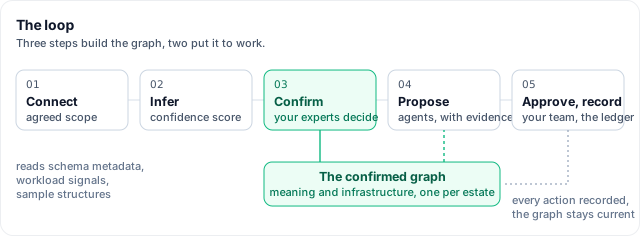
Every job in Datapace, from documenting an estate to right-sizing an instance, follows the same five steps. The first three build the graph; the last two put it to work.
1. Connect within an agreed scope
Which databases and environments Datapace may read is agreed with your team before anything connects. Datapace is designed to read within that scope only: schema metadata, workload signals, and sample structures. It does not need a copy of production.
2. Infer
From what it reads, Datapace infers what the data means: entities, measures, relationships, and lineage. Each inference carries a confidence score. The infrastructure facts around each database (instance class, storage, cost, performance, usage, freshness) land on the same graph. See the graph.
3. Confirm
Your experts accept or reject each inference in a few working sessions. Nothing enters the confirmed graph unvalidated, which is what makes it documentation people and AI systems can trust. See infer and confirm.
4. Propose
On the confirmed graph, the agents draft the routine work: the FinOps agent proposes right-sizing and flags idle databases, the Performance agent proposes index and rewrite work and overdue upgrades, the Quality agent proposes checks, the Migration agent proposes field-level mappings, the Documentation agent keeps the docs current. Every proposal carries its evidence. See agents.
5. Approve and record
Every action goes through policy. The risky ones wait for a person. Whatever happens, by an agent or a person, is written to the audit ledger with who, what, on which database, the evidence, the approver, and the outcome. See policy, approval, and audit.
What stays constant
- Agents propose, people approve. No proposal executes without your team's approval.
- The graph is the product. Every agent, every AI system, and every dashboard works from the same confirmed graph.
- Governed context, never raw access. Copilots, BI, and MCP clients reach production data through the graph and its gate. See governed context.
- Across engines. The loop is the same for every engine you run. See across engines.