TL;DR. On September 15, 2026, Cockroach Labs launched Cockroach Continuum, which it calls the agentic database cloud: thousands of isolated virtual clusters pooled onto shared infrastructure, storage disaggregated from compute, idle databases billed at zero, and a read-only AI operator watching the whole estate. Strip the launch language and the underlying bet is precise, and worth taking seriously even if you never run CockroachDB: agents multiply the number of databases faster than they multiply the load on any one of them, and an estate of small, bursty, mostly idle databases makes per-cluster capacity planning economically absurd. The pooling math is real. What it does not change is just as instructive: a regressed query plan is still billed work, and a fleet-wide control plane is now a fleet-wide dependency.
Cockroach Continuum is the first product from a major database vendor that treats agent-driven workloads as a capacity-planning category of their own rather than as more queries per second. The announcement, written by CEO Spencer Kimball, opens with provisioning, not performance: someone files a ticket, an engineer sizes a cluster against a worst-case peak estimate, and the organization then pays for what Kimball puts at 85-95% idle capacity in every moment that peak fails to materialize. That critique is decades old. What is new is the force multiplying it: agents that create databases on their own schedule.
Kimball's evidence is internal. Earlier this year Cockroach Labs rolled out a platform for agent-built applications, used by programmers and non-programmers alike; in two months, 500 people launched more than 1,000 applications, most with a database behind them, and one internal group went from 13 active databases in March to 392 in July at a total organizational cost of $250. Vendor numbers about the vendor's own product deserve the usual discount, but the shape of the claim is the interesting part. The growth is in the count of databases, not in the traffic any single one serves. Nobody sizes 392 clusters by ticket.
The estate is the unit now
The architecture post by Isaac Wong, EVP of R&D, states the workload thesis in one line: "Agentic workloads are numerous, exploratory, and bursty." Each of those three words attacks a different assumption baked into per-cluster provisioning. Numerous breaks the assumption that database count grows with headcount. Exploratory breaks the assumption that a workload's query mix is knowable in advance; we measured a version of this on Postgres, where agents write unrepeatable SQL that churns through pg_stat_statements faster than the eviction budget can keep up. And bursty breaks the assumption that load curves are diurnal and forecastable, the assumption every human-traffic autoscaling policy quietly rests on.
If the workload really looks like that, the correct unit of capacity planning stops being the database and becomes the estate. That is the actual product decision inside Continuum, and everything else in the architecture is machinery to make it safe:
- Plenum, a disaggregated storage layer, moves data into shared object storage across availability zones with NVMe as the fast tier, so storage and compute scale independently. Cockroach claims storage cost reductions of more than 70% from this alone.
- Virtual clusters give every tenant a fully functional CockroachDB inside a shared keyspace, isolated by a tenant-prefixed key encoding rather than by dedicated hardware.
- SQL pods scale from zero to N per tenant and are billed in vCPU-hours, so an idle virtual cluster incurs no compute charge at all.
- Admission control rations shared capacity through slots for concurrency and tokens for bursts, which is what keeps one tenant's burst from becoming every tenant's latency.
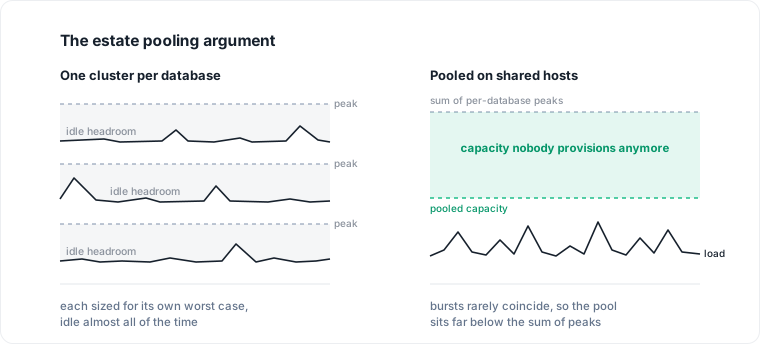
The pooling argument in one picture. Bursts on small databases rarely coincide, so shared capacity sits far below the sum of per-database peaks. The emerald band is the product.
The economics here are not novel, and Cockroach does not claim they are; the announcement credits five years of its serverless offering for the multi-tenant machinery. Statistical multiplexing is the same math that makes scale-to-zero Postgres platforms work, and we walked through its architectural cost when Databricks built Lakebase on Neon's compute-storage split. What Continuum adds is scope: the pooling happens across an organization's whole database estate, under one control plane called RoachMgr, with the explicit expectation that most tenants in the pool were created by an agent and will be idle at any given moment.
What pooling cannot optimize
The launch is validation for a thesis this blog has argued from the Postgres side, so it is worth being precise about what the elasticity does and does not buy.
Elasticity converts waste from headroom into billed work. On a provisioned cluster, a regressed query plan shows up as pages and saturation; on elastic compute, capacity follows the regression and the bill absorbs it. We measured that failure mode in what Postgres autoscaling can and cannot optimize: scaling reacts to load, and a bad plan simply is load, indistinguishable from legitimate demand to every layer below the SQL. Continuum's admission control makes tenants fair to each other; it does not make any tenant's queries good. An agent in a retry loop against a missing index is a well-behaved customer of slots and tokens, burning vCPU-hours that all price in honestly.
Consolidation also concentrates the control plane. Per-cluster sprawl is expensive precisely because the blast radius is small: one mis-sized cluster hurts one workload. An estate of thousands of virtual clusters behind one management layer inverts that trade. The industry got a preview of what control-plane concentration means in July, when Replit's agent deleted a production database through the layer that managed it. None of that is an argument against Continuum specifically; it is the standing argument for treating the control plane of a consolidated estate as tier-zero infrastructure, with the audit and access story evaluated as carefully as the storage layer.
Aegis reads, someone still has to write
The third leg of the launch is Aegis, a hosted AI DBA and SRE that Cockroach describes, carefully, as read-only. It watches metrics and cluster state, identifies root causes, warns about impending incidents, and recommends improvements, with the reasoning orchestrated through Claude Managed Agents and an MCP endpoint exposed so your own agents can interrogate it. The design partner anecdotes are the kind vendors lead with: a composite index recommendation that took a query from 850ms to 12ms, and 76 tables correctly sorted into GLOBAL, REGIONAL BY ROW, and REGIONAL BY TABLE replication zones in five minutes, work Cockroach says usually takes experienced DBAs days.
Two readings of the read-only boundary are available, and both are probably true. The generous one: after a year of agent incidents, a vendor shipping an operator that cannot mutate anything has read the room. The structural one: read-only is where the easy part ends. A recommendation still has to become a change, and the gap between "Aegis suggests an index" and "the index exists in production, reviewed, with a rollback path" is exactly the gap where database automation has always stalled. Postgres is converging on the same seam from the other direction, building plan pinning and online maintenance primitives designed for automated callers. Whoever closes that seam, on either engine, owns the actually scarce resource: a change path that is fast enough for agents and governed enough for production.
What to take from it if you run Postgres
Continuum is CockroachDB-only, and most estates reading this run Postgres. The transferable conclusions are the premises, because Cockroach has effectively published its capacity-planning model for the agentic era and it disagrees with the one most platform teams still use. If agents are landing in your organization, the database count is about to grow faster than headcount; the new databases will be small, bursty, and mostly idle; per-database provisioning will misprice essentially all of them; and the operational load of the estate, not the throughput of any instance, becomes the binding constraint. Each of those premises can be checked against your own estate today, and they are worth checking before a renewal cycle prices them in for you.
Where Datapace fits
Continuum automates the capacity of a database estate. Datapace works on the layer the launch leaves open: what an AI agent is allowed to know and do against the databases you already run. Datapace builds the context layer between your databases and your AI, with resolved meaning validated by the people who own the data, workload evidence beside it (cost, performance, usage and freshness, lineage), and a policy gate over what an agent may do and access, served over MCP. The seam this post ends on, turning a correct recommendation into a governed change, is the seam we think determines which database automation actually ships. If you are working through what that should look like for your estate, book a call.
Sources
- Cockroach Labs, Cockroach Continuum: the Agentic Database Cloud, Spencer Kimball, September 15, 2026 (provisioning critique, 85-95% idle figure, internal platform numbers, availability).
- Cockroach Labs, Inside Cockroach Continuum: Elastic Database Architecture, Isaac Wong, September 15, 2026 (Plenum, virtual clusters, SQL pods, admission control, Aegis, Migration Assistant, workload thesis).