TL;DR. The searches for Datadog Bits AI alternatives lead to a strange corner of the internet: every ranking page is written by a vendor that ranks itself first, and most of them compare against a product name Datadog retired in March 2026. The product is now Bits Investigation, it is investigation-only by design, and it reads what Datadog can see. That last clause is the actual decision. Two questions sort the whole field: can the agent read the stack you already run, or only its own platform's telemetry, and is it limited to investigating, or may it act with a human gate. Where a candidate lands on those two axes matters more than where it lands on anyone's top-nine list.
If you are looking for Datadog Bits AI alternatives, the first useful fact is that the product you are trying to replace no longer goes by that name. What launched as Bits AI SRE at Datadog's DASH conference in 2025 became Bits Investigation with the update Datadog announced on March 5, 2026. The rename was not cosmetic: the update rebuilt the agent harness around MCP-powered tools so the agent can, in Datadog's words, "plan investigations, evaluate competing hypotheses for root causes, and refine its investigations in real time", and it made investigations "approximately twice as fast", completing in three to four minutes depending on complexity. The comparison pages ranking for the alternatives query were mostly written before that update, so they describe a slower product under an older name. Worth knowing before you trust their feature tables.
What Bits Investigation is, precisely
Datadog's product page describes "an always-on SRE agent built to handle complex troubleshooting and late-night alerts". When an alert fires, the agent investigates without being prompted: it reads metrics, logs, traces, dashboards, change events, source code, RUM sessions, database monitoring, network paths and profiler data, follows runbooks, and delivers a root cause analysis with an Agent Trace view exposing its reasoning steps.
Two design choices define it. First, it is investigation-only. It produces conclusions, dynamically suggested code fixes, and triage actions such as posting to Slack, creating an incident, or filing a Jira ticket. It does not execute remediation. Second, it is priced separately from the Datadog platform, in AI credits, with a 14-day trial. The product page prints no dollar figure; the two vendor comparisons discussed below independently report the same numbers, which puts a conclusive investigation somewhere around $25 to $30. In a noisy environment, that meter runs whether or not the alert deserved an investigation.
Neither choice is a flaw. An investigation agent that cannot touch production is a reasonable default, and metered pricing is at least honest about where the cost lives. But both choices are exactly where the alternatives differentiate, which is why a ranked list is the wrong shape for this decision.
Every list you will find ranks its author first
The current top results for this query are comparison pages by Better Stack and Metoro. Better Stack's page lists nine alternatives with Better Stack at number one. Metoro's page lists four with Metoro at number one. Both still call the product Bits AI SRE.
Read past the self-ranking and the two pages agree on a real critique, in near-identical terms. Better Stack: the product "delivers the most value when your entire application footprint is instrumented inside Datadog". Metoro: it is limited to "what is already visible to Datadog", its "code context is narrower than many teams expect" since it reads GitHub, and several third-party integrations sit in preview. Both also observe that per-investigation pricing is hard to predict when alert volume is not.
That critique generalizes, and this is the part the listicles omit: it applies to their own products too. Metoro's agent runs on Metoro's own eBPF-instrumented observability layer. Better Stack's AI SRE is bundled into Better Stack's own platform alongside its log management, monitoring and on-call products. Choosing either is not escaping platform coupling. It is choosing whose platform the agent is coupled to, and paying the migration cost to get there.
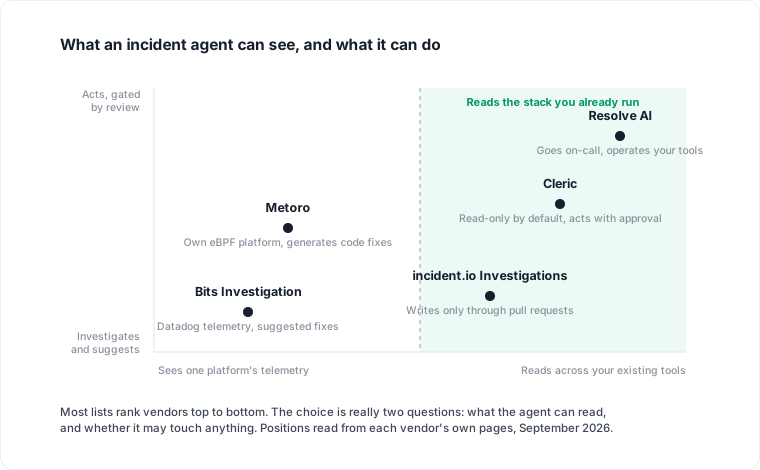
Question one: what can the agent see
Sorted honestly, the field splits into two camps rather than nine ranks.
Platform agents investigate on top of their vendor's own telemetry. Bits Investigation is the strongest case: if your footprint is instrumented in Datadog, the agent starts with dashboards, deploy tracking, database monitoring and profiler data already correlated, and the March 2026 update widened that surface further. Metoro and Better Stack are structurally the same bet with a different platform underneath, worth considering when you were leaving Datadog anyway, misleading to evaluate as a drop-in swap.
Overlay agents read across whatever you already run. Cleric connects to existing observability and deployment tooling, Datadog included, and pitches that you can "connect your whole stack in an afternoon". Resolve AI says it "operates all your tools" across observability, infrastructure and source control. incident.io Investigations correlates telemetry, code changes, pull requests and your incident history, and provisions each customer an isolated instance of its Nexus model. The overlay bet is coverage over depth: no single platform's blind spots, in exchange for integration surfaces you have to grant and maintain yourself.
The test is concrete. List the systems that actually paged you in the last quarter. If they are all instrumented in one platform, that platform's agent starts with the best evidence. If the list crosses tool boundaries, an agent that sees only one of them will investigate confidently inside its boundary, and the root cause will keep living outside it.
Question two: what may the agent do
The second axis is what happens after the root cause is found, and vendors sit at usefully explicit points along it.
Bits Investigation and incident.io hold the investigation line. incident.io states it plainly: the agent "never takes action without you", and its only write path into your systems is a pull request a human merges. Cleric sits one step up: "Read-only by default. Every action logged, every investigation auditable", with the ability to close false-positive alerts and open fix PRs for review. Resolve AI occupies the far end, an agent that "goes on-call on your behalf" and autonomously mitigates. Its headline outcomes, five times faster MTTR and downtime cut by up to 80 percent, are its own published claims, so weigh them as marketing until your own pilot reproduces them.
Notice what changes as you move up this axis: the evaluation stops being about the agent's intelligence and starts being about its access. An investigation agent that is wrong wastes twenty minutes and some credits. An acting agent that is wrong is an incident. We made the longer version of this argument for database agents in read-only access will not make your AI agent safe: the gate that matters is not the vendor's intent but whether every statement the agent runs is classified and the risky ones are held for review. The same standard applies to an AI SRE. Ask each vendor to enumerate exactly which actions the agent can take, what gates each one, and what the audit record shows afterwards. Cleric's read-only default and incident.io's PR-only write path are the right kind of answer; a list of adjectives is not.
When the alert is the database
One gap runs through the whole category, platform and overlay agents alike. Every vendor on this page treats the database as one more telemetry source: Datadog reads its database monitoring product, overlays read whatever database dashboards you expose. That works until the incident is the database, where two problems are harder than the category admits. Attribution is one: inferring which commit caused a database regression is a research problem that observability-side root cause analysis has not closed, because the causal chain passes through query plans and schema state that telemetry summarizes away. Evidence is the other: where AI agents generate the queries, the query statistics an investigator needs are the first thing to churn, as we showed for pg_stat_statements eviction under agent SQL.
That layer is where Datapace works: resolved, validated context about what is actually in your databases, with the workload evidence beside it, governed and served to AI over MCP, so that an agent investigating or acting on Postgres reasons from the database's own ground truth rather than from telemetry about it. If your incidents keep ending at the database boundary, book a call.
The alternatives search has a good outcome either way. Just run it as two questions rather than one ranking: decide whether you want the agent inside your platform or across your tools, then decide how much it may touch. The vendor that survives both questions for your stack is your shortlist, whatever position it holds on its competitors' lists.
Sources
- Datadog, Bits Investigation product page (always-on SRE agent, suggested code fixes, AI credits pricing, 14-day trial, RBAC, Slack, Jira, ServiceNow and GitHub integrations).
- Datadog, Meet the new Bits Investigation: deeper reasoning, twice as fast, March 5, 2026 (rename from Bits AI SRE, MCP-powered harness, 3 to 4 minute investigations, expanded data sources, Agent Trace, triage actions).
- Better Stack, 9 best Datadog Bits AI SRE alternatives for 2026 ($500 for 20 investigations per month annual, $600 month to month; ecosystem-dependency and pricing critiques; alternative list).
- Metoro, Best Datadog Bits AI SRE alternatives (visibility limited to Datadog telemetry, GitHub-only code context, per-investigation cost estimates, Metoro and Neubird pricing).
- Cleric, cleric.ai (read-only by default, logged actions, fix PRs for review, connects across existing tooling).
- Resolve AI, resolve.ai (goes on-call on your behalf, operates all your tools, published MTTR and downtime claims).
- incident.io, AI SRE: Investigations (never takes action without you, pull-request-only writes, dedicated Nexus instance per customer).