Why does up-to-date documentation make an organization resilient?
Because resilience is recovery speed, and documentation is where an organization stores it. Every shock that tests a company follows the same script: something breaks (a production incident, the resignation of the one engineer who understands billing, an audit, an AI agent acting on live data), and the outcome is decided by how fast the people on duty can rebuild an accurate model of the system. With documentation they can trust, that takes minutes. Without it, it takes archaeology: reading source, interviewing whoever is left, guessing.
The gap is measured. Google's SRE book reports that on-call engineers working from a playbook resolve incidents about three times faster than engineers improvising: "roughly a 3x improvement in MTTR", in the book's words. DORA's Accelerate research found that teams with quality documentation are 2.4 times more likely to hit their software delivery and operations targets. And two of the most instructive failures on record, GitLab's 2017 database outage and Knight Capital's 45-minute collapse in 2012, are at bottom stories about organizations whose written model of their systems had quietly diverged from the systems themselves.
Documentation here means the operational kind: runbooks, architecture notes, schema and data definitions, ownership maps, deploy procedures. The kind consulted under pressure. What follows is the case that keeping this corpus current is a resilience property rather than a hygiene habit: what it is worth in numbers, why it decays, why stale pages hurt more than missing ones, and what resilient teams do structurally to keep theirs true: the practice increasingly called living documentation.
Resilience lives in recovery, and recovery runs on a current model
Robust systems resist shocks; resilient organizations absorb them. The distinction matters because prevention has a ceiling: the list of possible surprises is open-ended, so no budget enumerates its way out of them. Recovery generalizes. An organization that can quickly rebuild an accurate understanding of any system handles shocks it never predicted, which is why mature incident reviews spend less time on "why did this happen" and more on "why did understanding it take four hours".
Four shocks arrive on every organization's schedule, none of them optional:
| Shock | The question it asks, immediately | What current documentation buys |
|---|---|---|
| An incident at 3 a.m. | "How does this actually work, right now?" | A playbook instead of improvisation: roughly 3x faster recovery |
| A key person leaves | "What did they know that nobody else does?" | Onboarding in days, and no single human point of failure |
| An audit or new regulation | "Show us how the system works and who may change it" | Answers from records instead of reconstruction under deadline |
| AI agents are adopted | "What can the model be grounded on?" | Machine-readable truth instead of statistical guessing |
Every row has the same shape. The shock demands a true model of the system, at speed, from people (or software) that did not build it. Documentation that is current supplies the model. Documentation that is stale supplies a convincing counterfeit.
What documentation that is still true is worth, in numbers
The strongest quantitative case comes from DORA, whose 2021 Accelerate State of DevOps report measured documentation quality across thousands of teams and found the 2.4x likelihood gap in delivery and operations performance. The 2022 report went further and measured how documentation quality changes the payoff of everything else an engineering organization invests in. The pattern is stark:
| Practice | Estimated performance lift, above-average docs | Same practice, below-average docs |
|---|---|---|
| Trunk-based development | 1525% | 36% |
| Continuous integration | 750% | 34% |
| Site reliability engineering | 343% | 79% |
The mechanism is unglamorous: practices run on shared knowledge. Continuous integration assumes people understand the pipeline they are feeding; SRE assumes the on-call engineer can find the runbook and believe it. When the knowledge is stale, each practice degrades into local improvisation and its measured benefit collapses. Documentation quality behaves like a multiplier on the whole engineering portfolio, which is a strange property for the artifact most teams file under chores.
The same research tradition prices the steady-state cost of missing knowledge. In Stack Overflow's 2022 developer survey, more than 60 percent of developers reported spending over 30 minutes every day searching for answers, and one in four lost more than an hour; Stack Overflow's own arithmetic put the aggregate for a 50-developer team at 333 to 651 hours a week. Sixty-eight percent said they hit a knowledge silo at least weekly. Incidents are merely where this everyday tax becomes visible: the organization pays it daily, documented or not. The difference is whether it pays in minutes of reading or hours of archaeology.
Stale documentation fails harder than missing documentation
Missing documentation slows people down, and they know they are slow, so they compensate: they read code, they ask, they test assumptions. Stale documentation does something worse. It speeds people up in the wrong direction, at precisely the moment (an incident, a deadline, a migration) when there is no slack for double-checking. The engineer pastes the restore command from the runbook. The runbook is two infrastructure generations old. Now there are two incidents.
| Missing documentation | Stale documentation | |
|---|---|---|
| The reader's state | Knows they know nothing | Believes they know |
| Behavior under pressure | Slow and careful | Fast and wrong |
| Failure mode | Delay | Misdirection at the worst possible time |
| After discovery | Nothing to distrust | Every other page is now suspect |
The last row is the expensive one. A documentation corpus is a promise that someone maintains the map, and the first confidently wrong page breaks the promise for every page. Engineers who have been burned verify everything by hand, which is exactly the slowness documentation existed to remove. A corpus is worth what its least trustworthy page is worth, at the worst moment.
The record backs this up. On January 31, 2017, a GitLab engineer working a replication incident late at night deleted around 300 GB from the primary database instead of the secondary. The mistake was human and unremarkable. What turned it into an 18-hour outage with permanent data loss was the written model of their safety net: the organization believed it had backups because procedures and configuration said so. In reality, pg_dump had been producing nothing (the backup host ran PostgreSQL 9.2 binaries against a 9.6 database, and the failure was silent), the S3 bucket that should have held backups was empty, and the emails that would have reported the failures were being rejected for a missing DMARC signature. Azure disk snapshots were not enabled for the database servers. Replication procedures were, in the postmortem's own words, "not clearly documented in our engineering runbooks". Recovery ran from a manual snapshot an engineer happened to have taken six hours earlier, copied over a throttled network for roughly 18 hours; about 5,000 projects, 5,000 comments, and 700 new accounts were unrecoverable. GitLab's transparency about all of this remains exemplary. The lesson stands regardless: a runbook is a set of claims about reality, and every claim drifts unless something forces it back.
Knight Capital's version involved a different corpus: the organization's recorded knowledge of its own deployment state and procedures. On August 1, 2012, Knight deployed new order-routing code that reused an old feature flag. The deploy reached seven of eight servers. On the eighth, the recycled flag activated Power Peg, a routine that had been dormant for years, and per the SEC's order, Knight had no written procedures requiring a second technician to review the deployment. In 45 minutes the firm lost more than $460 million, roughly ten million dollars a minute; it survived the week on rescue financing and was acquired the following year. No wiki page would have saved the firm on its own. Knight is what divergence looks like at machine speed: the organization's model of what was running and what was actually running differed on one server, and no written procedure existed to force the two back together before the market opened.
Documentation decays at the rate the system changes
Neither of these organizations was lazy. Their documentation rotted for the same structural reasons everyone's does. Updating documentation sits off the critical path: the fix must ship now, the page can wait forever. The payoff is asymmetric: the author pays today so that some future stranger collects the benefit. And, most fundamentally, there is no failure signal: code that drifts from reality throws an exception, while documentation that drifts from reality just sits there, wrong, accumulating readers.
So a documentation corpus has a half-life set by the change rate of the system underneath it. Every deploy invalidates a sentence somewhere. A team shipping daily rewrites its own ground truth weekly, whether or not anyone rewrites the pages.
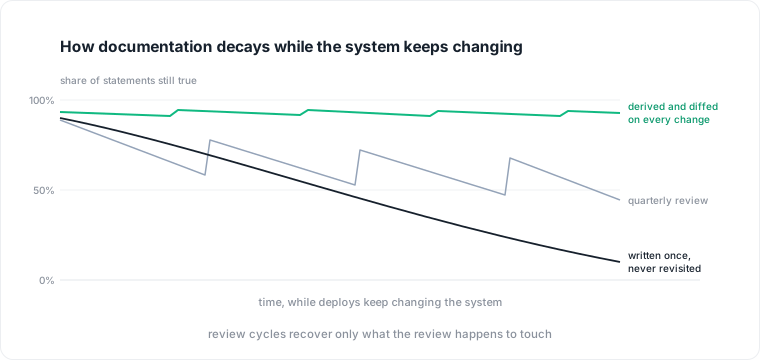 Review cycles fight decay with willpower and lose slowly: each pass recovers only what it happens to touch. Deriving and diffing hold the line structurally.
This is why the standard remedy, "we should be more disciplined about docs", is a plan to lose slowly. Discipline is a flow of effort set against a flow of change, and the change side compounds. Periodic review helps but recovers only what the review touches, on an interval bounded by meeting math. The teams whose documentation stays true do something different in kind, not in degree.
Living documentation: derive, diff, load-bear
Living documentation is documentation maintained against the system it describes rather than by periodic willpower: when the system changes, something forces the docs to change with it. Resilient teams converge on three structural moves that make this real, all of which replace willpower with mechanism.
Derive the reference from the system. Machines maintain the inventory; humans maintain only the meaning. Schema references, API surfaces, infrastructure inventories, and dependency maps are generated from the source of truth and regenerated on every change, in the docs-as-code style: the documentation lives in the repository and travels in the same pull request as the change that affects it. What is generated cannot go stale, and what remains hand-written becomes small enough to actually review. For a database estate, the system catalogs already hold most of the inventory; reverse-engineering an undocumented schema shows how much ground truth is extractable before a human writes a word.
Diff the docs against reality. Freshness needs a failure signal, so build one: extract the current state, compare it with what the documentation claims, and fail loudly on drift, in CI or on a schedule. Give every page an owner and a review date, and treat a stale sentence as what it is, a latent misdirection with a blast radius, filed and fixed like a bug. The half-life problem does not disappear, but decay becomes a visible event with a name attached instead of silent rot.
Make the documentation load-bearing. The strongest freshness guarantee is use. Restore drills executed from the runbook as written (the exercise GitLab's post-incident action items instituted), game days that follow the escalation doc, onboarding where the new hire performs the procedure using only the page: each one converts hidden drift into a loud failure in a calm moment. Documentation that sits on the critical path of routine work cannot rot invisibly, because the rot breaks something the same week it appears.
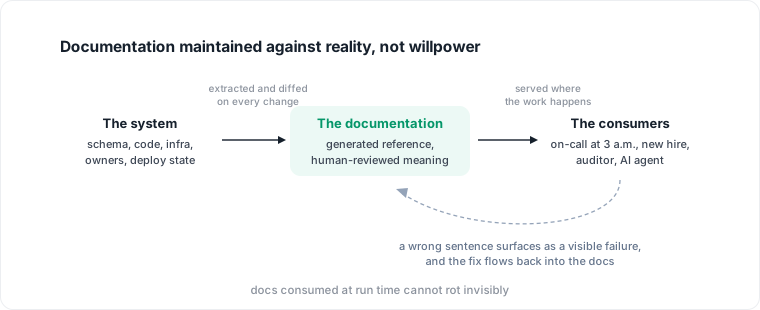 The loop that replaces willpower: derive, diff, serve where the work happens, and let use surface the drift.
One honest limit. Generation has a ceiling: a generated reference without curated meaning is an inventory, and an inventory answers what but never why. The part of documentation worth paying humans for is judgment: why the system is shaped this way, which of three similar columns finance actually trusts, what a deprecation implies for the team downstream. Tooling keeps the floor true. The meaning still needs owners, and review is the point, not the overhead.
AI agents raise the price of a stale sentence
Until recently documentation had one kind of consumer, and that consumer brought staleness detectors to every page: a last-updated date from 2023, screenshots of a UI two redesigns ago, a colleague who says "ignore that page". Models bring none of that. In 2026, agents consume documentation as runtime input, served over protocols like MCP as context for real queries against real systems, and they act on what they are served with full confidence at machine speed. A stale page that used to cost a human twenty minutes of confusion now costs a confidently wrong number in a report, or a confidently wrong action against a live system. The failure modes and the fixes are the subject of the context layer guide: grounding an agent is, in large part, serving it documentation that is provably current. The same layer is what makes giving agents production access reviewable at all, because a policy can only protect data that something authoritative can name.
Regulation has arrived at the same conclusion from the compliance side. Article 11 of the EU AI Act requires the technical documentation of a high-risk AI system to be drawn up before the system reaches the market and, in the regulation's words, to be "kept up-to date". North America is converging on the same duty from the operational-resilience side: in Canada, OSFI's Guideline E-21 expects federally regulated financial institutions to maintain a documented, current map of their critical operations and dependencies, and its full-adherence date of September 1, 2026 has now passed, and Bill C-8, now law, extends cybersecurity-program and reporting duties to finance, telecom, energy, and transport operators. In the United States the same pressure arrives as a patchwork of NYDFS Part 500, SEC disclosure rules, and, for anyone selling B2B software, SOC 2 audits that expect the written account to match the running system. Freshness is no longer a virtue; for a growing class of systems it is a legal property of the documentation itself. Data infrastructure is where this lands hardest, because it is where the knowledge is most tribal, the drift is fastest, and both the agents and the auditors are now asking for the same artifact: a current, trustworthy account of what is there, what it means, and how it connects. Teams starting from zero on that account can follow the Postgres context runbook end to end.
Where Datapace fits
Datapace is building for exactly this class of problem on operational databases, the corner of the estate where staleness is most expensive and the knowledge most often lives in two people's heads. The context graph holds the resolved meaning of your schemas, validated by the people who own the data: what's there, what it means, how it connects, with the operational reality on the same graph (cost, performance, usage and freshness, quality, lineage). Datapace is building the documentation and dbt metric drafts your team reviews, a policy gate over what AI may do against the data, and delivery of the reviewed result to people, BI, and agents over MCP, exports, and dashboards, re-derived and diffed as the estate drifts, so staleness becomes a visible event with a review attached instead of silent rot. Living documentation instead of a wiki nobody trusts: we fix the base so your team can work on better things. See how Datapace compares to adjacent tools, or book a call and we will map your estate together.
Sources
- DORA: Documentation quality capability
- Google Cloud: Announcing the 2021 Accelerate State of DevOps report
- Site Reliability Engineering (Google), Introduction
- GitLab: Postmortem of database outage of January 31, 2017
- SEC: In the Matter of Knight Capital Americas LLC, administrative order, October 2013 (PDF)
- Stack Overflow Developer Survey 2022
- EU AI Act, Article 11: Technical documentation
- OSFI: Backgrounder on Guideline E-21, Operational Risk and Resilience
- Public Safety Canada: Royal Assent of Bill C-8