TL;DR. On August 4, 2026, Google published the deep dive on its Database Observability Agent: telemetry correlation across four sources, root cause analysis "in minutes", and, for a preview group, execution of the fix once a human approves it, across Cloud SQL, AlloyDB, Spanner, Bigtable, Firestore, and Memorystore. Diagnosis from correlated telemetry is the part hyperscalers are structurally best at, and it is now a bundled platform feature rather than a product you buy. That moves the whole question to the four words carrying the announcement: "with your approval". An approval gate is only as strong as the context it presents, and the context a remediation decision actually needs (write load, lock paths, session semantics, which queries the business cares about, who owns the table) is not telemetry. None of it lives in the four sources the agent correlates.
On August 4, Google published its deep dive on the Database Observability Agent, the operational half of a pair of database agents inside Gemini Cloud Assist. The agent correlates telemetry across Database Insights, Cloud Monitoring, Cloud Logging, and Cloud Trace, produces what Google calls "a clear root cause analysis in minutes" for issues like latency spikes and lock contention, and then goes one step further than diagnosis: it "suggests recommended actions to fix the issues found, and can execute validated actions with your approval." Execution is in preview with select customers. Coverage spans Google's managed database estate: Cloud SQL for PostgreSQL, MySQL, and SQL Server, plus AlloyDB, Spanner, Bigtable, Firestore, and Memorystore.
The diagnosis half is impressive and unsurprising. Vendors have sold telemetry correlation for a decade, and a hyperscaler that owns all four telemetry sources will do it with less integration friction than anyone selling it standalone. The half that deserves scrutiny is the four words the announcement leans on and does not unpack: "with your approval". That phrase is now the entire trust boundary between an AI agent and a production database, and the industry is about to find out whether it means a control or a click.
Root cause analysis just became a bundled feature
Start with what the launch means structurally. Finding the "why" behind a database incident (the lock queue behind a latency spike, the query behind the CPU wall) was, until recently, a product category. Tools built businesses on correlating query statistics with system metrics and presenting the story. Google now does the correlation natively, inside the console, across every telemetry source it already operates, and hands you the narrative in a chat panel. AWS is on the same path with its own assistant surfaces, and Azure will not sit it out.
When a hyperscaler bundles a capability, the standalone version of that capability stops being a moat. Platforms absorb adjacent categories; that is their nature, and no criticism of the agents themselves. The consequence for anyone thinking about database reliability tooling is that breadth of diagnosis is no longer the contested ground. What remains contested is the part Google's announcement compresses into a clause: deciding whether the recommended fix is safe to run, and proving after the fact that the decision was sound. The self-driving database vision has been converging on this same boundary for a decade: the machine proposes, and the hard problem is what the human needs in order to dispose.
"With your approval" is carrying the whole announcement
Google gives two concrete examples of what the agent can execute: adding an index to a Cloud SQL instance, and enabling connection pooling, presented with "the rationale and expected impact before you commit to the change." Rationale and expected impact are the upside of the change. Neither is the risk, and for both examples the risk is specific and well understood.
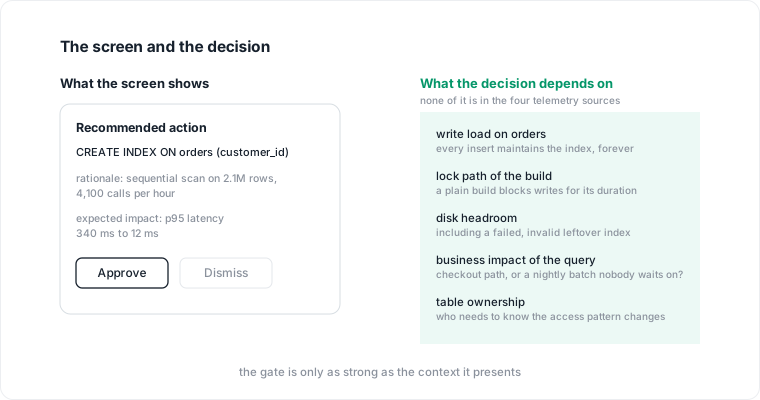 The approval screen shows the upside. The decision depends on context that is not telemetry.
Take the index. The rationale writes itself: a sequential scan on a large table, thousands of calls per hour, a projected two-orders-of-magnitude latency drop. What the rationale does not say is what the index costs. Every future insert, update, and delete on that table now maintains one more structure, forever, which on a write-hot table can be a worse trade than the slow read. And the build itself has a lock story that depends entirely on which variant runs:
-- What the recommendation names
CREATE INDEX idx_orders_customer_id ON orders (customer_id);
-- Takes a SHARE lock: reads proceed, every write to orders
-- blocks for the duration of the build.

-- The production-safe variant
CREATE INDEX CONCURRENTLY idx_orders_customer_id ON orders (customer_id);
-- No write blocking, but: more total work, waits on existing
-- transactions, and a failed build leaves an INVALID index
-- that taxes every write until someone notices and drops it.
A plain CREATE INDEX on a busy table is a self-inflicted partial outage; Postgres holds writes back for the whole build. CONCURRENTLY avoids that and introduces its own failure mode, the invalid leftover index, which the Postgres documentation is admirably blunt about. An approval screen that does not say which path the agent will take, on a table whose write rate the approver can see, is asking for a signature on a blank line.
Connection pooling, the second example, is quieter and sharper. "Enable connection pooling" sounds like a pure win, and often is. But transaction-mode pooling changes session semantics: session-level prepared statements, SET values, advisory locks, and LISTEN/NOTIFY all assume a connection that belongs to one client, and a pooler in transaction mode breaks that assumption. The approval screen says reduced connection overhead; the incident three days later is the application code that relied on session state and now intermittently gets someone else's. Pooling also has a way of erasing per-client identity on its way through, which matters more, not less, when the client is an agent.
Neither fix is wrong on its face; both are the right call in a majority of the situations the agent will encounter. The approval, though, is where the remaining risk concentrates, so the approval screen's contents, not the model's diagnostic accuracy, are what determines the safety of the system. Most human-in-the-loop advice stops at "approve database changes"; the render, gate, route, and record machinery it skips is precisely what a hyperscaler's version will be judged on. A gate whose approvers lack the context to say no is approval theater, and approval theater has a known failure curve: the tenth prompt gets read, the hundredth gets clicked.
The context the decision needs is not in any of the four sources
Look again at the telemetry the agent correlates: Database Insights, Cloud Monitoring, Cloud Logging, Cloud Trace. Everything in those four sources describes how the system behaves. Nothing in them describes what the system means. Whether orders is the revenue path or a reporting shadow copy; whether the slow query the index would rescue serves checkout or a nightly batch nobody waits on; which of three lookalike amount columns downstream jobs actually trust; who owns the table and needs to know its access pattern is about to change. That knowledge exists in every organization and in almost no machine-readable form. It is the difference between "this query is slow" and "this query matters".
A remediation agent without that layer optimizes what is measurable: latency, CPU, lock waits. Usually that aligns with what matters. The cases where it does not (the index that speeds a batch job while taxing checkout writes, the pooler that helps the connection graph and breaks an assumption two services away) are exactly the cases a well-informed human would have caught, and exactly the cases a context-starved approval screen sails through. Read-only access does not solve this either; the moment an agent can propose changes that a tired human rubber-stamps, the write path exists, whatever the credential says.
Your observability stack is someone else's roadmap
There is a second, more prosaic reason to think before making a bundled agent your operational muscle memory: hyperscaler observability tooling churns on the vendor's schedule, not yours. Four days before Google's deep dive, on July 31, AWS retired the Performance Insights console and moved its users to CloudWatch Database Insights, with on-demand analysis and execution plan capture surviving only in a paid Advanced mode. Teams that had built runbooks, dashboards, and habits around one surface got a migration project instead. Nothing about the new Database Observability Agent is exempt from that dynamic; it is a preview feature inside an assistant surface that is itself two years old.
And the agent's world ends at the cloud boundary. It sees Google's six managed database services. The median estate it will be deployed into also contains something else: an RDS instance from an acquisition, an on-prem SQL Server behind an ERP, a warehouse on another cloud. The agent's diagnosis is only as wide as its telemetry, so the incidents that span boundaries (the lakehouse job hammering the operational Postgres, the cross-cloud replication lag) are structurally outside its frame. Bundled agents will own single-platform diagnosis because they should. What they cannot own is the layer that has to be true across platforms: what the data means, what agents may do to it, and the record of what they did.
One honest caveat in the other direction. Approval-gated remediation from a vendor with Google's engineering depth will probably be conservative, well-tested, and right far more often than it is wrong. The failure mode described here is quieter than an agent proposing absurd changes: an organization slowly outsources the judgment call to a screen that was never given the information judgment requires. That is a failure that takes a year to notice, which is what makes it worth naming in week one.
Google detailing an execution-capable database agent is the strongest signal yet that "AI proposes, human approves" is becoming the default shape of database operations, not a niche pattern. Model quality will take care of itself. The thing worth watching is whether the approval surfaces grow up: whether they learn to show blast radius, lock paths, session semantics, and business context, or whether they stay a rationale, a projected win, and a green button.
Datapace is building the context layer between your databases and your AI: resolved meaning validated by the people who own the data, the workload evidence beside it (cost, performance, usage and freshness, lineage), and a policy gate over what an agent may do and access, served over MCP. If you are deciding what an agent should be allowed to do to your production databases, and what an approval needs to show before anyone clicks it, book a call and we can walk through it.
Sources
- Deep dive on new AI-powered database agents, Google Cloud Blog, August 4, 2026
- Gemini Cloud Assist product page, Google Cloud
- AI-powered assistance across your database journey, Google Cloud
- PostgreSQL documentation: CREATE INDEX, Building Indexes Concurrently
- PgBouncer documentation: pooling modes and session-state features