In January 2017, Andrew Pavlo and colleagues at Carnegie Mellon published Self-Driving Database Management Systems at CIDR. The paper argued for "a new architecture designed for autonomous operation," in which "all aspects of the system are controlled by an integrated planning component that not only optimizes the system for the current workload, but also predicts future workload trends so that the system can prepare itself accordingly." Nine years later, the research program has produced genuine advances. It has not produced the system that paper described. This is a retrospective on what shipped, what did not, and what the gap looks like now.
TL;DR. The 2017 vision was a DBMS that tunes, indexes, and heals itself without a human. The 2024 to 2026 reality is an ecosystem of research systems that each solve a slice: index advisors that regress on realistic workloads, training-data pipelines that spend 93 percent of their time on data collection, LLM copilots that advise but do not act, and early-stage prototypes like NeurDB. The persistent gap is operational: in production, a human is still the one who signs off on the change.
What the 2017 vision asked for
The CIDR 2017 paper, which introduced the Peloton DBMS as "the first self-driving DBMS," named three capabilities the system would own end-to-end. First, workload forecasting: the system predicts what queries will arrive in the next window. Second, action selection: given the forecast, the system decides which knob changes, index builds, and partitioning operations will improve performance. Third, autonomous deployment: the system applies the selected actions without a human in the loop.
The integrated framing matters. The paper explicitly contrasted its proposal with "advisory tools" that "require humans to make the final decisions." The Peloton architecture was designed for a world where the DBA reviews actions after the fact, not before. Nine years on, almost nothing in production inverts that relationship. The systems that ship still need a human to apply the recommendation.
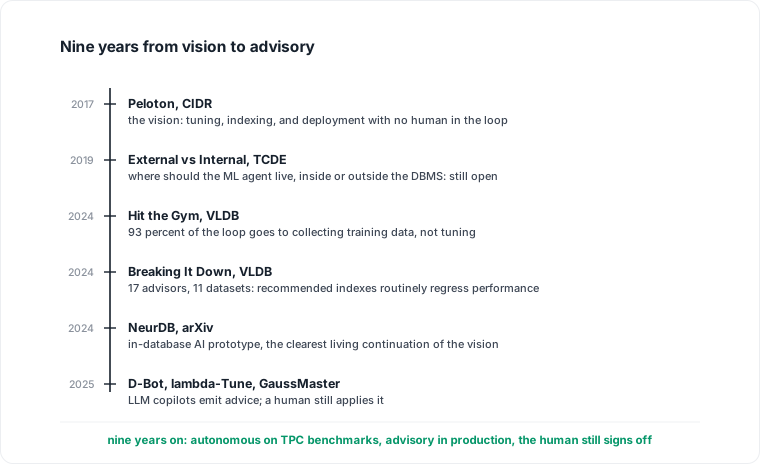
The program shipped real research. The deployment model did not change.
Where the autonomy concretely fell short
Four places in particular, drawn from papers published in 2024.
Training-data collection dominates the loop
The 2024 VLDB paper "Hit the Gym," by Lim, Ma, Butrovich, Arch, and Pavlo, reports that "state-of-the-art methods spend over 93% of their time running queries for training versus tuning." The Boot framework the paper proposes is a direct attack on this problem: run TPC-H query Q9 1,000 times at scale factor 100 on PostgreSQL, and without Boot it takes 17 hours; with Boot it takes about one minute. That is real engineering and a real speedup. It is also an explicit statement about where the bottleneck has been: not in planning or decision-making, in gathering enough behavior data to train the models that planning depends on.
The Peloton vision assumed the behavior model is cheap to update as the workload shifts. Nine years of downstream work has shown that assumption was optimistic. The models are expensive to train, which means they are retrained less often, which means they drift out of sync with production workload faster than the planning loop can correct for.
Index advisors are not production-safe
The 2024 VLDB paper "Breaking It Down: An In-Depth Study of Index Advisors" by Zhou, Lin, Zhou, and Li evaluates 17 index advisors across 11 datasets, decomposing each advisor into three building blocks and scoring each block's contribution. The key finding the paper reports, through an open-source testbed (Index_EAB), is that learned and heuristic advisors alike routinely recommend indexes that regress workload performance on realistic data. The paper's contribution is a decomposition that names which building blocks fail where, rather than a single headline percentage, but the direction is consistent: advisors that score well on synthetic benchmarks underperform when the benchmark reflects production-shaped data and query distributions.
The downstream conclusion matters for the 2017 vision. If the recommendations an autonomous DBMS makes have measurable regression rates, applying them without a human in the loop is an active risk model. The systems that ship into production are the ones where a human reads the recommendation and decides whether to apply it. That is advisory, not autonomous.
LLM copilots advise, they do not act
The 2024 and 2025 wave of LLM-based DBA systems all share one characteristic: they produce natural-language diagnoses or tuning recommendations, which a DBA or operator then applies. D-Bot writes a diagnosis report, and a companion post reads that report beside the earlier root-cause-analysis systems. λ-Tune emits a configuration script that an operator runs. GaussMaster invokes DBMind's diagnostic tools and reports back. None of these systems closes the loop the Peloton paper described. The human is still the one applying the action.
This is a choice, not a limitation. Putting an LLM directly in the decision-and-apply loop carries failure modes nobody has a principled way to bound yet. The community is, correctly, not doing it. That choice implicitly concedes the 2017 framing: advisory is what the systems can deliver responsibly, and advisory is what they do.
Benchmark performance does not transfer
The systems that perform well on TPC-H, TPC-C, and TPC-DS do not necessarily perform well on the real workloads at companies that run Postgres or MySQL in production. The reasons are familiar: the benchmarks do not carry the complexity of real schemas, the concurrency patterns of real workloads, or the distribution shifts of real data. A learned model trained on a benchmark transfers badly to production. A learned model trained on one production instance transfers badly to another.
The 2022 CMU paper "Tastes Great! Less Filling!" (Ma et al., SIGMOD 2022) and the 2024 "Hit the Gym" paper are both, in different ways, attempts to lower the cost of collecting enough production-specific training data to make these models work. The fact that papers from 2022 and 2024 are still working on this problem is evidence of how open it remains.
What did ship
A list of what is actually in production, as of 2026.
Autonomous-within-bounds tuning. Oracle's Autonomous Database, AWS DevOps Guru for RDS, and several cloud-database vendors ship services that apply knob tuning within hand-curated bounds, with extensive fallback to default configurations when the ML layer produces uncertain recommendations. These are successors to the 2017 vision in style, but the scope is narrower and the fallback behavior is more conservative than Peloton described.
Query-plan optimization with learned components. Learned cost models, cardinality estimators, and plan steering (Bao, Neo, and their descendants) have shipped in various forms, mostly as optional components the planner can fall back from. The most visible production deployment is in cloud data warehouses where plan-quality pathologies are more expensive than the cost of the learned layer.
Index advisors as an advisory UI. Postgres managed services, pganalyze and similar tools surface index recommendations to the user. The user applies the recommendation. The "Breaking It Down" findings suggest this is the right arrangement until the regression rate drops meaningfully.
LLM copilots for diagnosis and Q&A. D-Bot, GaussMaster, and the wave of related systems ship in DBA-console surfaces and improve DBA productivity. The upper bound on what they can do is the DBA's ability to translate their output into code, not the system's ability to find the right output.
NeurDB and the next wave. Beng Chin Ooi's group at NUS published NeurDB on arXiv in May 2024 and again at Science China Information Sciences, framing "a new generation of data systems" with integrated AI components. The project is early-stage. It is also the clearest living continuation of the Peloton vision, with an explicit AI-in-the-database framing and a concrete prototype. Whether it closes the loop the 2017 paper described is not yet settled.
The research now gates its own proposals
The clearest internal evidence that autonomous tuning needs a filter comes from the guardrail papers the field started publishing once its own components got close to production. Eraser (VLDB 2024) sits on top of learned query optimizers like Lero and HyperQo and decides, per query, whether to trust the learned plan or fall back to the Postgres baseline; the paper reports that it eliminates performance regressions while keeping most of the improvement. RIB (PACMMOD 2026) replaces scalar index-benefit estimates with full distributions, using a bidirectional GNN encoder and quantile regression, so a tuner can reject any recommendation whose lower-confidence tail includes a regression. Uncertainty-quantification work by Yu et al. generalizes the move: wrap any learned estimator in calibrated bounds, and refuse to act when the interval on the predicted benefit straddles zero.
The three share one structure. An automated component proposes, a promotion gate compares the proposal against a safe baseline, and only proposals that clear the comparison ship. That structure is an admission, in code, that some fraction of automated proposals are regressions and the tail has to be filtered before it reaches production. The gates in these papers live inside the database, at plan-choice or recommend time. The same logic applies one layer earlier, where the proposal is a migration or schema change rather than a plan: the filter needs context about what the change touches and what production looks like when it lands, and it has to run before the change ships, not after the damage is measurable.
The honest gap in 2026
The self-driving DBMS program produced real research. It did not produce self-driving DBMSs in production. What sits in the middle, nine years in, is a research pipeline that keeps generating useful components (learned cost models, training-data pipelines, LLM diagnosis, index scoring taxonomies) and an operational practice that keeps requiring a human at the apply step. That is the gap.
Two ways to read the gap. One is that the human-in-the-loop requirement is temporary, and the research will eventually get to the autonomy the 2017 paper described. The other is that the gap is structural: some class of database change is, by its nature, a judgment call about production state and organizational risk, and "remove the human" is not the right frame for that class. This article is arguing the second reading. The failures the 2024 evaluations surface (advisor regressions, training-data cost, LLM advisory-not-action) are not implementation problems. They are constraints the deployment model imposes.
2017 vision
- Agent
- integrated planning, DBMS-internal
- Apply
- autonomous, no human
- Workload model
- forecasted, proactive
- Benchmark of success
- TPC suite and synthetic
2026 deployed reality
- Agent
- LLM advisor, DB-external
- Apply
- human-in-the-loop, advisory
- Workload model
- observed, reactive
- Benchmark of success
- production incident reduction
The gap as a market
The honest gap is interesting. It is also the market Datapace operates in. A governed context layer that resolves what production state means and gates what AI may do stays deliberately advisory rather than autonomous: a human still approves the change. What it does that the 2017 vision's descendants do not is give the person deciding a resolved account of the database rather than a DB-internal report. The research contribution is orthogonal; the deployment model is different. This is the shift from a self-driving DBMS to what Datapace is building: a semantic context layer over the database, meaning plus operational evidence, with a Policy Gate over what AI may do, and your team in control. The layer brings the context (what's there, what it means, how it connects) to the decision; the human keeps the apply step. The companion piece on why the DBA role disappeared traces why that judgment still needs an owner.
Closing note
Nine years after the CIDR 2017 paper, the research community has been honest about the limits. The 2019 "External vs. Internal" essay by Pavlo and Butrovich explicitly frames the open trade-off between embedding the agent in the DBMS and running it as an external service, with both approaches still under active investigation. The 2024 evaluation papers quantify where the autonomous framing has underperformed. The 2024 LLM wave has been careful not to close the apply loop. That restraint reads as maturity: a research program that has learned enough about the problem to stop overstating what is known.
The next nine years will not close the gap the way the 2017 paper described. They will produce more specialized components, more domain-specific copilots, and a gradual narrowing of the class of decisions that still require human judgment. Specialization carries a measurable cost of its own: models tuned hard for one phase of the database job get worse at the others. The class of decisions that remain human will be smaller than it was in 2017. It will not be zero. What we are building at Datapace is one answer for the decisions that remain human: a context layer that gives the person deciding the meaning, cost, and usage evidence they need to make the call. If that maps to a problem you have, book a call and we can walk through it.
Frequently asked questions
Has Peloton itself shipped?
Peloton was an academic prototype. The successor work lives in NoisePage and the CMU DB Group's dbgym infrastructure. There is no Peloton in production in the sense the 2017 paper described. Its influence is the research program it kicked off, not a deployed system.
What about Oracle Autonomous Database? Is that not a counter-example?
Oracle Autonomous Database ships autonomous-within-bounds behavior: backups, patching, and tuning of a curated knob set. It runs inside a managed service where Oracle controls the boundaries, with autonomy scoped to bounded failure modes. It is not the general-purpose autonomous DBMS Peloton named.
Is NeurDB the closest living continuation of the self-driving DBMS line?
Architecturally, yes, with caveats. NeurDB frames AIxDB as a new generation of data systems and embeds AI components in every major subsystem. It is a research prototype, not a production database. The claim "closest continuation" is about research framing, not deployment readiness.
Why do the 2024 index advisor findings matter if advisors are optional?
Because they bound what an autonomous DBMS can do without human review. If recommendations carry a measurable regression rate, applying them unreviewed is a net negative some fraction of the time. Deployments of the 2017 vision keep the human as reviewer; the advisor findings say why.
Is this article arguing the research was a failure?
No. The research produced a generation of learned components, mature evaluation infrastructure, and a precise understanding of where the autonomous framing breaks down. What it did not produce is the specific end-state the 2017 paper named. Both things can be true.
Sources
- A. Pavlo, G. Angulo, J. Arulraj, H. Lin, J. Lin, L. Ma, P. Menon, et al., "Self-Driving Database Management Systems", CIDR 2017.
- A. Pavlo, M. Butrovich, et al., "External vs. Internal: An Essay on Machine Learning Agents for Autonomous Database Management Systems", IEEE Data Engineering Bulletin (TCDE), 2019.
- W. S. Lim, L. Ma, W. Zhang, M. Butrovich, S. I. Arch, A. Pavlo, "Hit the Gym: Accelerating Query Execution to Efficiently Bootstrap Behavior Models for Self-Driving Database Management Systems", PVLDB 17(11), 2024.
- W. Zhou, C. Lin, X. Zhou, G. Li, "Breaking It Down: An In-Depth Study of Index Advisors", PVLDB 17(10), 2024.
- B. C. Ooi, S. Cai, G. Chen et al., "NeurDB: An AI-powered Autonomous Data System", arXiv 2024 and Science China Information Sciences, 2024.
- A. Pavlo, "What is a Self-Driving Database Management System?", CMU Database Group Blog, 2018.
- L. Weng, R. Zhu, D. Wu, B. Ding, B. Zheng, J. Zhou, "Eraser: Eliminating Performance Regression on Learned Query Optimizer", PVLDB 17(5), 2024.
- "RIB: Robust Learning-based Index Benefit Estimation", PACMMOD 2026.
- T. Yu, Z. Zou, H. Xiong, "Can Uncertainty Quantification Improve Learned Index Benefit Estimation?", arXiv 2024.
- Datapace blog, "Which commit caused the database regression?".