TL;DR. On August 22, OpenAI acqui-hired the team behind Instant, the open source real-time database better known as InstantDB. Terms undisclosed, and the shape of the deal is the message: the open source code stays, but Instant Cloud stops taking signups now and shuts down on August 31, 2027. OpenAI did not buy a database business; it bought the people who spent four years making concurrent reads and writes converge across many clients, because that is precisely the problem agent state creates at scale. It is the third time in two years a lab has absorbed a neutral piece of the agent runtime: Rockset for retrieval in 2024, Ona for execution environments in June, now Instant for state. If part of your agent stack runs on someone else's hosted state layer, the question is no longer whether it is good. It is what happens to you the day its team gets a better offer.
The announcement is two paragraphs of gratitude on Instant's own site and it ends a product with real numbers behind it. Instant, a Y Combinator company from 2022 that built what its users called a modern Firebase, reports roughly 17,000 developers, 400,000 apps created, and about 2.5 billion transactions processed over its lifetime. Coverage of the deal confirms what the announcement implies: no price disclosed, the whole team moves to OpenAI, and the hosted service goes into managed decline. New signups are closed, billing after July 31, 2026 is refundable, cloud apps run until August 31, 2027, and backups stay downloadable for a year after that.
The part worth an infrastructure engineer's attention is the sentence explaining why OpenAI wanted them. Instant's announcement says that over the last few years most of its users began to arrive through agents, not through the dashboard. The product had quietly become what AI coding tools reach for when a generated app needs a backend, and the team's expertise, keeping data consistent across many clients that all read and write concurrently, is the unsolved systems problem underneath every long-running agent OpenAI wants to ship.
The product was healthy. The team was the asset.
Look at what Instant actually is, because the architecture explains the acquisition better than any strategy memo. The open source repo, Apache 2.0 licensed with about 10,500 GitHub stars, describes a system with three unusual commitments. Every piece of user data is stored as triples in one large multi-tenant Postgres database. A sync server written in Clojure tails the Postgres write-ahead log to detect novelty and invalidate exactly the live queries that changed. And the client holds its own triple store, persisted to IndexedDB on the web or AsyncStorage in React Native, so apps keep working offline and reconcile when the connection returns. Queries are written in InstaQL, a relational language shaped like GraphQL, backed by a datalog engine, with permissions expressed in Google's CEL.
That is not a CRUD backend. It is a machine for making many concurrent writers converge on one consistent state and for telling every interested reader about it immediately, and the design borrows deliberately from Asana's WorldStore and Figma's LiveGraph, two of the best-known internal systems for exactly this problem. Firebase proved fifteen years ago that developers pay to skip building it. What changed in 2026 is who the developers are. When an agent scaffolds an app, it does not comparison-shop backends; it reaches for whatever gives it auth, storage, and live state in one dependency. Instant was becoming that default reach, which is why its users were increasingly agents.
Now trace the requirement one level up, to the agents themselves. A coding agent that works unattended for hours needs somewhere durable to keep what it has decided, done, and learned. A fleet of agents cooperating on one task needs that state shared, permissioned, and consistent under concurrent writes, or the fleet poisons its own context. The industry has spent a year learning that bolting state onto agents naively fails in embarrassing ways; append-only instruction files grow without bound because nothing tracks why anything was written. Real-time sync with provenance, permissions, and offline reconciliation is not an app-developer convenience anymore. It is the substrate long-horizon agents run on. OpenAI looked at that requirement and, rather than renting it, hired the team that had already built it once.
Three acquisitions, one layer
Put the deal in sequence and the pattern stops looking like coincidence. In June 2024, OpenAI acquired Rockset, a real-time analytics and search database, folded the team into its retrieval infrastructure, and gave customers roughly three months to migrate off the product. In June 2026, it agreed to acquire Ona, the German company formerly called Gitpod, whose cloud sandboxes let Codex run tasks for hours or days without a developer's laptop open; that deal was still pending regulatory approval as of mid-August. Now Instant: the sync and state layer, same playbook, team in, product wound down.
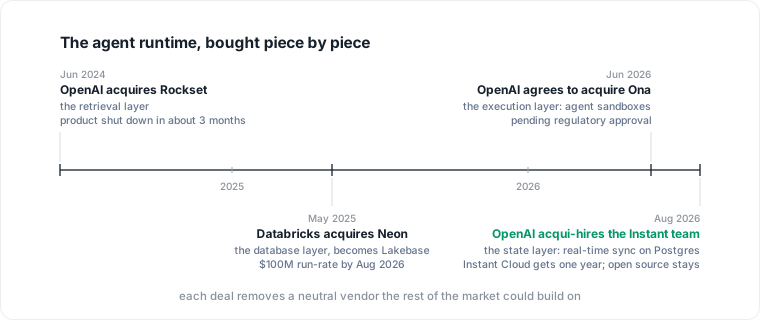
Retrieval, execution, state: the runtime around the model, bought piece by piece.
Read the three functions together: retrieval is how an agent finds what it needs, execution is where it acts, state is what it remembers between actions. That is the whole runtime around the model, and OpenAI has now bought a team for each layer. Nor is this one lab's eccentricity. Databricks acquired Neon in May 2025 and turned it into Lakebase, the serverless Postgres for agents that crossed a $100 million run-rate on August 13, and Neon had spent the prior year making its whole backend, object storage included, fork like a branch precisely for agent workloads. The vendors that spent 2024 and 2025 making databases agent-native have spent 2026 being absorbed by the platforms whose agents need them.
The difference between the two playbooks matters. Databricks bought Neon to sell the product harder. OpenAI buys teams and retires the products, because the product it wants them to build is internal: state infrastructure for its own agents, at a scale where a 17,000-developer SaaS is a distraction. Both moves shrink the same thing, the set of neutral, model-agnostic vendors an outside team can build on.
The migration is the easy part
For the 400,000 apps, or the live fraction of them, the mechanics are unusually humane. A year of runway, another year of backups, refunds back-dated to July, an Apache 2.0 codebase, a self-hosting guide, and committed migration support. Compare Rockset's roughly ninety days and Instant looks like the gentlest possible version of this ending.
But the gentleness is a property of choices Instant made years before the exit, and that is the transferable lesson. The code was genuinely open source, not source-available theater. The data lived in plain Postgres underneath, so self-hosters inherit a substrate every operations team already knows. The query cache on every client meant apps degrade rather than die when the server goes quiet. None of that was designed as an acquisition contingency; all of it now functions as one.
So the evaluation checklist for anything holding your agents' state writes itself. Is the code open and realistically runnable by your team, not just published? Does the data rest in a substrate you could operate alone, or in a proprietary store that dies with the service? Is export complete, including the permission model and not just the rows? And if the vendor announced a shutdown tomorrow, is the window a year or a quarter? Teams ask these questions about their production database and then skip them entirely for the layer holding agent memory, session state, and approvals, as if that layer were still an experiment. This week is the argument that it is not: the category is now valuable enough that its best vendors get bought, and bought specifically to stop serving you.
There is an honest counterpoint. Vertical integration is not theft; agents inside one ecosystem will likely get markedly better state handling out of it, the same way Firebase made mobile backends better by being opinionated. If your stack is already single-vendor, a lab owning the state layer mostly means better defaults. The cost lands on everyone else: the enterprise running agents from two or three providers against databases none of those providers own, which is to say, the ordinary case. A state layer owned by one lab serves that lab's agents first, its API surface second, and your heterogeneous estate last. Whatever memory and state vendors remain independent just watched their most credible differentiator get simpler to explain: they are not owned by anyone whose agents compete with yours.
The pattern will continue, because the logic that produced it has not changed. Labs shipping long-horizon agents need retrieval, execution, and state as owned infrastructure, and buying a proven team is faster than growing one. The next acquisition target is whichever neutral vendor is best at the remaining gap, and the teams that get surprised will be the ones who assumed neutrality was a permanent property of their dependencies rather than a phase.
Where Datapace fits
Datapace is building the context layer between your databases and your AI: resolved meaning validated by the people who own the data, the workload evidence beside it (cost, performance, usage and freshness, lineage), and a policy gate over what an agent may do and access, served over MCP. This week is a point in favor of that layer being independent by design: state and context infrastructure owned by one model provider follows that provider's agents, while your agents, whoever ships them, will keep hitting databases no lab owns. If you are mapping what a model-agnostic context layer looks like in practice, start with what an agent context layer is, or book a call.
Sources
- The Instant team joins OpenAI, Instant, August 22, 2026.
- OpenAI absorbs Instant team to enhance AI application infrastructure, Crypto Briefing, August 2026.
- OpenAI Acquires 10,000-Star GitHub Project's Team, 36Kr, August 2026.
- instantdb/instant, GitHub repository (architecture, license).
- OpenAI acquires Rockset, OpenAI, June 2024.
- OpenAI acquires AI agent orchestration startup Ona, SiliconANGLE, June 11, 2026.