TL;DR. On August 13, Databricks closed a $5 billion round at a $190 billion valuation, disclosing a revenue run-rate above $7 billion, up more than 80 percent year over year. The number that matters for anyone running databases is smaller: Lakebase, the serverless Postgres for AI agents built by the former Neon team, crossed a $100 million annualized run-rate in under two years, the first hard revenue evidence that agent-native database infrastructure is a real market. The money is earmarked for Lakebase, Genie, and Unity AI Gateway together, one agent stack, so the database comes bundled with the platform's own governance layer, deep exactly where the platform is and absent everywhere it is not. Agent traffic does not respect that boundary, and the real decision for buyers is whether governance becomes a property of the platform you rent or a layer you own.
Databricks raised $5 billion at a $190 billion valuation on August 13, its second $5 billion round this year, up from $134 billion about six months ago. The headline metrics are a revenue run-rate past $7 billion and growth above 80 percent year over year. The metric worth a database engineer's attention sat lower in the release: Lakebase, the serverless Postgres that Databricks builds for AI agent workloads, has crossed a $100 million annualized revenue run-rate. The company says the new capital will scale three products: Lakebase, Genie, and Unity AI Gateway, which it describes as core infrastructure for deploying AI agents inside large organizations. Read that list as a single sentence: the database for agents, the agent that answers questions, and the governance layer over both, sold together.
A database built for agents is now a $100M line item
The category needed this number. For two years, "agent-native database infrastructure" has been a thesis backed by product launches and funding rounds rather than revenue: Neon built branching so every agent run could fork its own environment, Supabase counted agents creating a majority of new databases, and every vendor deck asserted that agents would soon outnumber human developers as database consumers. What none of them had published was evidence that anyone pays at scale.
$100 million annualized is that evidence, with the usual caveats attached. A run-rate annualizes a good recent period, it is vendor-reported and unaudited, and Databricks does not break out how much of it is agent workloads versus teams simply using a well-priced serverless Postgres. But the trajectory is hard to argue with: Databricks acquired Neon in May 2025, shipped Lakebase on that team's architecture, and reached a disclosed $100 million run-rate in roughly fifteen months, inside a company growing 80 percent at $7 billion scale. Enterprises are paying real money for database infrastructure whose design center is the agent, not the human developer.
The second-order fact is more interesting than the revenue. Databricks did not present Lakebase as a database business. It presented Lakebase, Genie, and Unity AI Gateway as one investment thesis: the stack an enterprise adopts to run agents. Unity AI Gateway went GA on August 4, nine days before the round, and it is the governance half of the pitch: access controls, per-model cost monitoring, and security policy enforcement across mixed-model environments. The signal is stronger than "agents need Postgres": it says agents need Postgres with governance already attached, and buyers will pay for the attachment.
What the bundle sees that a bolt-on cannot
Be honest about why this sells, because the advantage is structural, not marketing. A governance layer that the platform owns sits inside the same walls as the catalog, the engine, and the gateway. When the database, the lineage metadata, the cost meter, and the policy enforcement point all belong to one vendor, correlation that independent tools have to build is simply there: this agent, holding this grant, ran this query, against tables with this lineage, at this cost. Nobody integrates anything. Policy is enforced in a path the vendor controls end to end, by the party with the engine owner's view of every request.
This is the same logic that made Google bundle an approval-gated database agent into its cloud at no extra charge: the platform already sees the telemetry, so shipping governance over it costs the platform little and locks the workload in further. Databricks is running the strategy with more conviction and now has a revenue number suggesting it works. For a team whose operational data genuinely lives on one platform, declining the bundled governance would be strange. It sees more than anything you could bolt on.
The limits of that argument are the platform's own edges.
Platform governance stops at the platform's edge
An agent does not know or care where a database is hosted. The same orchestrator that queries Lakebase through Unity AI Gateway will, in the same hour, hit the RDS Postgres running your billing system, the MySQL that came with an acquisition, the SQL Server under the ERP, and the Snowflake warehouse finance lives in. That estate is the ordinary shape of a mid-size company's data infrastructure, and it is the environment agent frameworks are explicitly built to span.
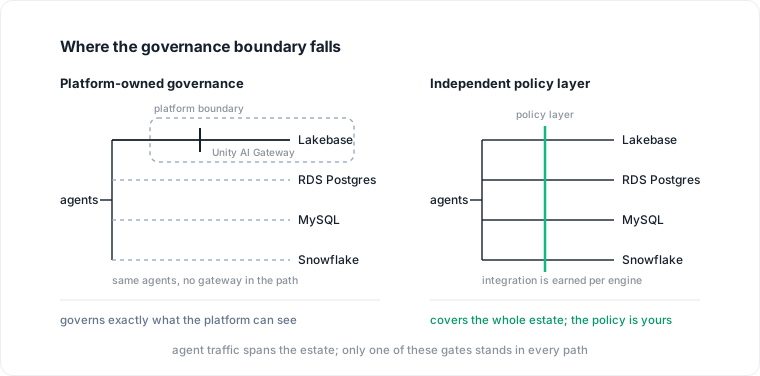
The bundle governs what the platform can see. The estate is bigger than the platform.
Platform-owned governance covers the first database on that list and none of the others. The gateway's policy, its cost caps, its audit trail: all of it applies to traffic that enters the platform. The rest of the estate is exactly as governed as it was before you bought the bundle, which for agent access to production databases typically means a shared role, a connection string in an environment variable, and hope. The uncomfortable geometry is that the bundle's depth and its coverage are inversely related to your estate's diversity: the more heterogeneous your infrastructure, the smaller the fraction of agent traffic the platform's governance ever sees.
The vendor's answer to this is consolidation, and it is worth stating plainly because it is the actual product strategy: move the operational data onto the platform and the boundary problem disappears. A $190 billion valuation prices that consolidation continuing. Some organizations will take the deal. Most will not get to choose; estates stay heterogeneous because of acquisitions, regulated workloads, latency, cost, and the plain fact that working databases do not get migrated for governance reasons.
The tradeoff is depth against scope, and someone owns your policy
Laid side by side, the two architectures trade exactly one thing for another.
| Platform-owned governance | Independent policy layer | |
|---|---|---|
| Sees | Everything on the platform, with engine-owner depth | Every engine it fronts, at integration depth |
| Covers | The platform | The estate |
| Integration cost | None inside the walls | Real, per engine |
| Policy lives | In the vendor's gateway, in the vendor's format | In a layer you can point at any backend |
| Fails when | Traffic bypasses the platform | An engine is not integrated yet |
| Exit cost | Policy, audit history, and enforcement rewritten elsewhere | The layer moves with you |
Neither column is free. An independent layer never matches the introspective depth of the engine's owner, it has to earn its view of each backend, and it is one more vendor in the path. But the right column has a property the left one cannot offer at any price: the policy is yours. Rules, approval flows, audit trails, and spend limits encoded in one platform's gateway are, on the day you leave or the day the pricing changes, work you do again. The industry has been through this cycle with data semantics, which is why an open interchange for semantic models now exists under the Apache umbrella after years of the same definitions being rebuilt inside every BI tool. Governance policy is heading into the identical fork: platform property or portable layer.
There is also a layer of this problem that neither column solves by placement alone. Governance that stands in front of a database, whoever owns it, is still making request-time decisions about effects that commit later, and the only component that can re-validate a decision at commit time is the database itself. Where the policy layer lives determines what it can see and what it costs to keep; it does not exempt anyone from engaging the transaction boundary.
One more honest caveat about the number that started this. $100 million of Lakebase run-rate proves enterprises pay for agent-native database infrastructure. It does not prove they pay for the governance: Databricks does not separate what buyers are buying, and a strong serverless Postgres at platform pricing would sell some volume with or without a gateway attached. The cleanest reading is narrower: the bundle is selling, and the vendor believes governance is enough of the reason to aim the round at it.
The round settles the question the category has been asking for two years: agent-native database infrastructure is a business, with revenue, growing inside the best-capitalized data platform there is. The question it opens is the one that will actually shape architectures: whether governance over agent access becomes a feature of whichever platform owns each database, fragmenting policy across vendor boundaries an agent never respects, or a layer that belongs to the organization and spans the estate. Teams will not decide that by keynote. They will decide it by counting their databases and noticing how many of them live outside anyone's platform boundary.
Where Datapace fits
Datapace is building the context layer between your databases and your AI: resolved meaning validated by the people who own the data, the workload evidence beside it (cost, performance, usage and freshness, lineage), and a policy gate over what an agent may do and access, served over MCP. The argument above is the reason that layer is independent by design: policy that lives inside one platform's walls governs that platform, while agent traffic spans everything you run, whatever the engine. If you are mapping out what governed agent access looks like across a real estate, start with safe AI agent access to production databases, or book a call.
Sources
- Databricks Grows >80% YoY, Surpasses $7B Revenue Run-Rate, Scales Lakebase, Genie, and Unity AI Gateway, Databricks press release, August 13, 2026.
- Databricks Raises $5 Billion at a $190 Billion Valuation, Bloomberg, August 13, 2026.
- Databricks wraps $5 billion funding round at $190 billion valuation, CNBC, August 13, 2026.
- Databricks Unity AI Gateway Hits GA, StartupHub.ai, August 2026.
- Databricks Raises $5 Billion to Expand Enterprise AI Agent Platform, PYMNTS, August 2026.