TL;DR. On August 6, 2026, Neon moved its backend services to beta: Object Storage (S3-compatible), Functions, and an AI Gateway covering seven model providers on one bill, run on Databricks infrastructure. On September 17, 2026, the whole set went GA, with Managed Better Auth added as a fourth primitive that branches with the database. The mechanic that matters is the fork boundary. One branch_id now forks the Postgres data, the object storage buckets, the functions, and the gateway scope together, copy-on-write, with nothing duplicated until the branch diverges. Neon says over 80 percent of databases on its platform are already created by AI agents, and this release makes the branch, not the instance, the unit an agent provisions. What the fork copies, it copies perfectly, every page and every object as of one instant; what it cannot copy is everything that makes a copy trustworthy: which branch is canonical, why it exists, and whether anything that changed on it still means what the parent meant.
For most of database history, the unit of isolation was the instance. You got a database by getting a server, and everything that came with the application (files, background jobs, API credentials) lived somewhere else, glued on by configuration. On August 6, Neon moved its backend services to beta and made a quietly radical claim about that unit: fork a branch, and you get an isolated copy of your database, your files, your functions, and your AI gateway, under a single branch_id. The instance is gone from the story. The branch is the backend.
The release itself is three services. Object Storage is an S3-compatible object store: the AWS SDKs, boto3, the CLI, and presigned URLs all work, no proprietary client. Functions is long-running compute that runs next to the database rather than in a separate platform. AI Gateway is one credential and one bill covering seven model providers (OpenAI, Gemini, Grok, Meta among them), run on Databricks infrastructure that Neon says already serves more than 145 trillion tokens a month, a vendor number we have not verified. At beta the gateway ran in a single region (AWS us-east-2) on paid plans, which is the usual shape of a beta and worth knowing before you architect around it.
Any of those three alone would be a routine platform-expansion announcement. The fork boundary is what makes the release worth taking apart.
What changed at GA
Six weeks later, on September 17, 2026, Neon declared the backend generally available and added a fourth primitive: Managed Better Auth, which stores users, sessions and organizations in a neon_auth schema you can query with SQL and protect with row-level security, and which branches with the database, so a preview branch's signups stay on the preview branch. Functions run Node.js 24 HTTP handlers on the same branch and in the same region as the database, with DATABASE_URL and the credentials for the other primitives injected, and gained triggers and custom domains at GA. Object Storage ships with 5 GB per project on the Free Plan, auth with 60,000 monthly active users, and Postgres with 100 projects of 100 CU-hours each. Everything is declared in one defineConfig call from @neon/config/v1: buckets, functions, auth: true, aiGateway: true.
The AI Gateway is the one primitive that stayed paid-only. At GA the docs list four AWS regions (Ohio, N. Virginia, Frankfurt, Singapore), models served through Databricks Foundation Model APIs at the provider's published per-token price with no markup, drawn from prepaid credits (one credit is one dollar, five dollars minimum, valid twelve months). Each branch gets its own gateway endpoint, so model access forks with the data exactly as it did in beta.
Neon's framing of the release is worth quoting because it is a design commitment: a backend as "a set of solid primitives an agent can call, not a bundle of managed services behind one bill". The argument is that agents compose well-known interfaces (Postgres, an S3 API, a standard model SDK, Better Auth) and get the app right on the first try when the primitive is solid. The post also notes that the Electric team, who built PGlite and the Electric sync engine, is now part of Neon, with realtime named as the next primitive. Read against the fork boundary below, GA means one more thing now forks under a branch_id (the users) and the argument about what a fork cannot carry gets one more column.
Copy-on-write is why the fork is free, and what free means
When you create a branch, the child inherits the parent's database pages and the parent's buckets and objects as they existed at that instant. Nothing is physically copied. The branch is a metadata operation: a new set of pointers into shared storage, plus the rule that writes on the child go to new pages and new objects that the parent never sees. Storage cost starts at zero and grows only with divergence. Neon's own framing is exact: nothing gets duplicated up front, and the bill only grows if the branch diverges.
It is the same trick that built Neon, now moving up the stack. Neon's architecture (its docs now call it the lakebase architecture) decomposes Postgres into stateless compute over a replicated write-ahead-log service and a page service that materializes the log into object storage. Once the database's true state lives in versioned shared storage, a branch is cheap by construction, which is exactly the property Databricks bought for roughly a billion dollars in May 2025 and built Lakebase on, the transactional half of the LTAP architecture we took apart in July. What shipped in August extends the same copy-on-write boundary from Postgres pages to S3 objects: the rows and the files they reference now snapshot together, consistently, under one identifier.
The consistency point is the technically interesting one. A common failure mode of preview environments is the split snapshot: the database is cloned at 14:02, the file store is synced at 14:20, and the rows in between reference objects that do not exist yet or no longer exist. Forking both sides under one branch_id closes that gap. A preview branch sees the rows and the files as of the same instant, and writes on the child never touch the parent.
The customer for this is the agent
Neon states, in the beta announcement, that over 80 percent of databases on its platform are created by AI agents, not humans. Treat it as a vendor number, but note that it is a consistent one: the same statistic circulated when Databricks announced the acquisition in May 2025. The beta ships with agent skills, prompt-installable instructions that teach a coding assistant how to provision and wire the services itself. The release notes are addressed to the humans; the API is addressed to their agents.
Read the fork boundary through that lens and it becomes a sandbox primitive. The standing advice for letting an agent touch a schema at all is to never let it rehearse on production: give it a copy, gate the promotion, render and record the migration before anything runs. The weakness of that advice has always been the quality of the copy. Staging databases are sampled, stale, and structurally unlike production, which is how a CHECK constraint validated on 10,000 rows locked a production table for four hours at 84 million. A copy-on-write fork is the strongest version of the copy that has ever been cheap: full data, exact distributions, real statistics, spun up in under a second, discarded without ceremony. An agent that tests a migration against a fork of production is rehearsing against the real thing, minus the traffic.
Minus the traffic is the caveat worth saying plainly. A fork is a snapshot, not a live system. Lock contention, concurrent writes, connection pressure, cache state: none of that forks. The staging gap in data closes; the staging gap in workload does not. A migration that is safe on a quiet fork can still queue every reader behind an ACCESS EXCLUSIVE lock on a busy parent. The fork answers "is this change correct"; it cannot answer "is this change safe to run at 14:00 on a Tuesday."
A fork copies every byte and none of the knowledge
Here is the question the branch model does not answer, and it gets sharper the better the branching gets: when agents create 80 percent of the databases and every one of them can fork the whole backend in a second, what do you know about the copies?
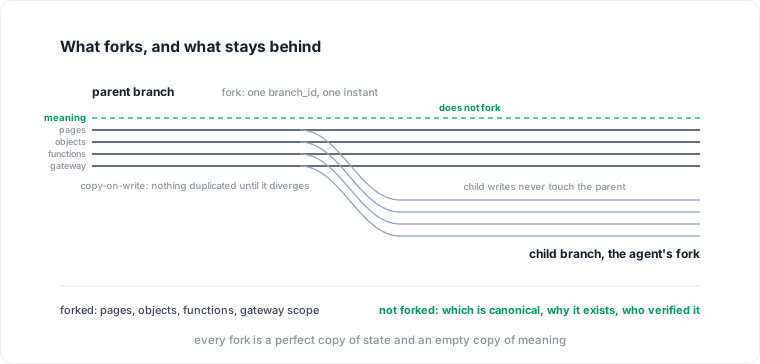
The fork boundary in one picture. State forks perfectly; meaning does not fork at all.
Each fork is a perfect copy of state and an empty copy of meaning. The branch tree records parentage: this branch came from that one, at this LSN. It records nothing else. Which branch is canonical for a given question. Why an agent created this one, and whether the reason still holds. Whether the schema change that lives only on branch 47 was an experiment, a fix waiting to be promoted, or a mistake. Whether the amount_total column that an agent renamed on its fork still maps to what finance calls revenue. Multiply by a fleet of agents creating branches faster than any human reviews them, and the result is a very modern kind of sprawl: not orphaned instances, which cost money and get noticed, but orphaned meanings, which cost nothing and get trusted.
We made a version of this argument about Apache Ossie last week: the interchange format moves definitions between systems, and has no place for lineage, freshness, or verification, so definitions travel while trust does not. Branching is the same boundary drawn in storage instead of in a spec. The fork moves state between environments perfectly, and everything that would tell you whether to trust a given copy (its purpose, its divergence, its review status, its relationship to the canonical line) is out of frame. That is not a flaw in either design. Storage layers standardize the copyable half. The uncopyable half is still every team's private problem, and agent-scale branching just multiplied how much of it there is.
The surrounding week says this is where the pressure is going. The same day Neon's beta landed, Naïve raised $28.5 million for a governance gateway that sits in front of agents provisioning real infrastructure, enforcing budgets and approvals before anything executes. Provisioning is becoming agent-native at the bottom (Neon) and approval-gated at the top (Naïve). Neither layer knows what any of the provisioned copies mean, which copy is load-bearing, or what changed between a fork and its parent beyond the bytes.
Where Datapace fits
Datapace is building the context layer between your databases and your AI: resolved meaning validated by the people who own the data, the workload evidence beside it (cost, performance, usage and freshness, lineage), and a policy gate over what an agent may do and access, served over MCP. A world where every agent can fork the whole backend in a second is a world where that resolved layer has to span copies: knowing which branch is canonical, what an agent's fork changed, and whether a definition still holds on the branch you are about to promote. If your team is working out how agents should rehearse database changes, start with human-in-the-loop database migrations, or book a call.
Sources
- Neon, "The Neon backend is GA: a complete set of primitives so agents can build", September 17, 2026, and Neon Docs, "Neon AI Gateway overview" (regions, paid plans, no-markup pricing, prepaid credits).
- Neon, "Test out the Neon backend: Object Storage, Functions, and AI Gateway are beta", August 6, 2026.
- Neon, "Building Neon Object Storage", August 2026.
- Neon Docs, "Changelog, August 7, 2026" and "The lakebase architecture".
- Databricks, "Databricks Agrees to Acquire Neon to Help Developers Deliver AI Systems", May 2025.
- TechCrunch, "Naïve raises $28.5M to automate the grunt work of setting up and running a company", August 6, 2026.