What is a context layer for AI agents?
A context layer is the governed layer of infrastructure that sits between AI agents and your data and answers three questions about it: what's there (the inventory of schemas, tables, and columns, with freshness and sensitivity); what it means (the definitions, metrics, units, and caveats humans carry in their heads); and how it connects (the joins, lineage, and usage patterns that make the data navigable). Agents consume it as machine-readable ground truth, typically over MCP, instead of reconstructing all three from raw schema dumps and tribal knowledge.
The term matters in 2026 because agents moved from demos to production, and production exposed the gap: models are good at SQL and bad at your data. Nothing in a CREATE TABLE statement says which of three amount columns finance actually trusts, which foreign keys were never declared, or that status = 3 stopped meaning "churned" after the 2024 migration. People absorb that knowledge over years of Slack threads. An agent has whatever you can serve it at query time, which is exactly what a context layer is for.
One note before the details: "context layer" is used two ways right now. Some memory-infrastructure vendors use it for conversation memory. This guide covers the data sense, and draws the line between the two precisely, because confusing them leads teams to buy the wrong thing.
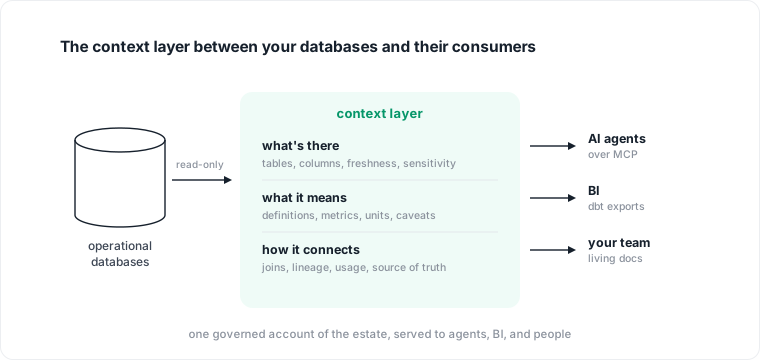 The context layer: one governed account of the data estate, serving agents, BI, and people.
Context layer vs memory layer: two different problems
Both layers live outside the model and feed it at runtime, which is why they get conflated. They store different things, written by different processes, and they fail differently.
| Memory layer | Context layer | |
|---|---|---|
| Question it answers | "What happened in past interactions?" | "What does the data estate contain and mean?" |
| Typical contents | Conversation summaries, user preferences, episodic facts | Schemas, definitions, metrics, joins, lineage, freshness |
| Written by | The agent itself, at runtime | Derived from live systems, reviewed by humans |
| Goes stale when | Conversations recede and preferences change | Schemas drift and pipelines change |
| Failure without it | The agent forgets you and re-asks everything | The agent misreads your data and answers wrong |
A support copilot that greets a returning customer cold has a memory problem. A copilot that reports revenue from the wrong column has a context problem. Serious deployments usually need both, and the full boundary between the two layers is worth being precise about before you buy either. Mem0's State of AI Agent Memory report and Atlan's agent memory architectures guide map the memory side well, and we cover those architectures in the AI agent memory layer guide. But they are separate purchases and separate builds, and the rest of this guide is about the context side.
Why AI agents fail without a context layer
The failures are not exotic. They are the same three mistakes, over and over, and none of them trips an access control, because every one is a permitted query.
The wrong-column pick. Production schemas accumulate lookalikes: total_amount, net_amount, amount_usd, three columns that all plausibly mean "revenue" and only one of which finance trusts. An agent picks by name similarity, which is a coin flip. We dissected a real case in three columns, same metric: the fix was never more SQL skill, it was a recorded source of truth.
The hallucinated join. Most production databases do not declare all their foreign keys; application code holds the real relationships. An agent joining on column-name resemblance produces results that look right and are silently wrong: fan-outs that double-count, matches on IDs that were never related.
The demo-to-production gap. Models look convincing against a clean, documented, self-explanatory schema, then stumble against a real estate, because production ships history: soft deletes, retired status codes, superseded columns, join paths no constraint ever declared. The gap is not model quality; it is missing context, which is why it does not close with a bigger model.
The common thread: these are correctness failures with governance consequences. A wrong number in an agent-written report travels further and faster than a wrong number a human produced, because nobody proofreads the machine that sounded confident.
What goes inside a context layer
The triad (what's there, what it means, how it connects) unpacks into four kinds of content:
| Component | What it holds | Example entry |
|---|---|---|
| Inventory | Schemas, tables, columns, types, row counts, freshness, sensitivity tags | "orders: 41M rows, updated continuously, contains PII in email" |
| Semantics | Definitions, governed metrics, units, caveats, deprecations | "Revenue = net_amount in EUR; total_amount is pre-refund, do not report" |
| Relationships | Declared and undeclared joins, lineage, source of truth per metric | "orders.customer_ref joins customers.id (not declared as FK)" |
| Access metadata | Who and what may read each object, approval rules, audit hooks | "Agents may read support.* except customer_email" |
Two properties separate a context layer from a wiki page holding the same facts. It is machine-readable and queryable at runtime: an agent mid-task can ask "which column is the source of truth for revenue?" and get an answer, not a link to Confluence. And it is maintained against reality: regenerated from the live systems and diffed as they drift, because documentation that silently ages is worse than none: it teaches the agent (and you) to trust stale facts confidently.
Context layer vs semantic layer vs data catalog
Three adjacent terms, three real differences, mostly about who the consumer is.
| Data catalog | Semantic layer | Context layer | |
|---|---|---|---|
| Built for | Humans searching for data | BI tools computing metrics | AI agents (and the humans behind them) |
| Core content | Dataset descriptions, owners, tags | Governed metrics and dimensions | Inventory + semantics + relationships + access metadata |
| Interface | A web UI you browse | SQL generation and metric APIs | MCP and machine-readable exports |
| Guarantees | Findability | Consistent numbers | Grounded, navigable meaning |
A data catalog answers "does a table for this exist, and who owns it." A semantic layer (dbt's is the canonical example; see the dbt Semantic Layer docs) answers "what is revenue, exactly," so every dashboard computes it the same way. The context layer is not a replacement for either; it is what they become when the primary consumer is an agent: catalog facts and semantic definitions, joined with relationship knowledge and access rules, served at query time in a form a model can ground itself on. The catalog platforms and lakehouse vendors are converging on the same conclusion from their side (Unity Catalog's 2026 additions push metadata toward agent consumption), and Gartner's agentic AI hype cycle flags governance of agent knowledge as a rising priority for the same reason.
How agents consume it: MCP
The delivery mechanism matters as much as the content. In 2026 the practical answer is MCP: the context layer runs as an MCP server, and any agent (a coding agent in your repo, an analytics copilot, a support bot) connects and asks. Schema questions ("what columns does orders have and what do they mean?"), navigation questions ("how do I get from subscriptions to invoices?"), and trust questions ("which of these is the source of truth?") all resolve against the same governed layer, instead of against whatever half-remembered schema landed in the prompt.
The same content should flow to the non-agent consumers too, from one source: metric definitions as dbt exports for BI, and human-readable living documentation for the team. One layer, three audiences: that is what keeps the answers consistent across them.
Where safety attaches
Access control and context are usually treated as separate projects. They are one project seen from two sides. The context layer is where you record what data exists and what it means, which makes it the natural place to record sensitivity, scope, and who may touch what. Enforcement then has somewhere coherent to point: a production database access policy can say "agents may read support tables but never customer_email" only if something authoritative knows which columns those are. The full enforcement stack (least-privilege grants plus a gateway on the connection path) is covered in safe AI agent access to production databases.
The inverse also holds: most "AI safety" incidents with databases are not dramatic deletions but confident wrong answers, and those are prevented by context, not by permissions. Guardrails keep the agent inside the boundary; the context layer keeps it right within the boundary.
How to build one
You can stand up a first context layer by hand, and for a single Postgres database it is a weekend-sized project with compounding returns. The short version:
- Extract the inventory from the system catalogs: tables, columns, types, row estimates, freshness signals.
- Recover the undeclared relationships: mine join patterns from query logs and application code, because the FK constraints you can see are a minority of the joins that exist. If the schema is undocumented territory, start with reverse-engineering an undocumented schema.
- Attach meaning (definitions, units, caveats, deprecations) and have the people who own each domain review them. This is the step that cannot be fully automated, and the review is the point.
- Serve it machine-readably: an MCP endpoint agents can query at runtime, plus exports for BI and docs for humans.
- Keep it against reality: re-extract on a schedule, diff, and route changes through review, so drift becomes a visible event instead of silent rot.
The full walkthrough, with the SQL and the pipeline, is in build a context layer for Postgres: the runbook.
Where Datapace fits
Datapace is building this layer for operational databases, and one dimension further. The context graph holds the resolved meaning of your schemas, validated by the people who own the data (what's there, what it means, how it connects), and carries the operational reality beside it: cost, performance, usage and freshness, quality, lineage. Datapace is building the documentation and dbt metric drafts your team reviews, delivery of the reviewed result to people, BI, and agents over MCP, dbt exports, and dashboards, and a policy gate over what AI may do and access. Living documentation that stays true instead of a wiki that quietly rots: we fix the base so your team can work on better things. See how Datapace compares to adjacent tools, or book a call and we will map your estate together.