TL;DR. June 2026 gave the autonomous DBA its product category, with launches from Revefi and EDB; August 2026 gave it its first real measuring sticks. DBLifeBench (posted August 4) scores LLMs across five lifecycle phases and finds that models fine-tuned for text-to-SQL suffer what the paper calls a curse of specialization: better at writing SQL, measurably worse at everything else. DBA-Bench (posted July 24) rebuilds evaluation around a live PostgreSQL under concurrent workload, and across its 106 scenarios agents averaged a 12.4 percent safe pass rate, with the best automated baseline at 17.9 percent against 93.4 percent for the human DBA reference. Read together, they say the evidence behind most autonomy claims measures one fifth of the job, in an environment that does not exist in production, and that on the full job the gap to the human is still enormous.
June 2026 was the month the autonomous DBA became a product category. Revefi launched what it calls a 24x7 AI DBA for Snowflake, Databricks, and BigQuery. A week later, EDB launched EDB Postgres AI, describing a Postgres that runs as an autonomous system: monitoring more than 200 operational metrics, reasoning about changes, applying its own tuning and scaling. August 2026 is the month the measuring sticks arrived. Two benchmarks, posted eleven days apart by separate groups, are the first serious attempts to score what these products claim to be. Neither is kind to the way the category currently markets itself.
The job is five phases. The public evidence measures one.
DBLifeBench, posted August 4, starts from an observation that will be familiar to anyone who has run Postgres for a living: almost all published evaluation of LLMs on databases measures text-to-SQL, the translation of a natural-language question into a query. The paper's authors put it directly: a model that excels at generating SELECT statements but cannot design a viable schema or debug a deadlock is insufficient for real deployment. Their benchmark scores five lifecycle phases separately: design (schema and constraints), implementation (the SQL itself), operation (configuration and live workloads), debugging (faults and root cause), and maintenance (the long tail of indexes, bloat, and post-deployment health).
That decomposition matches how the work is actually distributed. Writing the query was never the scarce skill. When we traced where the DBA role went after it dissolved at mid-size SaaS companies, the buckets that mattered were exactly the ones outside the implementation phase: schema judgment, production diagnosis, capacity decisions. Text-to-SQL benchmarks measure the phase that backend engineers were already covering fine.
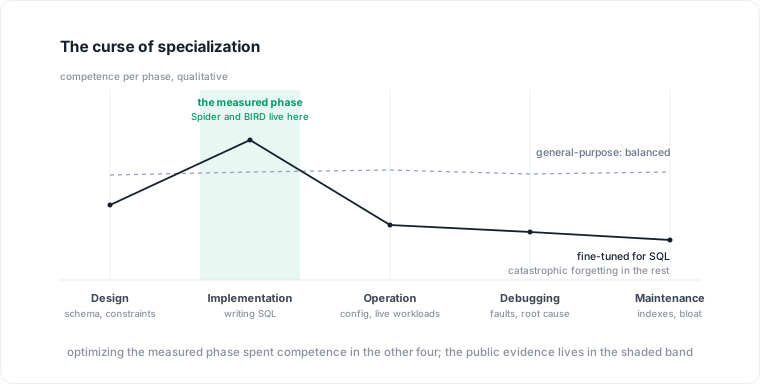
Nearly all public LLM database evaluation lives in the middle box. The other four phases went unmeasured until this month.
Getting better at SQL made models worse at the rest
The paper's headline finding is the one with consequences for how this market sells itself. General-purpose models showed balanced performance across the five phases, with OpenAI's GPT-4o family leading on most dimensions in the paper's evaluation. Models fine-tuned specifically for text-to-SQL did not degrade gracefully: they exhibited what the authors describe as catastrophic forgetting in the non-coding phases, design and maintenance in particular. The paper names the pattern the curse of specialization. Training a model to climb a SQL leaderboard actively traded away competence at the rest of the database lifecycle.
The finding is qualitative in this writeup by necessity (the per-phase score tables are in the paper, which we could not mirror here; the direction of the result is corroborated across every summary of it we could check), but the direction alone is enough to invert a common assumption. The intuitive story says a SQL-specialized model is a safe component of a database agent: it is the expert module, and breadth can come from elsewhere. The measured story says specialization is not free. The fine-tuning that buys the leaderboard score spends the general competence that operating a database actually draws on. A vendor whose agent is built around a SQL-specialized model, and whose published evidence is a SQL benchmark score, has produced evidence about the one phase least likely to be the failure mode, using a model type the new evidence suggests is weakest at the other four.
We saw a version of this pattern in pgrust, where AI agents rebuilt Postgres against its regression suite and delivered exactly what the suite encoded, with everything the suite did not encode initially absent. The mechanism recurs here at the level of model training: the benchmark is the fitness function, and what the benchmark does not measure, the optimization does not preserve. It measurably erodes it.
The second benchmark: production is not a clean database
DBA-Bench, posted July 24 by Junming Chen and colleagues, attacks the same overstatement from the environment side. Its diagnosis of existing agent evaluation: benchmarks instantiate fresh, clean databases or compact task environments where unrelated activity is largely absent. That tests task execution in isolation, and it removes precisely the thing that makes production diagnosis difficult, which is telling signal from noise on a system where thousands of time series, business logs, and concurrent queries are all moving at once.
Their answer is a benchmark built for production fidelity: instrumented PostgreSQL environments with active workloads and persistent state, multi-turn read-write interaction with the live system, faults that cascade across internal mechanisms, and an outcome-first definition of success. An agent passes when the fault is measurably eliminated or the system measurably recovers, under safety constraints, with the environment restored from snapshots so scenarios stay reproducible. Solutions are allowed to differ, because real incidents admit multiple remediations with different operational trade-offs.
The scores land the argument harder than the design does. Across the benchmark's 106 scenarios in seven task domains, agents averaged a 12.4 percent safe pass rate over 848 automated runs, and the best automated baseline reached 17.9 percent. The human DBA reference on the same scenarios: 93.4 percent. The gap widens with difficulty, with automated safe pass falling from 19.6 percent on easy scenarios to 7.6 percent on hard ones, which is the wrong direction for a system marketed as handling what humans cannot keep up with.
The two papers are independent, and that is what makes their convergence worth noticing. One group found the capability evidence measures the wrong phases. The other found it measures the right phases in the wrong world. A model can score well on SQL generation and still be a poor bet to diagnose a lock cascade at 3 a.m., and until this month there was no public instrument that could tell you so.
| DBLifeBench | DBA-Bench | |
|---|---|---|
| Posted | August 4, 2026 | July 24, 2026 |
| Measures | Five lifecycle phases, design to maintenance | Operations and fault remediation |
| Environment | Phase-specific tasks and metrics | Live instrumented PostgreSQL, concurrent workload |
| Key finding | SQL fine-tuning degrades non-coding phases | Agents at 12.4% safe pass; human reference at 93.4% |
| What it corrects | Which capabilities get measured | Where they get measured |
What to ask a vendor who says autonomous
None of this says the products do not work. Revefi's agent has operated against warehouse platforms since 2024; EDB's launch claims tuning up to 10x faster and analytics TCO up to 58 percent lower, numbers that are the vendor's own and worth treating as such. What the two benchmarks change is the burden of proof. As of this month there is a public, phase-by-phase way to ask what an autonomy claim rests on, and the questions write themselves.
Which lifecycle phases does the evidence cover? A text-to-SQL score covers one, and after DBLifeBench, a strong specialized score is arguably weak evidence about the rest. Was the evaluation environment live? A clean database with no concurrent activity is, per DBA-Bench, the easy mode that production never resembles. Is success defined by outcome or by output? Plausible root-cause prose and a measurably resolved fault are different deliverables. And what happens between diagnosis and action? When Google shipped its approval-gated database agent in August, the interesting design decision was exactly where the human sits in that gap, because remediation on a production system is the step where a wrong answer stops being a benchmark miss and becomes an outage.
That last question is the one the benchmarks cannot answer for you. The self-driving database was promised in 2017 and arrived as a set of narrower, supervised capabilities; the lesson of that decade was that autonomy claims run ahead of the evidence in exactly the phases that are hardest to measure. The new benchmarks shrink the unmeasured space. They do not shrink the blast radius of an unsupervised wrong action.
The checks define the deliverable
The durable lesson is the same one the pgrust story taught about test suites, now operating at the scale of a product category. Whatever instrument the market grades on becomes the specification vendors build to. For three years that instrument was text-to-SQL, so the category optimized SQL generation, and DBLifeBench has now measured what that optimization quietly spent. If lifecycle benchmarks and production-fidelity environments become the grading instrument instead, the products will chase those, and the gap between marketed autonomy and measured autonomy will narrow. Until it does, the honest reading of the evidence is that current LLMs are strong implementation-phase assistants with unproven and, for specialized models, measurably degraded competence across the rest of the lifecycle, and every claim past that should come with a benchmark that actually measured it.
Where Datapace fits
Datapace is building the context layer between your databases and your AI: resolved meaning validated by the people who own the data, the workload evidence beside it (cost, performance, usage and freshness, lineage), and a policy gate over what an agent may do and access, served over MCP. The two papers this month are the evaluation-side statement of the same premise: a model's SQL score does not tell you it can be trusted with the other four phases of the job, so the boundary around what it may do has to live outside the model. If your team is deciding what an agent should be allowed to do against production, start with what the DBA role's dissolution left uncovered, or book a call.
Sources
- Evaluating LLMs in Database Scenarios: A Lifecycle Benchmark for Assessing Their Potential in Core Database Tasks (DBLifeBench), arXiv, posted August 4, 2026.
- DBA-Bench: A Production-Fidelity Benchmark for LLM-Based Database Operations Agents, Junming Chen et al., arXiv, posted July 24, 2026.
- Revefi, "AI DBA Is Here: How AI Agents Are Transforming Database Management", June 2026.
- EDB, "EDB Postgres AI Q2-2026: A Trusted Foundation in Agentic AI", June 23, 2026.
- InfoWorld, "EDB converges analytics on Postgres to support AI agents", June 2026.