TL;DR. ClickHouse pricing on ClickHouse Cloud, read on October 28, 2026 for AWS us-east-1: $0.2985 per compute unit hour on Scale, $0.3903 on Enterprise, $25.30 per TB-month of compressed storage. For one stated workload (5 TB, a 2-minute query burst every 15 minutes, a nightly job) on three 64 GiB replicas, the month costs $1,159 if the service idles after 5 minutes and $5,483 if it never idles: same queries, 5.8 times the compute. ClickHouse's CostBench, published the same day, reports 412x to 1,996x better performance per dollar than four rivals, and its method removes idle capacity and minimum billing from the score. Those are the lines that set this bill.
ClickHouse pricing pages list a rate per compute unit and a rate per terabyte. Neither tells you a monthly bill, because the bill depends on how many replicas you run and how many hours they stay awake. This post prices one workload from ClickHouse's own pricing page, read on October 28, 2026, with every assumption written down. It is a list-price model: no query ran.
ClickHouse Cloud pricing has five billing lines
| Line | Unit | AWS us-east-1 list price |
|---|---|---|
| Compute | Compute unit hour, metered per minute | Basic $0.2181, Scale $0.2985, Enterprise $0.3903 |
| Storage | TB-month of compressed data | $25.30 on every plan |
| Backups | TB-month, at the storage rate | One backup every 24 hours, kept a day, by default |
| Data transfer | GB out | Internet egress from $0.1152, inter-region from $0.0312; ingress free |
| ClickPipes | Compute unit hour plus GB ingested | Streaming and object storage: $0.20 per unit hour, $0.04 per GB |
Sources: ClickHouse pricing and its FAQ, the billing overview and ClickPipes billing.
ClickHouse defines the unit: "One compute unit is 8 GiB of RAM and 2 vCPUs. Compute is metered per minute". CDC ClickPipes are priced differently, at $0.20 an hour per service plus $0.10 per GB on the initial load and $0.20 per GB of continuous changes. New organizations get $300 in credits for 30 days.
Basic is capped at 1 TB of storage and one fixed-size replica, so a 5 TB workload starts on Scale.
The workload: 5 TB, a burst every 15 minutes, one nightly job
This is the same hypothetical workload as our data warehouse cost model, so the numbers compare:
- 5 TB of data after compression. ClickHouse bills storage on compressed bytes.
- A 2-minute query burst every 15 minutes for 10 business hours on 22 weekdays: dashboards and analysts. The gap between bursts is 13 minutes.
- A 1-hour nightly job on the same 22 days.
- Three replicas of 64 GiB on Scale. Three is the default replica count for Scale and Enterprise in the Cloud API. That is 24 compute units, $7.16 an hour. The size is our assumption: 192 GiB in total sits near the 1:25 memory-to-storage ratio the pricing calculator suggests for real-time analytics.
The queries keep the service busy for 51.3 hours a month. What you pay for depends on what happens in the 13 minutes between bursts.
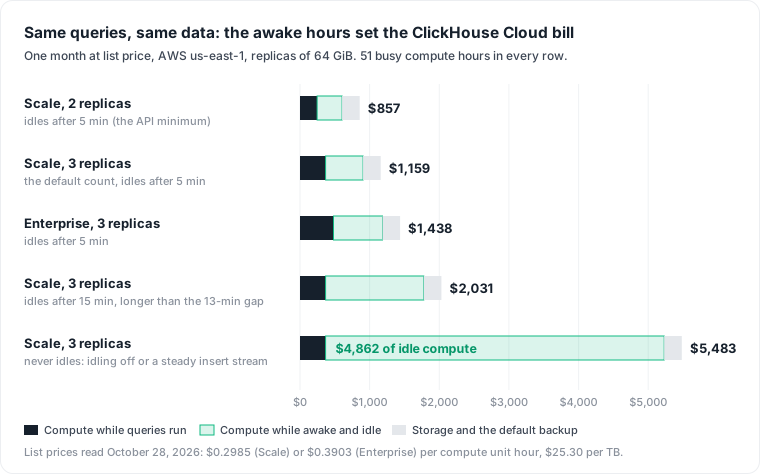
Idle hours move the bill 6x; the plan rate moves it 31%
ClickHouse Cloud scales a service to zero when it goes quiet: "Compute scales down to zero after a period of inactivity, so you stop paying for compute until the next query or insert wakes the service". Idling is "True by default", and the idle timeout "Must be >= 5 minutes".
Three cases follow from that rule:
- Timeout of 5 minutes. Each 2-minute burst bills 7 minutes and the service sleeps through the rest of the gap: 126.5 billed hours a month.
- Timeout of 15 minutes. The gap is 13 minutes, so the service never sleeps during the business day: 248.2 hours.
- Never idle. Idling turned off, or anything that writes more often than the timeout, keeps all replicas on for 730 hours.
| Setting | Billed hours | Compute | Storage and backup | Month |
|---|---|---|---|---|
| Scale, 2 replicas, 5-minute timeout | 126.5 | $604 | $253 | $857 |
| Scale, 3 replicas, 5-minute timeout | 126.5 | $906 | $253 | $1,159 |
| Enterprise, 3 replicas, 5-minute timeout | 126.5 | $1,185 | $253 | $1,438 |
| Scale, 3 replicas, 15-minute timeout | 248.2 | $1,778 | $253 | $2,031 |
| Scale, 3 replicas, never idle | 730 | $5,230 | $253 | $5,483 |
The same 51 hours of queries cost $906 or $5,230 in compute, depending only on whether the service gets to sleep. The step from Scale to Enterprise adds 31% to compute. Dropping a replica removes a third. The idle setting does more than both together.
The third case is ClickHouse's home ground. A real-time pipeline inserts all day, every insert wakes the service, and the idle discount never applies. ClickHouse also warns that idling "isn't recommended for services that power customer-facing features that are used frequently", because connections can time out while a paused service wakes. For those services, budget the never-idle row and size the replicas carefully.
Two smaller traps sit in the same docs. A service open to "Allow from anywhere" "may be periodically moved from an idle to an active state by internet crawlers and scanners". And adaptive idling keeps a service awake while merges run or when it has more than 10,000 active parts.
Storage is the small line: $253 for 5 TB and its backup
At $25.30 per TB-month, 5 TB costs $126.50. The default daily backup is billed at the same rate; ClickHouse's own billing examples price "1 TB of data + 1 backup" at $50.60, so we count a full copy. Storage is 5% of the never-idle month.
Compression decides the storage line. ClickHouse says analytical data "typically compresses around 10×" and that "The only practical way to know exactly is to ingest your dataset into ClickHouse and compare". Separate compute services can share one copy of the data, so storage is billed once.
ClickHouse vs Snowflake cost: the same range, the same lever
Our data warehouse cost post priced this workload on a Snowflake Medium warehouse: $911 a month with AUTO_SUSPEND at 60 seconds and $2,535 at the 10-minute default. ClickHouse Cloud with a 5-minute timeout lands at $857 to $1,159. No vendor publishes an exchange rate between a Snowflake credit and a ClickHouse compute unit, so the sizes are not equivalent and these numbers do not rank the engines.
What the comparison shows is structural. Both bills are set by the timeout against your query gap. The API's minimum timeout is 5 minutes, so a short burst always carries a 5-minute tail; the Snowflake cost optimization post covers the Snowflake side. On a continuous stream neither warehouse sleeps, and then engine efficiency per hour decides the bill. That is the question CostBench asks.
What CostBench measured, and what its score leaves out
CostBench is ClickHouse's benchmark, and its ratios are a vendor claim, not an independent measurement. It streamed 113.2 billion stock-market quotes into ClickHouse Cloud, Snowflake, Databricks, BigQuery and Redshift Serverless at a target of 1 million rows per second while queries ran. The code is public. ClickHouse reports 412x better end-to-end performance per dollar than Snowflake, 752x than Databricks, 438x than BigQuery Capacity and 1,996x than Redshift Serverless.
The multiple is cost times runtime, not dollars. The methodology defines it: "End-to-end score = (fresh-data-path cost + normalized query-serving cost) × total query runtime." The dollar figures ClickHouse published for preparing the data are $28.69 on ClickHouse Cloud against about $79 on Snowflake, $243 on BigQuery Capacity, $522 on Redshift Serverless and $696 on Databricks. On that line the gap is 2.8x to 24x, which is large; the rest of the headline comes from multiplying by query time.
The score removes the lines that set our bill. Query cost is normalized "as if compute were billed per second", and ClickHouse states that "Per-second normalization removes differences in idle timeouts and minimum billing windows". The exclusions are listed: "Storage, free tiers, discounts, idle capacity, minimum billing, post-ingestion queries, failed attempts, and standing fallback capacity are excluded." ClickHouse calls the result "a normalized comparison cost rather than a reconstruction of actual bills." That is a fair choice for comparing engines, and it is why the ratio cannot be applied to an invoice.
The workload is also specific: one stream of quotes, four aggregate queries every 10 minutes and two drill-downs every hour, with pre-aggregations that ClickHouse maintains at insert time. If your workload looks like that, CostBench is relevant evidence about the engine. The day before, a post on the Database Architects blog argued that Goodhart's law ("any measurable target stops being useful when people start optimizing for it") holds in database benchmarking, with ClickBench as its example.
The strongest objection to this section: a benchmark has to normalize something, or it measures configuration skill instead of engines. True. Use CostBench for what it isolates, the cost of keeping fresh data query-ready, and use your own billed usage for everything else.
Run this instead: billed cost per service, then your query gaps
ClickHouse Cloud: billed cost per day, by service and warehouse. The usageCost endpoint returns daily cost records for up to 31 days: computeCHC per service, storageCHC and backupCHC per data warehouse. One ClickHouse Credit equals one US dollar.
curl -s -u "$KEY_ID:$KEY_SECRET" \
  "https://api.clickhouse.cloud/v1/organizations/$ORG_ID/usageCost?from_date=2026-10-01&to_date=2026-10-28"
Then the gaps between queries, from system.query_log. If most gaps are shorter than your idle timeout, the service never sleeps and you are paying for the never-idle row:
SELECT event_date,
       countIf(gap_s > 300) AS gaps_over_5_min,
       quantile(0.5)(gap_s) AS median_gap_s
FROM (
  SELECT event_date,
         arrayJoin(arrayDifference(arraySort(groupArray(toUInt32(event_time))))) AS gap_s
  FROM clusterAllReplicas('default', system.query_log)
  WHERE type = 'QueryFinish' AND is_initial_query AND event_date >= today() - 7
  GROUP BY event_date
)
GROUP BY event_date
ORDER BY event_date;
This counts every initial query, including your own console and monitoring traffic, which wakes the service too. The equivalent queries for Snowflake, BigQuery, Redshift Serverless and Databricks SQL are in data warehouse cost.
Self-hosted ClickHouse: a third of the instance price, plus people
A Scale compute unit costs $0.2985 an hour. An m7i.large with the same 2 vCPUs and 8 GiB costs $0.1008 on demand in US East, per AWS's price data. Cloud compute is about 3 times the raw instance.
Price two always-on 64 GiB replicas both ways. ClickHouse's sizing guide recommends "at least three replicas per shard (or two replicas with Amazon EBS)", so self-hosted gets two:
| Line, per month | Self-hosted on AWS | ClickHouse Cloud Scale |
|---|---|---|
| Compute, 2 x 16 vCPU, 64 GiB, 730 h | $1,177 (m7i.4xlarge) | $3,486 |
| Coordination: 3 small Keeper nodes (our assumption) | $221 (m7i.large) | Included |
| Disk: a full 5 TB copy per replica on gp3 | $800 | Included in storage |
| Storage and backup | $115 (5 TB on S3 Standard) | $253 |
| Total before people | $2,313 | $3,739 |
Replicated tables need ClickHouse Keeper for replica metadata. EBS gp3 is $0.08 per GB-month and S3 Standard $0.023 in US East, from AWS's EBS and S3 price data.
The gap is about $1,400 a month. The BLS median wage for a database architect was $139,500 in May 2025, $11,625 a month. Self-hosting wins on infrastructure only if upgrades, Keeper, backups and restore tests, monitoring and on-call take less than about 5 hours of one person's week. And for a bursty workload, self-hosting gives up the idle discount: two Cloud replicas that sleep after 5 minutes cost $857, less than the self-hosted instances alone.
What this model does not tell you
- It is list price, read on October 28, 2026. Committed spend and marketplace contracts change every row.
- Sizes are our assumption. Vertical autoscaling, which can shrink replicas between bursts, is not modeled; we pinned 64 GiB.
- Wake-up time is not modeled. A paused service must start before it answers.
- Self-hosted uses on-demand EC2. Savings plans lower it; disk headroom and cross-zone traffic raise it.
Where Datapace fits
A ClickHouse bill reports cost per service, and a benchmark prices someone else's workload; neither says which dashboard, table or insert stream kept the service awake. Datapace is building one map of your data estate with usage and cost attached, and agents that propose changes as pull requests your team reviews and merges. To see how this workload prices on four other platforms, read data warehouse cost.
Sources
- ClickHouse, Pricing, read October 28, 2026 (rates for AWS us-east-1, compute unit definition, idling, storage, backups, trial).
- ClickHouse docs, Billing overview, ClickPipes for streaming and object storage and ClickPipes for CDC.
- ClickHouse docs, Automatic idling and the ClickHouse Cloud OpenAPI specification (replica default, idle timeout minimum, usageCost).
- ClickHouse, Why ClickHouse Cloud wins at real-time analytics and CostBench methodology, October 2026; CostBench repository.
- Database Architects, The Benchmarking Crisis, October 27, 2026.
- ClickHouse docs, Sizing and hardware recommendations, Data replication and system.query_log.
- AWS price data for US East: EC2 on demand, EBS and S3.
- U.S. Bureau of Labor Statistics, Database Administrators and Architects, Occupational Outlook Handbook.