Cost reduction
Small cuts ship as pull requests, big ones as a statement of work.
Book a call
Datapace turns what the map finds into business cases: the saving a year, the effort, the risk and the evidence behind it. Your team approves the cases worth doing. Small fixes ship as pull requests your team reviews and merges; big changes come as a generated statement of work, scoped and priced, ready to sign.
What it does
Ask what you need.
Still to gain, a year
$886k11 open cases
Signed this year
$221k1 case shipped
- Load only what changed$221k$24k1 month Pull request
- AI layer on a budget$164k$38k3 months Pull request
- Backups to the 35-day policy$118kNoneNow Pull request
- Rebuild project datasets weekly$96kNoneNow Pull request
- POS history to the lakehouse$92k$150k20 months Statement of work
- Lyon history off the SAN$78k$120k18 months Statement of work
- Warehouse sync on the lakehouse$46k$85k22 months Statement of work
- Retire the duplicate assistant table$44kNoneNow Pull request
Draft its statement of work
Here is a draft, from the business case and its evidence.
POS history to the lakehouse
- 1Copy the history and reconcile it
- 2Point Store replenishment and Demand forecasting at the lakehouse
- 3Retire the Oracle instances and licences
Constraint: holiday freeze, Nov 15 to Jan 5
No cutover during the holiday freeze
Updated: the cutover moves after the freeze, to January 12.
Ask about this part
Questions teams ask
- Does anything change on its own?
- No. Every fix starts as a business case your team approves. Small fixes ship as pull requests your team merges; big changes start only once your team signs the statement of work.
- How is the saving measured?
- As the yearly run-rate reduction once the change is merged.
- What is in a statement of work?
- The scope, the phases, the effort, the risk and the saving a year, generated from the business case and its evidence, ready to sign.
From the blog

Cloud waste in data infrastructure: energy and carbon cost
Companies estimate 29% of cloud spend is wasted. In data platforms it is idle warehouses, full scans, unread dashboards and GPUs waiting, all drawing power.
Read more
Industry 4.0 data explosion: the cost and complexity risk
Plants now log billions of readings a day. The cost risk sits less in the price of a gigabyte than in raw capture, small files, copies and integration work.
Read more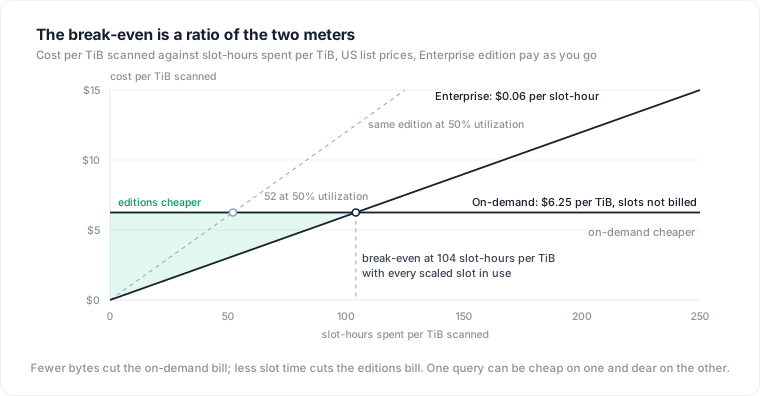
BigQuery on-demand vs editions: when slots cost less
BigQuery on-demand bills bytes scanned, editions bill slot-hours. The break-even is slot-hours per TiB, not monthly volume. How to compute it from job history.
Read more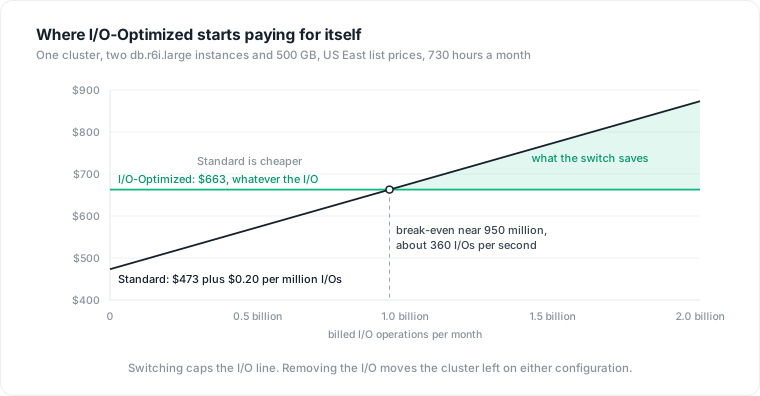
Aurora I/O-Optimized vs Standard: when the switch pays off
Aurora I/O-Optimized charges 30% more for compute and 2.25x for storage to make I/O free. The break-even formula, how to price I/O per query, and when to stay.
Read more
The other use cases
Ready to see your own estate on the map?
One call, your stack, and a first picture of what it holds and what it costs.