
TL;DR. AWS unused resources in a data estate are mostly clusters, and the money follows them. We priced ten idle data resources at US East on-demand list prices: a Redshift cluster left after a proof of concept, an EMR cluster with no steps and an MSK cluster with no producers cost $1,832.86 a month, 72.6% of a $2,525.55 total. The unattached EBS volume and the never-expiring log storage together are $70.72, 2.8%. Rank the cleanup by price, not by how easy the check is, and stop or snapshot before you delete.
AWS unused resources in a data platform are mostly clusters, not volumes. A cluster nobody queries bills every node-hour, while an orphaned volume or a log group costs tens of dollars. A OneUptime guide to idle and unused AWS resources covers EC2 instances, EBS volumes, load balancers, Elastic IPs, RDS, NAT gateways and snapshots, and none of Redshift, EMR, Glue, MSK or Kinesis. The table below prices ten data resources for one modelled estate, names the check that finds each, and says what the check misses.
Prices come from the AWS Price List API for US East, read November 20, 2026, with a 730-hour month. The EC2 and EBS rates come from the price files behind AWS's EC2 on-demand and EBS pricing pages. It is a worked model, not a measured bill, and the CLI calls are sketches not run against an account.
Unused AWS data resources: the ten to check, priced
Consider a team whose analytics project ended a quarter ago, on top of the usual dev and staging sprawl. Nothing below has been read or written for weeks.
| Resource, as modelled | Check that finds it | Per month |
|---|---|---|
| Redshift provisioned, 2 x ra3.large at $0.543 per node-hour, 1 TB managed storage at $0.024 per GB | DatabaseConnections at 0 (AWS/Redshift) | $817.36 |
| EMR, 3 x m5.xlarge at $0.192 EC2 plus $0.048 EMR per hour | IsIdle at 1 (AWS/ElasticMapReduce) | $525.60 |
| MSK provisioned, 3 x kafka.m5.large at $0.21 per broker-hour, 100 GB each at $0.10 | BytesInPerSec at 0 (AWS/Kafka) | $489.90 |
| S3 Standard, 10 TB at $0.023 per GB | Storage Lens prefix GET requests at 0 | $235.52 |
| RDS for PostgreSQL db.r6g.large at $0.225 an hour, 200 GB gp3 at $0.115 | DatabaseConnections at 0 (AWS/RDS) | $187.25 |
| Glue interactive session, 5 DPU for 48 h at $0.44, once a month | aws glue list-sessions | $105.60 |
| Aurora PostgreSQL Serverless v2, 0.5 ACU floor at $0.12, 60 GB at $0.10 | Minimum capacity above 0 | $49.80 |
| Kinesis Data Streams, 4 provisioned shards at $0.015 per shard-hour | IncomingRecords at 0 (AWS/Kinesis) | $43.80 |
| EBS gp3 volume, 500 GB at $0.08, unattached | describe-volumes status available | $40.00 |
| CloudWatch Logs, 1 TB stored at $0.03 per GB | Log groups with no retentionInDays | $30.72 |
| Total | $2,525.55 |
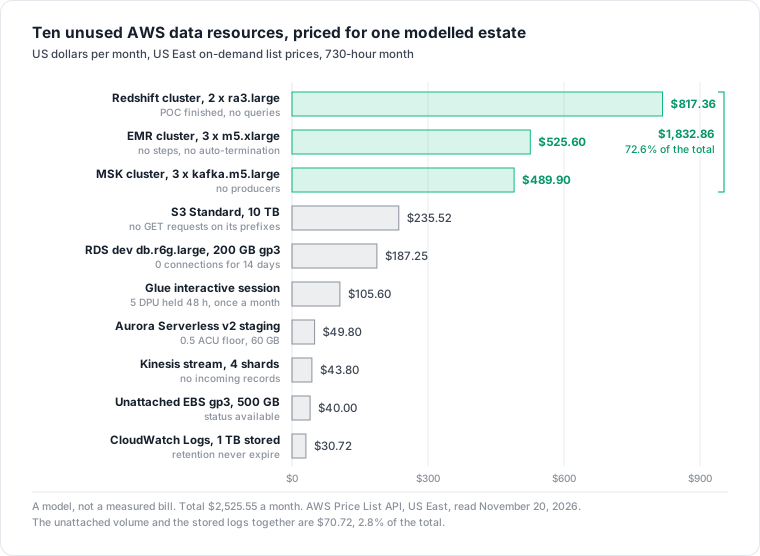
Ranked by price, the order flips. The three clusters are $1,832.86 a month, about $22,000 a year. The volume and the log storage are $70.72 together. A cleanup that starts with what is easiest to find spends its first afternoon on the 2.8%.
Dev and staging databases with no connections
The CloudWatch metric DatabaseConnections counts the client network connections to the database instance. A maximum of 0 every hour for 14 days marks a candidate:
aws cloudwatch get-metric-statistics --region us-east-1 \
  --namespace AWS/RDS --metric-name DatabaseConnections \
  --dimensions Name=DBInstanceIdentifier,Value=dev-db \
  --start-time 2026-11-06T00:00:00Z --end-time 2026-11-20T00:00:00Z \
  --period 3600 --statistics Maximum
The idle db.r6g.large above costs $187.25 a month, $164.25 of it instance hours. Stopping it saves those hours only, and RDS starts it again after seven consecutive days; our stop RDS instance post prices the schedule that handles that.
Aurora Serverless v2 does not pause at a 0.5 ACU minimum. AWS notes that it's tempting to always choose 0.5 for the minimum, a value that keeps the instance active; only a minimum of 0 ACUs turns on auto-pause, and then its instance charge is zero while paused. At 0.5 ACU the staging cluster bills $43.80 of capacity a month plus $6.00 of storage with nobody connected.
The pain is not AWS-specific. On Hacker News, a ClickHouse Postgres user wrote that they "have to pay for dev/staging databases that receive no traffic most of the time". The reply said work to integrate Xata's technology into ClickHouse Managed Postgres includes scale-to-zero.
What the check misses: a job that connects once a month falls outside a 14-day window. Read 35 days before you delete anything.
Clusters and jobs left running after the project ended
Redshift. The DatabaseConnections metric exists for clusters too, with the dimension ClusterIdentifier. A paused cluster stops on-demand billing, and AWS says "Only the cluster's storage incurs charges", so the modelled cluster drops from $817.36 to $24.58 of managed storage. Pausing needs automated snapshots turned on. Our Redshift cost optimization post prices a pause schedule for a cluster that is still used.
EMR. AWS describes IsIdle as a cluster "no longer performing work, but is still alive and accruing charges". EMR has its own cleanup: an auto-termination policy whose idle timeout defaults to 60 minutes. The catch is where it is on by default: "With Amazon EMR versions 6.4.0 and later, auto-termination is enabled by default when you create a new cluster with the Amazon EMR console." The page states that console default only, so check clusters created from the CLI or API for an --auto-termination-policy. The same page says auto-termination is not supported for Presto, Trino or HBase.
MSK and Kinesis. BytesInPerSec at 0 on every broker marks an MSK cluster with no producers, and it is a DEFAULT-level metric, which is free. The cluster still bills $0.21 per broker-hour. For Kinesis, IncomingRecords and GetRecords.Records are basic stream-level metrics sent at no charge; four provisioned shards with no records cost $43.80 a month. An on-demand stream bills $0.04 per stream-hour instead, $29.20.
Glue interactive sessions. A notebook closed without %stop_session keeps its session until the idle timeout, and the default for Spark ETL sessions is 2880 minutes (48 hours). Glue's pricing page says a session has 5 DPU by default and bills per second. One forgotten session is 5 DPU for 48 hours: $105.60 at $0.44, or $73.92 at the $0.308 rate the price list gives for Glue 6.0 and later. Set %idle_timeout 60 in the notebook template.
What the checks miss: a cluster kept warm for a quarterly close shows zero activity for weeks. That is why the cleanup order below starts with reversible steps.
Data nobody reads: S3, EBS and log groups
S3. Storage Lens activity metrics, including GET requests, need the advanced tier, and AWS says prefix-level activity metrics help find prefixes used infrequently. The US East price list bills Storage Lens at $0.20 per million objects per month for the first 25 billion objects. Free-tier metrics are available for queries for 14 days, advanced metrics for 15 months. Ten unread terabytes in S3 Standard cost $235.52 a month; our S3 Intelligent-Tiering post covers when a class change beats deletion.
EBS. A volume in the available state is attached to nothing:
aws ec2 describe-volumes --region us-east-1 \
  --filters Name=status,Values=available \
  --query 'Volumes[].[VolumeId,Size,VolumeType,CreateTime]'
Self-managed databases leave these behind because of a default. AWS's table of DeleteOnTermination defaults preserves a data volume attached after launch, and one attached at launch from the console, when the instance terminates. "Preserved volumes continue to incur charges": $40.00 a month for 500 GB of gp3.
CloudWatch Logs. AWS states that by default, log data is stored in CloudWatch Logs indefinitely. Stored logs bill $0.03 per GB-month, so 1 TB is $30.72, and the line grows every month the data keeps arriving. On November 9, 2026, AWS announced account-level retention policies "at no additional cost", covering every log group or a name prefix such as /aws/lambda, up to 20 per account and Region. The minimum is 30 days, a policy takes effect 24 hours after you create it, and it overrides a longer retention set on a log group, so run it with --dry-run first.
Clean up in this order: stop, snapshot, delete, then lifecycle rules
The strongest objection to any cleanup is that a resource with no activity for weeks may still matter: a quarterly job, a disaster-recovery standby, a dataset an auditor asks for once a year. A mistaken delete can cost more than a year of the saving. The answer is an order where each step can be undone until the last one.
- Tag and stop. Put an owner tag and a review date on every line. Pause the Redshift cluster ($817.36 down to $24.58), stop the RDS instance, set the Aurora minimum to 0 ACUs and attach an auto-termination policy to EMR. Anyone who needs them can start them again.
- Snapshot, then delete. After 35 quiet days, take a final snapshot and delete. In this model the EMR and MSK clusters are deleted rather than stopped, so their data needs to sit somewhere else first. Snapshots are a cost line of their own; our AWS snapshot cost post prices what they keep billing after the source is gone.
- Lifecycle rules last. S3 lifecycle rules and a log retention policy stop the storage lines from growing back. They are the cheapest lines here, which is why they come last.
Each of these checks reads one service. None of them shows that the Redshift cluster, the S3 prefix it loaded from and the EMR job that wrote that prefix belong to the same finished project, which is the fact that makes all three safe to remove together. Our data FinOps post explains why the invoice line is the wrong grain for that question.
The model uses US East on-demand list prices and a 730-hour month. It leaves out data transfer, the EBS volumes EMR attaches to its nodes, Redshift backup storage and any reservation or Savings Plan, which can make an idle resource look free on the bill while the commitment still pays for it.
Idle clusters and unread data sit across many AWS services, each with its own metric. Datapace is building one map of your data estate (databases, warehouses, pipelines and what consumes them) with usage and cost attached, and agents that propose changes as pull requests your team reviews and merges. Here, those agents would draft the auto-termination policy or the retention rule. To find which of your clusters could pause this week, book a call.
Sources
- AWS Price List API for US East, read November 20, 2026: offer files for Amazon Redshift, Amazon EMR, Amazon MSK, Amazon S3, Amazon RDS, AWS Glue, Amazon Kinesis and Amazon CloudWatch.
- AWS, the price files behind the EC2 on-demand and EBS pricing pages, read November 20, 2026, and AWS Glue pricing.
- AWS, Amazon RDS CloudWatch metrics, stopping an RDS instance, Aurora Serverless v2 capacity and auto-pause.
- AWS, Redshift metrics and pausing a cluster; EMR metrics and auto-termination; MSK metrics; Kinesis Data Streams metrics; Glue interactive session magics.
- AWS, S3 Storage Lens, preserving EBS volumes on termination, CloudWatch Logs retention and the account-level retention announcement of November 9, 2026.
- Hacker News, comment on "ClickHouse Acquires Xata", November 2026, and OneUptime, How to identify idle and unused AWS resources.