TL;DR. Azure Data Explorer pricing for one modelled cluster ingesting 50 GB a day came to $1,260.39 a month with 30 days in the hot cache and a year retained, at East US list prices read November 15, 2026. A year of storage was $57.35 of that. The hot cache window sets how many nodes you run, and every engine vCore carries a $0.11 hourly markup that costs more than the VM itself. Left with no caching policy on compute-optimized Edv5 nodes, the same data reached $12,948.95 a month by month 12.
Azure Data Explorer pricing looks like a VM price list, but the VM is less than half of what an ADX engine node costs. Microsoft adds a markup per engine vCore, and the hot cache, more than anything else, sets how many nodes you run. Storage for the full retention period is a rounding error next to those two lines.
The model below prices one cluster at Azure's own list rates. VM rates come from the Azure Retail Prices API and the markup from the ADX pricing calculator's data, East US, read November 15, 2026. The workload is invented; every rate is real.
How Azure Data Explorer bills: engine VMs plus $0.11 per vCore
Microsoft's pricing page describes a cluster as "a pair of engine and data management clusters", billed "on a per minute basis". Four meters follow from that:
| Meter | What it bills | East US rate used here |
|---|---|---|
| Engine VMs | Each engine node at its Linux VM price | E2d v5 $0.144, E4d v5 $0.288, L8as v3 $0.624 an hour |
| ADX markup | Each engine vCore, every hour the engine runs | $0.11 per vCore-hour |
| Data management VMs | Ingestion nodes Microsoft sizes for you, no markup | 2 x D2a v4 at $0.096 an hour (assumed) |
| Storage | Compressed data, billed "as Standard LRS or as Standard ZRS" (calculator guide) | $0.0208 per GB-month (Hot LRS, assumed) |
On every SKU priced here, the markup costs more than the VM it sits on. An E2d v5 has 2 vCores, so it pays $0.22 an hour of markup on a $0.144 VM: 60.4% of the node's cost. On the storage-optimized L8as v3 it is 58.5%. Reservations, below, cut the markup by at most 30%.
Networking is $0 when the sources and readers sit in the cluster's region: Microsoft's calculator guide says "There's no data transfer cost between Azure services deployed in the same region."
Cheaper shapes exist, none with an SLA: a dev/test cluster runs one engine node with no markup, and the free cluster holds "~100 GB (20 GB compressed)". A stopped production cluster bills only storage: per the pricing page FAQ, "When the cluster is stopped, customers are only billed for underlying storage accounts."
One cluster priced for a month: $1,260.39 with 30 days hot
The workload, stated in full:
- 50 GB of raw data a day (logs or telemetry), compressed 7 times, the default ratio in Microsoft's calculator data: 7.14 GB a day on disk.
- Hot cache 30 days, retention 365 days, recoverability left on (its default).
- Priced in month 12, when a full year sits in storage. 730 hours, pay-as-you-go, East US.
- Engine sized only for the hot data. Query CPU can force more nodes; this model does not try to predict that.
| Line | Inputs | Monthly |
|---|---|---|
| Engine VMs | 2 x E4d v5 x 730 h x $0.288 | $420.48 |
| ADX markup | 2 nodes x 4 vCores x 730 h x $0.11 | $642.40 |
| Data management VMs | 2 x D2a v4 x 730 h x $0.096 | $140.16 |
| Storage | 386 days x 7.14 GB = 2,757.1 GB x $0.0208 | $57.35 |
| Networking | Same region | $0.00 |
| Total | $1,260.39 |
Storage counts 386 days, not 365. Microsoft's cost breakdown adds a "Retention buffer" of 7 days and, with recoverability on, keeps data "for an additional 14 days".
Two lines are assumptions. Microsoft sizes the data management nodes itself; its pricing FAQ says they use "a Da_v4 series SKU when available", and D2a v4 is the smallest size in the Dav4 series. Microsoft also does not name the blob tier, so storage is priced at Hot LRS; Cool LRS would make it $41.91.
The hot cache sets the cluster size
ADX keeps hot data on each engine node's local SSD, and the cache policy doc says "The cache uses 95% of the local SSD disk for hot data." So the hot window, divided by 95% of a node's SSD, gives the node count. Thirty days is 214.3 GB hot. An E4d v5 has a 116 GB SSD, 110.2 GB usable, so two of them fit with 6 GB to spare.
That makes the hot gigabyte the unit worth pricing:
| SKU | SSD | Usable hot GB | Cost per hot GB-month |
|---|---|---|---|
| E2d v5 (compute optimized) | 55 GB | 52.3 | $5.09 |
| E4d v5 | 116 GB | 110.2 | $4.82 |
| E16d v5 | 485 GB | 460.8 | $4.61 |
| D2ads v6 (compute optimized, Dadsv6) | 976 GB | 927.2 | $0.26 when full |
| L8as v3 (storage optimized) | 1,792 GB | 1,702.4 | $0.64 when full |
| Hot LRS blob, for comparison | $0.0208 |
On the compute-optimized Edv5 series, a gigabyte held hot costs roughly 220 to 245 times the same gigabyte in blob storage. Each day added to the hot window adds 7.14 GB to that line.
Two exceptions are worth pricing before you settle on Edv5. Microsoft's SKU guide ranks Eadsv5 first, with the same SSD sizes at a lower VM rate (E2ads v5 is $0.131 an hour). The pricing page also lists Dadsv6 as compute optimized with 976 GB of SSD from 2 vCPUs: at $0.114 an hour, a D2ads v6 hot GB costs $0.26 a month when full. Check that your region offers it.
Now the four designs in the figure, all with the same data:
| Design, month 12 | Engine | Hot data | Total | Markup share |
|---|---|---|---|---|
| 7 days hot, 1 year retained | 2 x E2d v5 | 50.0 GB | $728.95 | 44.1% |
| 30 days hot, 1 year retained | 2 x E4d v5 | 214.3 GB | $1,260.39 | 51.0% |
| No caching policy, storage optimized | 2 x L8as v3 | 2,607.1 GB | $2,390.23 | 53.8% |
| No caching policy, Edv5 | 6 x E16d v5 | 2,607.1 GB | $12,948.95 | 59.5% |
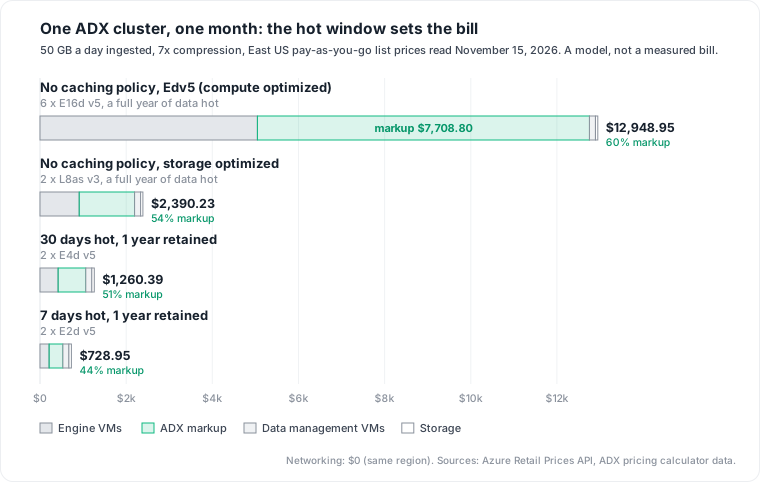
The no-policy rows are what a new table gets: the cache policy doc says "By default, the effective policy is null, which means that all the data is considered hot." With no retention policy either, month 12 holds the whole year, 2,607.1 GB, and the hot set keeps growing every day after.
The cluster grows with that data only because autoscale lets it. The scaling guide calls optimized autoscale "the default setting during cluster creation" and scales out when "The cache utilization is high for over an hour", up to the maximum instance count you set. On manual scale, the cache keeps the newest data and the node count stays put.
The SKU choice matters almost as much. Across the Edv5 series and the L8as v3, two L8as v3 nodes ($2,195.84 of engine) beat every Edv5 size once the hot data passes 456 GB, which is 64 days at this ingest rate. Below that, Edv5 wins; Microsoft's SKU guide frames the same trade as "Choose a compute-optimized SKU for optimal performance when there are high query volumes." If your region offers Dadsv6, three D2ads v6 nodes would hold the whole year hot for $731.46 of engine.
Caching everything buys fast old queries at 10 times the bill
The strongest objection: cold queries are slow, and they cost money too. Microsoft's cost breakdown says "Queries that access cold data trigger read transactions and add to cost", and the hot windows guide says the loading step from storage has "much higher latency than the local disk".
That argues for a hot window sized to what people query, not for caching a year. If dashboards read the last week and an analyst sometimes reads last March, a hot window can cache that range for the investigation and be removed after. Teams that scan months of history all day do need it hot; for them a large-SSD SKU is the answer: $2,390.23 on L8as v3 rather than $12,948.95 on E16d v5.
Retention, reservations and autoscale
Retention bounds storage, and on its own also bounds the hot set. A new table has no retention policy, and applying the default object sets a soft-delete period that the retention policy doc gives as "1,000 years". Storage is cheap here ($57.35 for a year), so the reason to set retention is that, with no caching policy, everything retained is hot.
Reserve the markup, and the VMs separately. The reservation guide says an ADX reservation "doesn't cover compute, networking, or storage charges". In the calculator data, a 1-year reservation prices the markup at $0.0935 per vCore-hour (15.0% off) and a 3-year one at $0.0770 (30.0% off). A 1-year VM reservation for an E4d v5 is $1,488 a year, $0.16986 an hour, 41.0% under pay-as-you-go. With 1-year reservations on the markup and on all four VMs, the 30-day design drops from $1,260.39 to $933.68 a month, 25.9% less. Cancelling may cost "a 12% early termination fee", so reserve the floor you will run for a year, not the peak.
Cap autoscale. Optimized autoscale both adds and removes nodes, but the scaling guide notes that scale-in "needs a 1-day evaluation" first. Set the maximum instance count to the cluster you have budgeted for, so a missing caching policy shows up as cache pressure, not as new nodes.
Give heavy readers their own cluster. A follower database can carry its own caching policy, and Microsoft says a follower "can also be used to associate the cost of Azure Data Explorer cluster to the party that runs queries on the data".
For ADX on one plant's sensor data, see Azure IoT Hub pricing; for when Athena's per-scan billing beats an always-on ADX engine, IoT platform pricing; for Snowflake, BigQuery, Redshift and Databricks, data warehouse cost.
Find the tables nobody queries
Two management commands give you hot size and readers per table. First, the hot cache each table holds, from .show tables details:
.show tables details
| project DatabaseName, TableName,
          HotGB = round(HotExtentSize / 1e9, 1),
          TotalGB = round(TotalExtentSize / 1e9, 1),
          CachingPolicy, RetentionPolicy
| order by HotGB desc
Then, for each large table, who queried it. .show commands-and-queries keeps completed queries "for 30 days", with their CPU time:
.show commands-and-queries
| where CommandType == "Query" and Text has "AppLogs"
| summarize Queries = count(), LastQuery = max(StartedOn),
            CpuHours = round(sum(TotalCpu) / 1h, 2)
  by User, Application
A large HotGB with few queries is the cheapest line to cut: shorten its caching policy and the next scale-in can drop a node. The text match is crude, though. A query that reads a table through a function or a materialized view does not name it, so check those before you shorten anything.
Each table's hot window is a choice someone made, or never made, and the bill does not say which table pays for which node. Datapace is building one map of your data estate (databases, warehouses, pipelines and what consumes them) with usage and cost attached, and agents that propose changes as pull requests your team reviews and merges. To size your own cluster's hot cache against its readers, book a call.
Sources
- Microsoft, Azure Data Explorer pricing and the ADX pricing calculator data, read November 15, 2026.
- Azure Retail Prices API, East US: E2d v5, E4d v5, E16d v5, L8as v3, E2ads v5, D2ads v6, D2a v4, Azure Data Explorer and Blob Storage, read November 15, 2026.
- Microsoft Learn, Azure Data Explorer: pricing calculator, cost breakdown, select a SKU, free cluster, reserved capacity, horizontal scaling, hot windows and follower databases.
- Microsoft Learn, Kusto: caching policy, retention policy, .show table details and .show commands-and-queries. Microsoft Learn, Dav4 sizes.