TL;DR. IoT platform pricing for one modelled plant (2,000 tags read once a second) came to between $110 and $950 a month in month 12 at US list prices. Getting the readings in cost $63 a month on AWS (IoT Core plus Firehose) and $250 on Azure (one IoT Hub unit). The query layer was the largest line in three of four designs, and on AWS converting the readings to Parquet cut the bill 8.6 times. Pick the format and the query engine for your readers first; the choice of hub moves the bill less.
IoT platform pricing pages compare the price of a message. For a plant, the message is the cheap part. A gateway that batches readings sends a few million messages a day, and both clouds take them in for a few hundred dollars a month at most. The money goes to keeping a year of readings and answering the dashboards that read them.
The model below prices one plant end to end on both clouds: the hub, the storage, and the query engine. AWS rates are N. Virginia (US East) rows of the AWS Price List API, Azure rates come from the Azure Retail Prices API for East US, both read November 15, 2026. The plant is invented. The file sizes are measured on one synthetic hour of its data, described below.
Google is out of this comparison: it set the retirement of Cloud IoT Core for August 16, 2023.
How AWS IoT Core and Azure IoT Hub meter a message
The plant is the one from our Azure IoT Hub pricing post: 2,000 tags (temperatures, pressures, flows, motor currents, states, totalizers) sampled at 1 Hz, about 100 bytes of JSON per reading. That is 172.8 million readings a day. One gateway packs 36 readings into each message, about 3.6 KB, so the plant sends 4.8 million messages a day, 144 million a month.
The two hubs count those messages differently:
| AWS IoT Core | Azure IoT Hub | |
|---|---|---|
| Unit of sale | Per message, per rule, per action | A unit with a daily message quota |
| Message size counted | "5 KB increments" | "4-KB chunks" |
| Rate used here | Rules $0.15 and actions $0.15 per million | S2: $250 a month for 6,000,000 messages a day |
| A 3.6 KB batch counts as | 1 message, 1 rule, 1 action | 1 message |
On AWS, Basic Ingest publishes straight to a rule "without incurring messaging costs", so only the rule and its action bill: 144 million x $0.30 per million is $43.20. One gateway connected all month adds $0.08 per million connection-minutes, under one cent. The rule sends each message to Amazon Data Firehose, which bills ingestion "per GB ingested in 5KB increments": 144 million records count as 686.6 GB, or $19.91 at $0.029 per GB. AWS ingestion: $63.12. If a live screen subscribes to the broker topic instead, each batch bills as one publish-in message plus one publish-out message for every subscriber (see the examples on AWS's pricing page), at $1.00 per million: $288 more a month for one subscriber. Our AWS IoT Core pricing post works through the same meters for a truck fleet.
On Azure, 4.8 million messages a day fit in one S2 unit (80% of its quota): $250. The Basic B2 unit has the same quota for $50, but Microsoft's tier guide marks cloud-to-device messaging and Azure IoT Edge as Standard-tier features, so a plant gateway running IoT Edge needs Standard.
One plant, two clouds: the monthly bill
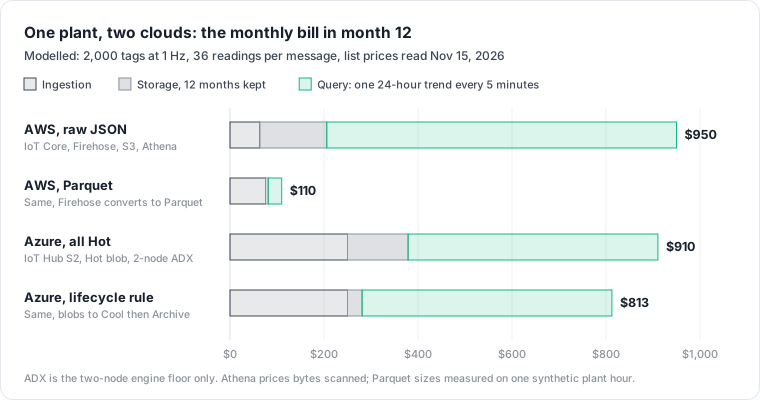
Each cloud gets two designs, priced in month 12, when the plant holds a year of readings. The reader is the same everywhere: one trend dashboard that queries the last 24 hours and refreshes every 5 minutes, 8,640 queries a month.
| Design, month 12 | Ingestion | Storage | Query | Total |
|---|---|---|---|---|
| AWS: IoT Core, Firehose, raw JSON in S3, Athena | $63.12 | $142.66 | $744.31 | $950.09 |
| AWS: same, Firehose converts to Parquet | $75.48 | $5.74 | $28.80 | $110.02 |
| Azure, all Hot: IoT Hub S2, raw JSON in Hot blob, two-node ADX | $250.00 | $129.01 | $531.44 | $910.45 |
| Azure: same, lifecycle rule to Cool and Archive | $250.00 | $31.07 | $531.44 | $812.51 |
The inputs, line by line:
- Raw JSON is 516.9 GB a month (measured below at 99.7 bytes a reading; the Azure post's 518.4 GB assumes exactly 100 bytes). Twelve months is 6,202.6 GB: $142.66 in S3 Standard at $0.023 per GB, or $129.01 in Azure Hot blob at $0.0208. On Azure, the IoT Hub storage route is set to JSON encoding; Avro is its default.
- The lifecycle rule keeps the last month Hot, the two before it Cool ($0.0152) and the other nine in Archive ($0.00099): $31.07.
- Parquet is 20.8 GB a month, 249.6 GB for the year: $5.74 in S3. Firehose's format conversion is priced "based on GBs ingested in 5KB increments", so 686.6 GB at $0.018 adds $12.36 to ingestion.
- Athena bills $5 per TB scanned in the Athena price list. A 24-hour query on hourly partitions reads 17.23 GB of raw JSON (148.9 TB a month) or 0.667 GB of Parquet columns (5.76 TB a month).
- ADX is the engine floor from our Azure post: 2 E2d v5 nodes x 730 hours x ($0.144 VM + 2 vCores x $0.11 markup) = $531.44.
Storage and queries are most of it
In three of the four designs, the query layer is the largest line: 78% of the raw JSON bill on AWS, 58% and 65% of the two Azure bills. Ingestion is 7% of the AWS raw JSON bill and 27% to 31% of the Azure bills.
The two clouds fail in different ways. Athena charges for every byte a query reads, so the raw JSON design pays $744 a month for one dashboard. ADX charges for the cluster whether anyone queries it, so the Azure designs pay at least $531.44 even if the dashboard is switched off.
The break-even between them is a number of bytes: $531.44 buys 106.3 TB of Athena scans a month. On raw JSON that is 6,169 of the 24-hour queries, one every 7 minutes. On Parquet it is about 159,400, one every 16 seconds. A plant whose screens poll that often belongs on a cluster; a plant with a few engineers and one dashboard does not.
What one plant hour measured: 717.9 MB of JSON, 28.9 MB of Parquet
The file sizes come from a script that generated one hour of the plant: 2,000 tags, 3,600 seconds, 7.2 million readings, with temperatures and pressures drifting, flows and currents noisy around a setpoint, states that rarely change and counters that climb. It wrote the hour as newline-delimited JSON and as Snappy-compressed Parquet with pyarrow 26.0.1, one row per 36-reading message with the readings as a nested list, the shape a converter writes from the batched message.
| Format | Bytes for one hour | Per month (720 h) |
|---|---|---|
| JSON, one reading per line | 717.9 MB (99.7 bytes a reading) | 516.9 GB |
| JSON, gzip level 6 | 60.6 MB | 43.7 GB |
| Parquet, nested, Snappy | 28.9 MB | 20.8 GB |
| Parquet columns a trend query reads (tag, ts, v) | 27.8 MB | 20.0 GB |
Parquet was 24.8 times smaller than the JSON, and the value column was 91% of it. Noisy floating-point readings compress poorly, and a trend query skips only the gateway, sequence and quality columns, which saved 4% of the scan. The win came from encoding and compression. Athena says the same about compression and columnar formats: you "can save up to 90% per query".
Batching changes both bills
Send one reading per message and both hubs bill 36 times more messages:
| Gateway design | Messages a month | AWS ingestion | Azure hub |
|---|---|---|---|
| 36 readings per message | 144 million | $63.12 | $250 (1 x S2) |
| 1 reading per message | 5,184 million | $2,272.06 | $2,500 (1 x S3) |
On AWS, 5,184 million rules and actions cost $1,555.20, and Firehose bills each 100-byte record as 5 KB: 24,719 GB, or $716.86. On Azure, 172.8 million messages a day need an S3 unit ($2,500 for 300 million a day). Unbatched, ingestion becomes the largest line on both clouds. Batching is the one ingestion decision that matters, and it is made in the gateway, not in the cloud console.
The strongest case for comparing hubs comes from a 2018 451 Research study. RTInsights' summary of it says "Microsoft Azure IoT Hub is the cheapest provider at scale, especially when message size, number of messages and number of devices are all high", and that AWS IoT Core came out best for deployments under 20,000 devices sending fewer than three messages a minute. A plant sends through one gateway, and here AWS ingestion (IoT Core plus Firehose) cost less than the Azure hub in both gateway designs. Neither result changes the conclusion: after batching, the ingestion difference ($187 a month) is a fraction of the gap between the raw JSON and Parquet designs on the same cloud ($840).
Choose on retention and readers, not on the hub
Three questions set the bill more than the vendor does:
- How long is raw data kept, and in which tier? A lifecycle rule cut Azure storage from $129.01 to $31.07 in month 12. On AWS, Parquet did more than any tier would: $5.74 for the year.
- Who reads the data, and how often? One dashboard every 5 minutes is $28.80 a month on Parquet in Athena and $531.44 a month on ADX. Fifty dashboards at the same rate flip the answer. Count queries and bytes scanned before picking the engine; our Amazon Athena pricing post shows how table layout changes the bytes.
- Is there an always-on engine you would pay for anyway? On AWS, Timestream for LiveAnalytics closed to new customers on June 20, 2025, and AWS recommends that new customers evaluate Timestream for InfluxDB, which bills "per DB instance-hour consumed", as priced in our AWS Timestream pricing post. That brings back the fixed floor that Athena avoids.
A plant that wants a managed historian rather than a lake has a third option, priced in our AWS IoT SiteWise pricing post.
What this model leaves out
- The data is synthetic. Real tags compress better or worse depending on noise, deadband and how often values change. The Parquet came from pyarrow, not from Firehose's own converter, and a different writer will produce different sizes.
- The ADX line is a minimum. Missing from it: data management nodes, the compressed copy ADX keeps in storage, networking, and whether 30 days of hot cache fit on two nodes. Microsoft bills ADX "on a per minute basis"; the model counts 730 hours a month.
- Not priced: S3 and blob requests, Firehose buffering, Azure pay-per-query engines such as Fabric, the Athena 10 MB minimum per query (it does not bind here), reservations and free tiers.
- Units: storage and scan figures use decimal GB and TB; the Firehose lines use AWS's own 1,048,576 KB per GB. Counted in binary units, the storage lines would come out about 7% lower and the scan lines about 9% lower.
Each of these moves a line; none of them moves batched ingestion ahead of storage and queries on the raw designs.
Where the money goes is a question about readers
On both clouds, the bill follows the copies of each tag that are kept and the screens that read them, and no invoice line says which tags anyone reads. Datapace is building one map of your data estate (databases, warehouses, pipelines and what consumes them) with usage and cost attached, and agents that propose changes as pull requests your team reviews and merges. The same reasoning across the rest of the platform is in our data pipeline cost guide; to price your own plant's streams against their readers, book a call.
Sources
- AWS Price List API, US East: AWS IoT, Amazon Data Firehose, Amazon S3 and Amazon Athena, read November 15, 2026.
- AWS, AWS IoT Core pricing, Amazon Data Firehose pricing, Amazon Athena pricing, Reducing messaging costs with Basic Ingest and Timestream for LiveAnalytics availability change.
- Azure Retail Prices API, East US: IoT Hub, Blob Storage, E2d v5 and Azure Data Explorer, read November 15, 2026.
- Microsoft, Azure IoT Hub pricing, Azure Data Explorer pricing, IoT Hub billing information, Choose the right IoT Hub tier and size and Edv5 sizes.
- RTInsights, Research suggests Microsoft Azure cheapest at scale for IoT, on 451 Research's study. InfoQ, Google Cloud IoT Core discontinued.