
TL;DR. Canary historian pricing is public: Canary's pricing page lists 12 tag tiers, each as a perpetual license plus 18% CustomerCare or as a yearly subscription. A plant with 5,000 tags buys the 5,500-tag tier: $17,228 in year one perpetual, or $5,840 a year. The page says perpetual "pays off after ~3 years vs Subscription", but that holds only if you stop paying CustomerCare. Renew it, and subscription stays cheaper until year 5. Above the tier, the 5,501st tag adds $1,460 a year to a subscription.
Canary historian pricing turns on one number: the tag count in your license. Every tier on Canary's list prices a subscription year at about 40% of the perpetual license, and CustomerCare costs 18% of the license each year, so the perpetual payoff lands at the same point for every plant size: about 4.5 years with CustomerCare renewed.
Prices below were read from canarylabs.com/pricing on November 9, 2026. They are in US dollars, for purchases in the United States, and Canary says they are "subject to change at any time."
The first three years for a 5,000-tag plant
Consider a hypothetical plant logging 5,000 tags. The nearest tier is 5,500 tags.
| Cost line | Year 1 | Year 2 | Year 3 | 3-year total |
|---|---|---|---|---|
| Perpetual historian license (5,500 tags) | $14,600 | $0 | $0 | $14,600 |
| CustomerCare, 18% of the license | $2,628 | $2,628 | $2,628 | $7,884 |
| Perpetual total | $17,228 | $2,628 | $2,628 | $22,484 |
| Subscription (CustomerCare included) | $5,840 | $5,840 | $5,840 | $17,520 |
| Axiom and Excel Add-in clients | $0 | $0 | $0 | $0 |
| ODBC connector (optional) | $2,500 one-time or $1,000 a year |
Axiom and Excel clients cost nothing extra: both plans list "Unlimited Axiom Clients" and "Unlimited Excel Clients." Canary's Quick Start Guide adds that collectors (OPC, MQTT, CSV and others) "do not require licensing and can therefore be deployed as many time as needed." What else needs a license is narrow: a Views service remote from the historian, the ODBC server, and an ancillary server, which Canary quotes. On a single historian server without ODBC, the tag count is the bill.
How Canary licenses the historian: by tags in the newest file
Canary's licensing guide says "the tag count is determined by the number of tags within the last file of each DataSet." Its page on removing tags from the count adds the part that matters for cost: the count includes every tag in that file, "even if a tag is not receiving updates."
Two more rules from the same guide shape the count:
- Calculations cost tags. Licenses are consumed by tags logged "from various Canary Collectors or by the Calculation service." A KPI computed and stored by the Calculation server uses a license like a sensor does.
- Virtual Views are free. "Virtual Views do not consume a tag license," so renaming or regrouping tags for an asset model uses no tag licenses.
The tiers step, and the price per tag falls as they grow:
| Licensed tags | Perpetual license | Year one with CustomerCare | Subscription a year |
|---|---|---|---|
| 3,500 | $9,970 | $11,765 | $3,980 |
| 5,500 | $14,600 | $17,228 | $5,840 |
| 7,500 | $18,250 | $21,535 | $7,300 |
| 10,000 | $22,100 | $26,078 | $8,840 |
| 15,000 | $31,500 | $37,170 | $12,600 |
| 22,500 | $43,600 | $51,448 | $17,440 |
| 30,000 | $54,000 | $63,720 | $21,600 |
| 37,500 | $66,800 | $78,824 | $26,720 |
| 45,000 | $79,300 | $93,574 | $31,720 |
| 52,500 | $84,600 | $99,828 | $33,840 |
| 60,000 | $89,500 | $105,610 | $35,800 |
| 100,000 | $135,500 | $159,890 | $54,200 |
The perpetual license falls from $2.85 a tag at 3,500 tags to $1.36 at 100,000. Above 100,000 tags, and for unlimited tags under Enterprise licensing, Canary quotes. Its hosted option, Canary Private Cloud, is priced separately: the 7,500-tag size is $16,266 a year plus a one-time $1,500 setup fee, and it includes hosting in a US Azure environment with eight years of history, which the on-premises prices above do not.
What a 5,000-tag plant pays: subscription until year 5
Canary's pricing page says perpetual "pays off after ~3 years vs Subscription." The arithmetic behind it: year one perpetual is 1.18 times the license, a subscription year is 0.40 times (0.399 on the smallest tier), and 1.18 / 0.40 is 2.95 years.
That comparison stops paying CustomerCare after year one. The pricing page says you "can renew CustomerCare annually at 18% of the license cost", and that without it "your system will continue to operate, but you won't receive updates, patches, or priority support." A subscription keeps CustomerCare included every year. Compare like with like, with CustomerCare renewed, and perpetual spend only drops below subscription spend in year 5.
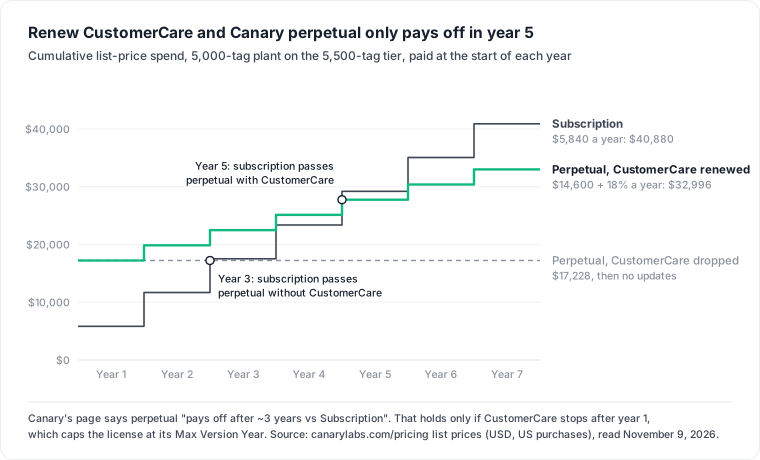
| Paid by the start of year | Perpetual, CustomerCare renewed | Subscription |
|---|---|---|
| 3 | $22,484 | $17,520 |
| 4 | $25,112 | $23,360 |
| 5 | $27,740 | $29,200 |
The break-even is the license price B times (1 + 0.18n) against 0.40 B times n, which gives n = 1 / 0.22, or 4.55 years. B cancels, so the answer is the same on every tier.
Dropping CustomerCare has a cost beyond patches. Canary's versioning page says each license carries a Max Version Year, and renewing customer care "extends the Max Version Year to the next year." Install a newer version than the license allows, and Canary warns the software "will be virtually unusable." A plant that drops CustomerCare is pinned to the versions its last Max Version Year allows.
Perpetual pays when the tag count is stable and the system will run well past 5 years. A plant still growing its tag count is better served by a subscription, for the reason in the next section. The pricing page also says customers can start on subscription and talk to their rep about "credit options for prior subscription payments" when they convert; the terms of that credit are not published.
What adding tags does to the bill: the 5,501st tag costs $1,460 a year
Tiers move in steps. On subscription, going from 5,500 to 7,500 tags adds $1,460 a year, whether you add 1 tag or 2,000.
Suppose the same plant adds 1,500 tags a year for new lines, test rigs and calculated KPIs. It starts year 2 at 6,500 tags and year 3 at 8,000.
| Plan | Year 1 | Year 2 | Year 3 | 3-year total |
|---|---|---|---|---|
| Subscription, stepping 5,500, 7,500, 10,000 tags | $5,840 | $7,300 | $8,840 | $21,980 |
| Subscription, retiring 500 of each 1,500 added (5,500, 7,500, 7,500) | $5,840 | $7,300 | $7,300 | $20,440 |
| Perpetual, buying 10,000 tags on day one | $26,078 | $3,978 | $3,978 | $34,034 |
Canary's page does not publish how a perpetual license is upgraded to a larger tier. If an upgrade were billed at the difference in list price, which is an assumption, stepping up perpetual would cost $17,228, then $6,935, then $7,828: $31,991 over 3 years, still above the subscription.
Retiring tags only saves money when it keeps you below a tier boundary. In the table, retiring 500 tags a year changes nothing until year 3, when it holds the plant at 7,000 tags, under the 7,500 boundary, and saves $1,540. Before cleaning, know how far you are from the next boundary.
Disk space is not where the money goes. Canary's disk space guide estimates 10.4 GB a year for 1,000 tags of mixed data types sampled every 5 seconds with a 30% change rate, the middle of three examples that run from 6.5 to 28.8 GB. Scaled to 5,000 such tags, that is 52 GB a year.
Canary vs PI: two licence models
Canary publishes its tiers. AVEVA's PI System license schedule lists the meters but no prices, so PI is priced by quote. Our OSIsoft PI pricing post reads AVEVA's license schedule instead.
| Canary | AVEVA PI System | |
|---|---|---|
| Price list | Public, 12 tiers up to 100,000 tags | No prices in the license schedule; quote |
| Tag meter | Tags in the newest file of each DataSet | Data streams by node, or an aggregate tag tier |
| Above the tier | Buy the next tier | Daily overage on the reporting Aggregate Tag model |
| Lowering the tier | Removing a tag frees its license; the page does not say if a subscription can drop a tier at renewal | Cannot be lowered during the term |
| Client tools | Axiom and Excel Add-in unlimited | PI Vision licensed by individual or named user |
Canary's own 2020 comparison sets its price against one PI quote it says it "cannot verify." It was written by Canary to sell Canary, so read it as a sales argument.
Counting the tags nobody reads before you buy the next tier
Canary documents how to take a tag out of the count. The steps differ by collector:
- Read the licensed count. The Licenses tile in Canary Admin shows "the total number of tags the historian is licensed for."
- List the tags in the newest file. In the Historian tile, open each DataSet's most recent HDB file, filter the tag list and export it as CSV, as Canary's obsoleting guide describes.
- Remove them at the source. For a tag-based OPC UA session, remove the tags from the session; for OPC DA, delete them in Logger Administrator and restart the session. For a path-based OPC UA session, "Sync Tags to Historian" removes tags no longer found in the OPC server, and on the MQTT Collector the same box removes tags "based upon the messages received from the broker."
- For other collectors, obsolete them. Remove the tags from the logging source first, then upload the CSV with OBSOLETE TAGS on the DataSet. Tags "cannot be obsoleted if they are still being actively logged or accessed," and they leave the list when the next HDB file starts.
There is a real cost to this. Canary says that once a tag is released from the count, "all historical data records remain in the Canary Historian but are no longer accessible for any client tools." We found no Canary page describing a way to keep a released tag's history readable. A tag whose history an audit or a quality investigation may need has to stay licensed.
That limits the cleanup to tags with no history worth reading: points created for a commissioning test, duplicates from a migrated session, calculations nobody opens. Make that call during the line change itself, while the people who installed the equipment can still say which signals matter. The same pattern drives cloud bills for plant data, as AWS Timestream pricing shows for the screens that read it and what a data pipeline costs for the jobs that move it.
Datapace is building one map of your data estate (databases, warehouses, pipelines and what consumes them) with usage and cost attached, and agents that propose changes as pull requests your team reviews and merges. To go through your own historian's tag count before the next tier, book a call.
Sources
- Canary Labs, Data Historian Pricing, tier table, CustomerCare and Private Cloud prices, read November 9, 2026.
- Canary Labs Help Center (version 26): How to License the Canary System, Removing Tags from the Total License Count, Versioning and License Compatibility, Licenses Tile, Obsoleting Tags from a DataSet.
- Canary Labs Help Center: Quick Start Guide (version 25), Estimating Historian Disk Space (version 24).
- Canary Labs, Enterprise Data Historian Pricing Comparison for AVEVA PI, Ignition, and Canary, April 23, 2020.