TL;DR. A bare hard drive works out to about $0.26 to $0.47 per TB a month. Backblaze's filings point to about $1 in direct costs for a durable TB. S3 Standard lists at $23, and S3 Glacier Deep Archive lists at $0.99 with the same durability rating. The bill for a stored TB has three parts: rent, tolls and waiting. S3 Standard's list price changed once across 72 price files since 2015, and most later savings came as new tiers. Drives explain part of the gap: capacity grew, random reads per drive did not. For large files, cold tier retrieval fees are smaller than their reputation. Small files and egress are the fees that hurt. The last section gives a query that sizes the small file cost on your own buckets.
This week I was charting ten years of storage prices across AWS, Azure and Google for our price history post. One chart stopped me. Seagate's revenue per TB shipped had fallen 62%, and S3 Standard had not moved at all.
So I kept pulling on it. What does a stored TB really cost? What sits between that cost and the $23 on the price list? And why does AWS sell the same durability rating for $23 and for $0.99?
Prices here are public list rates with no commitment, read in early November 2026: US East for AWS and Azure, Iowa for Google, and the first price tier where a product has tiers. S3 Standard's $23 is the rate for the first 50 TB, falling to $21 above 500 TB. AWS and Google bill by binary GB, so 1 TB here means 1,000 billed GB.
S3 Standard stopped falling in 2016 and most later savings came as new tiers
AWS keeps old versions of its price list online, back to 2015. Across all 72 versions of the S3 file, from October 2015 to October 2026, the first tier of S3 Standard changes once: from $0.03 to $0.023 per GB on December 1, 2016. GET and PUT request prices never change.
S3 fell in six steps from $0.15 at launch in 2006 to $0.023 in 2016. After that, most lower prices arrived as new products. Deep Archive came in 2019 at $0.99 per TB and Glacier Instant Retrieval in 2021 at $4. Among tiers that existed in 2016, the only US East cut since is Glacier, from $4 to $3.60 in 2021.
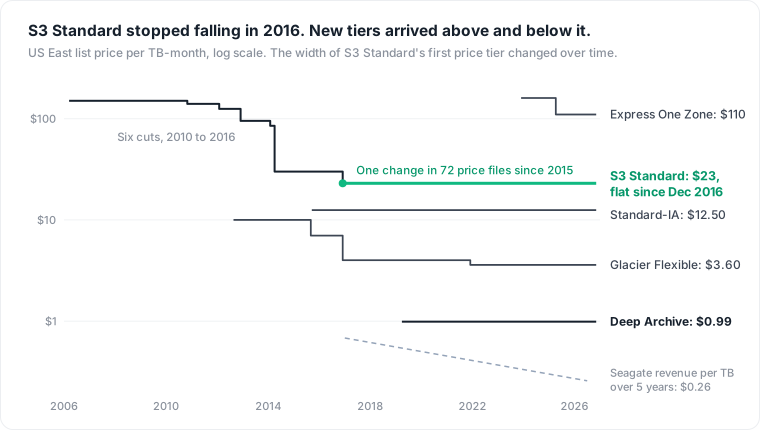
AWS also built upward. Express One Zone launched at $160 per TB in 2023 and fell to $110 in 2025. Google's Rapid class lists at the same $0.11 per GB. Azure's retail price API shows undocumented Turbo LRS meters, at $0.11 per GB plus account and throughput charges, effective November 1. I could not confirm it is a product yet.
The practical point: a bucket left on Standard since 2016 still pays the 2016 price. The cheaper storage exists, but you only get it by moving your data.
A durable stored TB costs about $1 a month in direct costs
Start with the drive. A new 24 TB Seagate Exos listed at $18.75 per TB in April, and eRacks tracked Exos street prices at $27.92 in August. Seagate's total revenue over exabytes shipped, $15.46 per TB in FY2026, works as a rough factory-gate price. Spread over the five-year warranty, that is $0.26 to $0.47 per TB a month.
One copy on one drive is not a storage service. Backblaze splits data into 17 data shards and 3 parity shards, which uses 1.18 times the raw space. One blog citing S3 talks puts S3 at about 1.8 times, but I found no AWS source for that. At 1.2 to 1.8 times, the drive share of a stored TB is 31 to 84 cents.
Power barely registers. A 32 TB Exos M draws at most 9.5 W. At AWS's PUE of 1.14 and the 2025 US industrial rate of 8.51 cents, that is about 2 cents per raw TB a month.
Then check from the top down. No vendor publishes a full running cost per TB, and Backblaze comes closest. Its cost of revenue was $15.9 million in Q2 2026, on about 5 exabytes. That is about $1.06 per TB a month. It is a crude figure: it blends B2 with the backup product, and the 5 exabytes comes from an earnings call with no raw or stored label.
That $1 covers direct costs only. With R&D, sales and admin, Backblaze spent about $3.13 per TB and earned about $2.85, so it ran at a loss. Inside the $1, equipment depreciation is about 25 cents, on a six-year life. My drive and power sum at this year's prices comes to 33 to 87 cents, which fits inside that $1.
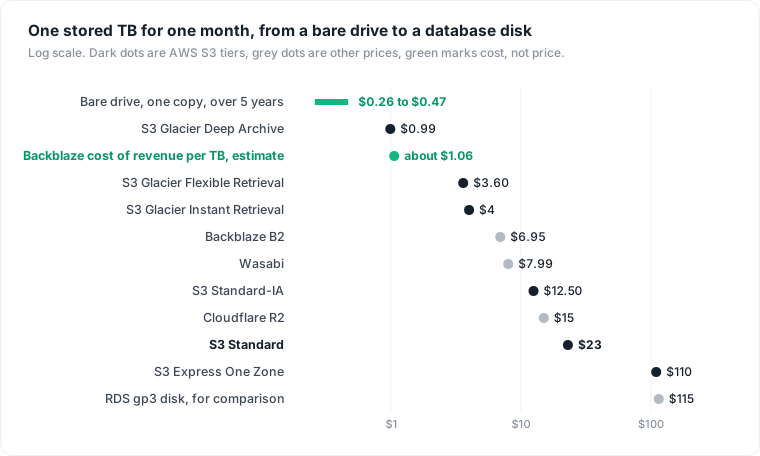
Put S3 Standard against the bare drive and you get roughly 45 to 80 times, once you allow for billed GB being binary. That makes a good headline and a poor measure, because a drive is one part of a service. Against Backblaze B2 at $6.95, a complete service rated at 11 nines, the ratio is about three times. Cloudflare R2 at $15 is closer still.
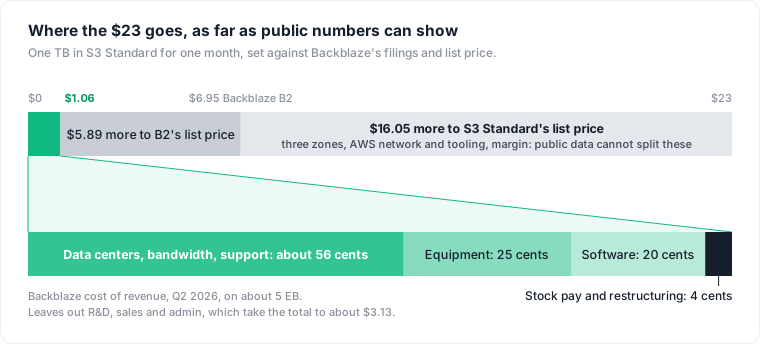
Part of the last $16 pays for real things. S3 Standard keeps data in at least three zones, and S3 as a whole serves over 200 million requests a second. Part of it is margin. AWS's operating margin rose from 25.4% in 2016 to 35.4% in 2025, across all its services. Public data cannot split the two.
Deep Archive is the surprise. At $0.99 it sits at Backblaze's direct cost, while keeping data in at least three zones. Possible reasons include cheaper media, hardware built only for cold data, or read fees carrying part of the cost. Public data cannot say. Of the original Glacier, James Hamilton of AWS wrote in 2017: "Some guess disk, some conclude tape, and we've not published what it is." In 2019 a spokesperson told Tech Monitor only that Deep Archive uses a mix of media. For scale, an 18 TB LTO-9 cartridge sells at about $6.60 per TB, before drives and robots.
Parts are getting dearer again. Seagate's revenue per TB rose from $14.45 to $19.24 in a year. This year Backblaze went from $6 to $6.95 alongside free API calls, and Wasabi moved to $7.99, citing hardware costs. S3 Standard held. My reading: a $23 price has room that a $7 price does not.
Drives got bigger and the door stayed the same size
This is my best answer to the chart that started all this. Capacity got much cheaper over the decade, even with this year's rise. Access did not.
Andy Warfield of AWS wrote in 2023 that drive capacity has grown 7.2 million times since 1956, while seek time improved only 150 times. A drive tops out at about 120 random reads a second, about the same as in 2006.
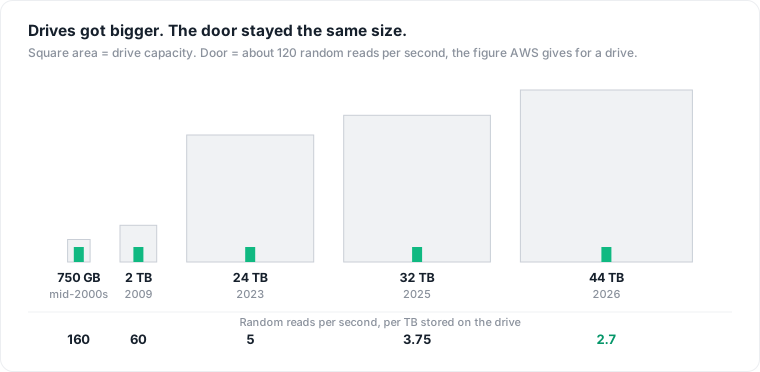
At 120 reads a second, a 750 GB drive gives 160 reads a second per TB. A 44 TB drive gives 2.7. Seagate's sheet for its 32 TB drive lists 170 reads at queue depth 16, so the exact figure moves with how you measure, but the direction does not. Reading a full 32 TB drive end to end takes at least 31 hours. A 2 TB drive from 2009 took at least 4.
So a TB that people read all day draws on a pool of reads that shrinks with every bigger drive. S3 handles this by spreading each customer's data across a very large number of drives, so that the load evens out. Warfield calls this managing heat. A TB nobody reads has no such need: you can fill the drive and leave it.
There is a limit to this argument. S3 prices fell 85% from 2006 to 2016 with the same 120 reads a second, so drive physics cannot say why the cuts stopped in 2016. It explains why hot and cold storage are different products. The flat price is also a pricing choice.
Every tier is a mix of rent, tolls and waiting
So I put every tier from all three clouds on one chart: what you pay to keep a TB, against what you pay to read it.
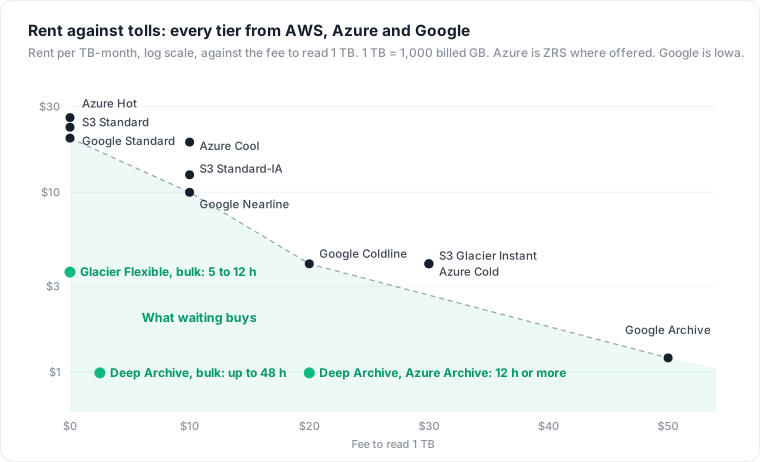
The tiers that read instantly line up: as rent falls, the toll rises. Google runs from Standard at $20 with free reads to Archive at $1.20, with a $50 toll and a 365-day minimum. AWS and Azure sit a little above that line.
The green dots are the tiers that make you wait, and they all sit below it. Glacier Flexible Retrieval is the clearest case: bulk restores are free and take 5 to 12 hours. That is the same $0 toll as S3 Standard at about a sixth of the rent. For large files kept 90 days or more, the main thing you give up is time.
Azure shows the same trade from the other side. Archive's high-priority restore lists at $100 per TB against $20 for standard. Microsoft says that can mean under an hour instead of up to 15, for blobs under 10 GB. Bulk reads take longer.
On large files, the fees cold tiers are famous for are small
Cold storage has a bad name. In 2016 Marko Karppinen paid about $150 to download 60 GB from Glacier when he expected 86 cents. That came from a peak-rate formula AWS has since replaced.
Today a full Deep Archive restore costs $20 per TB. Moving that TB off S3 Standard saves $22 a month. Usage AI has made the same point, and the chart shows how far it goes.
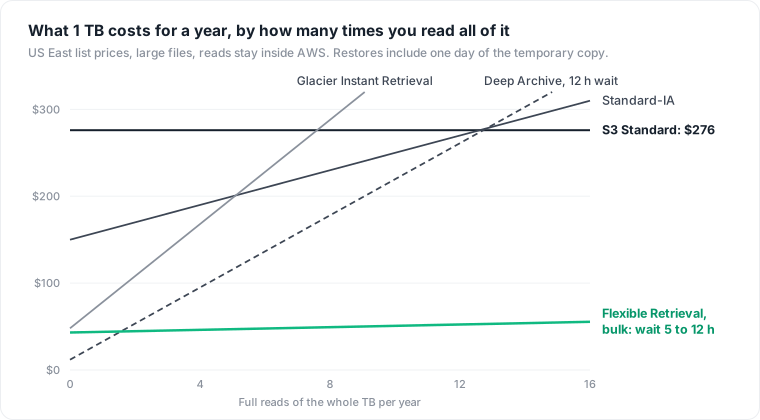
You could read all of your Deep Archive data about 13 times a year before it cost more than S3 Standard. Flexible Retrieval with bulk restores stays near $50 a year up to about 16 full reads.
The minimum storage period is small too. Delete a Deep Archive object on day one and you still pay for 180 days, which is about $6 per TB, or 8 days of S3 Standard rent.
So for large files, the real price of cold storage is time. Twelve hours is fine for an audit and useless during an outage.
Small files are what break cold storage
Every sum above assumed large files. AWS also charges per object: in Deep Archive, $0.05 per 1,000 objects going in, $0.10 per 1,000 for a standard restore, and 40 KB of billed overhead on each object.
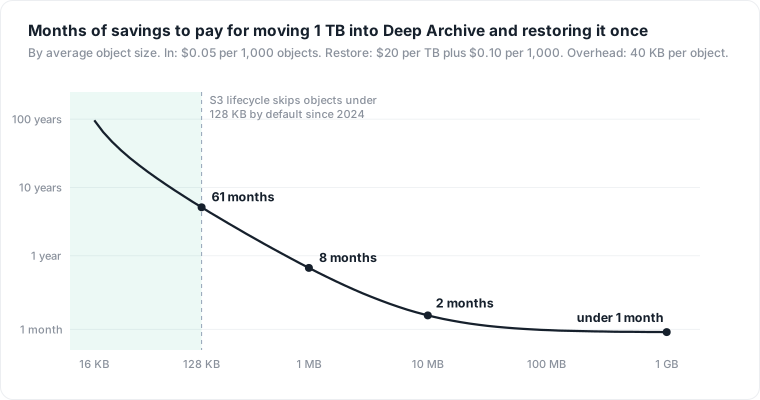
For 1 GB files, these fees are rounding errors. For 128 KB files, one move in plus one restore costs about $1,250 per TB, or 61 months of savings. Wellar priced the move in alone at about 20 months. Below about 10 KB per object, the overhead cancels the saving for good.
AWS added a guard in September 2024: lifecycle rules skip objects under 128 KB by default, on new or edited rules only. Older rules and direct uploads get no such protection, and the cost above 128 KB is still real.
Real numbers show the scale:
- A Reddit user with 60 TB of files around 70 KB was quoted about $265 a month in storage and about $46,000 upfront by the AWS calculator.
- Canva paid over $1.6 million to move nearly 80 billion objects to Instant Retrieval, for about $300,000 a month in savings. It started with buckets averaging 400 KB or more, which paid back within six months. Moving everything would have cost over $6 million.
- Rewind worked out that Intelligent-Tiering on its 80 billion objects would cost about $200,000 a month in monitoring alone, and did not use it.
The fix comes before the move: pack small files into larger ones. In a data lake that usually means compaction, which also cuts the dead bytes you pay for anyway.
For large files, leaving is the biggest fee on the list
Egress has nothing to do with cold tiers. Sending data from any S3 class to the internet costs $90 per TB for the first 10 TB a month, after 100 GB free, falling to $50 above 150 TB. Azure lists $87 and Google $120.
What changes by tier is how that fee compares with the rent.
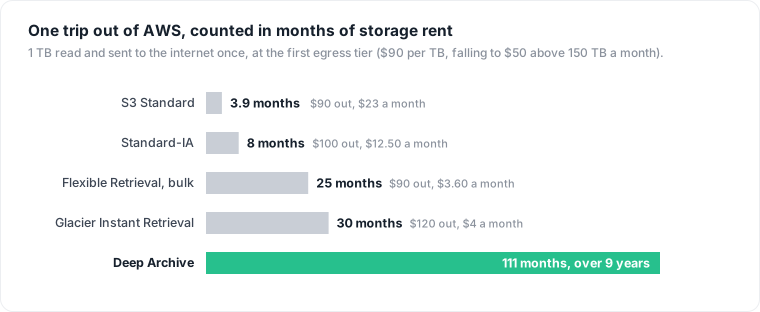
This is where the line about paying $1 to store and $100 to get back holds. Taking 1 TB out of Deep Archive costs $110, which is over nine years of its rent. On S3 Standard, the same trip is under four months.
Reads by AWS services in the same region skip the egress fee, so an archive you restore and process in place pays only the restore. R2 charges no egress and B2 includes up to three times your stored data, which is the other side of their prices.
Three questions decide the tier
How long can this data wait? If the answer is hours, look at Flexible Retrieval and Deep Archive first. If it must read instantly, you are choosing along the curve, and how often you read decides where.
How big are the files? Under about 1 MB, pack them first. S3 Inventory lists every object, so you can size this before moving anything.
Will it ever leave the region? If a migration is likely, price the exit now.
This query reads an S3 Inventory table in Athena and prices a move from Standard to Deep Archive by file size, in US East:
SELECT
  CASE
    WHEN size < 131072 THEN '1. under 128 KB'
    WHEN size < 1048576 THEN '2. 128 KB to 1 MB'
    WHEN size < 104857600 THEN '3. 1 MB to 100 MB'
    ELSE '4. over 100 MB'
  END AS size_band,
  COUNT(*) AS objects,
  ROUND(CAST(SUM(size) AS double) / 1073741824 / 1000, 3) AS tb,
  ROUND(COUNT(*) * 0.00005, 2) AS move_in_usd,
  ROUND(COUNT(*) * 0.0001 + CAST(SUM(size) AS double) / 1073741824 * 0.02, 2) AS one_restore_usd,
  ROUND(CAST(SUM(size) AS double) / 1073741824 * 0.02201 - COUNT(*) * 0.0000002057, 2) AS saving_per_month_usd
FROM s3_inventory
WHERE storage_class = 'STANDARD'
GROUP BY 1
ORDER BY 1;
Divide move_in_usd by saving_per_month_usd for the payback in months. The saving uses the first 50 TB rate, so it runs about 9% high above 500 TB. I tested this on sample rows in SQLite, not on a live Inventory table in Athena, so adjust the table and column names to yours.
What this analysis does not cover
These are list prices in US regions, with no discounts. Enterprise agreements can change every ratio here. The $1 is my estimate from one company's filings, and AWS's own costs, margins and media are not public. Drive prices came from trackers that disagree with each other, and one showed some drives well above these figures by October. Drive TB are decimal, about 7% smaller than a billed TB. Azure figures use ZRS where offered, and Azure Archive does not support it. The chart of full reads assumes large files and ignores request fees. The 120 reads a second is AWS's round figure, and real workloads vary.
Where Datapace fits
The query shows what a move would cost for one bucket. The harder question is which of your data can wait, and who would notice. Datapace is building one map of your data estate with usage and cost attached, and agents that propose changes as pull requests your team reviews and merges. To see how list prices moved over ten years, read the price history post.
Sources
- AWS, Price List API: S3 index of 72 versions, S3, Glacier Deep Archive data transfer and Amazon RDS, October 2026, read November 2026.
- AWS, S3 price history: launch, 2006, November 2010, February 2012, December 2012, February 2014, April 2014 and December 2016.
- AWS, tier launches: Glacier, 2012, Standard-IA, 2015, Deep Archive, 2019, Glacier Instant Retrieval, 2021, Flexible Retrieval price cut, 2021, Express One Zone, 2023 and its 2025 cut.
- AWS, S3 docs: storage classes, restore options, lifecycle transitions, Intelligent-Tiering, Glacier storage classes, S3 FAQ on billed GB, S3 pricing and the 128 KB lifecycle default.
- Andy Warfield, Building and operating a pretty big storage system called S3, July 2023. AWS, Twenty years of Amazon S3, March 2026.
- James Hamilton, comment on Glacier engineering, January 2017. Tech Monitor on Deep Archive media, April 2019.
- Microsoft, Azure Retail Prices API, read November 2026, access tiers and archive rehydration.
- Google Cloud, Cloud Storage pricing and storage classes, read November 2026.
- Seagate, FY2026 10-K and September 2026 10-Q, per TB ratios derived. Data sheets: Exos M, Exos X24 and Constellation ES. Mozaic 4+ announcement, March 2026.
- Drive prices: ListOfDisks, April 2026, eRacks, September 2026, and HDDHunt, October 2026. LTO-9: CDW listing, read November 2026.
- Backblaze, FY2025 10-K, Q2 2026 10-Q, Q2 2026 earnings call summary, durability, pricing and pricing update.
- Other providers: Cloudflare R2 and Wasabi pricing notice.
- Amazon, 2025 10-K and 2017 10-K.
- US Energy Information Administration, electricity prices. AWS, sustainability.
- Erasure coding, secondary only: 2 Minute Streaming on S3, September 2025.
- Bills and case studies: Marko Karppinen, January 2016, Reddit r/aws, November 2024, Canva, May 2023, Rewind, June 2022, Wellar, October 2026, and Usage AI, October 2026.