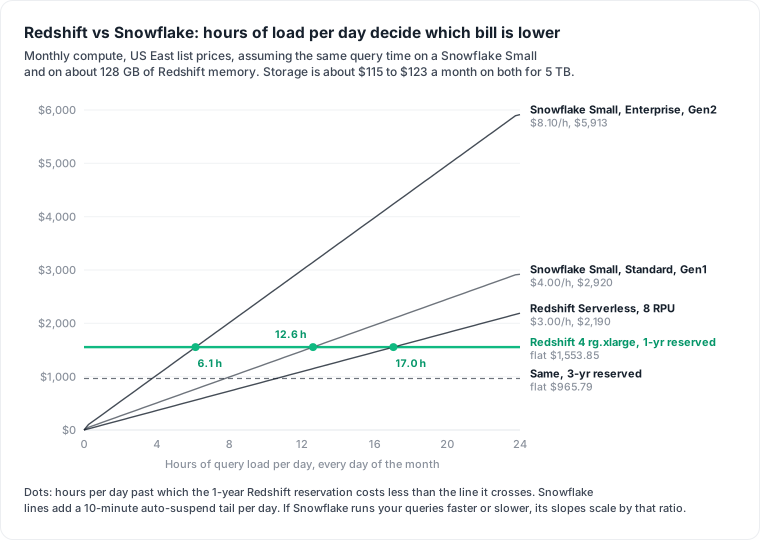
TL;DR. Redshift vs Snowflake on cost comes down to two numbers: how many hours a day your warehouse is busy, and how fast each engine runs your queries. At US East list prices, a 1-year reserved Redshift cluster with 128 GiB of memory costs a flat $1,553.85 a month. In our model, it beats a Snowflake Small past 6.1 hours of load a day on Enterprise with a Gen2 warehouse, and past 12.6 hours on Standard with Gen1. Snowflake's edition and warehouse generation alone move its hourly rate from $4.00 to $8.10, and new Snowflake warehouses default to Gen2 where it is available. Snowflake publishes no committed-use rate to answer a reservation.
Most "Redshift vs Snowflake" pages compare architecture and list rates side by side, and stop before a bill. This post prices one workload on both from each vendor's price list, read on November 2, 2026, and shows where the order flips as load grows from 2 to 24 hours a day. It is a list-price model, not a benchmark. No query ran, and the one assumption that decides everything (how fast each engine is on your queries) is stated, varied and left for you to measure.
Redshift vs Snowflake: busy hours and query time decide which is cheaper
The two warehouses bill compute in different shapes. Redshift gives you a flat price for owned capacity and a metered price for Serverless; Snowflake gives you only the meter. The cover photo is the same choice: a taxi bills while it drives you, a car you lease costs the same whether it moves or not.
| Option, US East | How compute bills | Published commitment discount |
|---|---|---|
| Redshift provisioned (RG, RA3) | Per node-hour while the cluster runs | Yes: reserved nodes, 1 or 3 years |
| Redshift Serverless | RPU-seconds while queries run, 60-second minimum | Yes: Serverless reservations |
| Snowflake | Credits per second while a warehouse runs, 60-second minimum per start | No: a discount set in your order form |
AWS says Serverless bills "on a per-second basis, with no charges during idle periods" and that "The minimum charge is for 60 seconds of resource usage". Snowflake's Service Consumption Table (effective October 29, 2026) says that when a warehouse starts, "a minimum of one minute's worth of Platform Credits will be consumed", then per second. For capacity contracts it applies "the Platform Credit Discount in your Order Form", a number it does not publish.
One workload, priced on both from the October 2026 price lists
Consider a hypothetical team with 5 TB of compressed data, one warehouse and a few concurrent users, so one cluster is enough. Its query load arrives as one block of hours each day, every day of the month. The rates, all US East on demand:
| Option | Hourly compute | Source |
|---|---|---|
| Redshift, 4 × rg.xlarge (128 GiB), on demand | 4 × $0.7602 = $3.04 | AWS price list |
| Same, 1-year reserved, no upfront | 4 × $0.53214, so $1,553.85 a month | AWS price list |
| Same, 3-year reserved, no upfront | 4 × $0.33075, so $965.79 a month | AWS price list |
| Redshift Serverless, 8 RPU (128 GB) | 8 × $0.375 = $3.00 | AWS price list |
| Snowflake Small, Standard, Gen1 | 2 credits × $2.00 = $4.00 | Snowflake consumption table |
| Snowflake Small, Enterprise, Gen2 | 2.7 credits × $3.00 = $8.10 | Snowflake consumption table |
Redshift rates come from AWS's price list for Amazon Redshift in US East (publication of September 11, 2026). One RPU "provides 16 GB of memory", so 8 RPUs (128 GB) come close to four rg.xlarge nodes, which have 32 GiB each (128 GiB, about 137 GB) in AWS's node type table. Monthly figures use 730 hours.
The equivalence is the assumption to watch. Snowflake sizes warehouses in credits per hour, and neither its consumption table nor its warehouse pages we read give a memory figure to match against. So the model assumes the workload finishes in the same time on a Snowflake Small and on either Redshift option. Snowflake lines also carry the default 10-minute auto-suspend tail once a day, which adds about $20 a month on the $4.00 warehouse.
Snowflake's edition and the Gen2 default double its hourly rate
The same Snowflake Small has four list prices in US East:
| Snowflake Small | Credits per hour (AWS) | Credit price | Per hour |
|---|---|---|---|
| Standard, Gen1 | 2 | $2.00 | $4.00 |
| Standard, Gen2 | 2.7 | $2.00 | $5.40 |
| Enterprise, Gen1 | 2 | $3.00 | $6.00 |
| Enterprise, Gen2 | 2.7 | $3.00 | $8.10 |
Two settings move the rate 2.03 times, more than the gap between Snowflake and Redshift Serverless. Gen2 burns 1.35 credits per hour per X-Small on AWS against 1 for Gen1, per Table 1(b) of the consumption table. And Snowflake's Gen2 page says: "If you create a standard warehouse without specifying the GENERATION clause, Snowflake defaults to GENERATION = '2' (Gen2), unless Gen2 isn't available in your region." The CREATE WAREHOUSE reference adds that the default also depends on "whether your organization was created after Gen2 support became available in that region". Check SHOW WAREHOUSES before you trust a quote built on Gen1 rates.
Snowflake says that with Gen2 "you can expect the majority of queries to finish faster", and also: "Conduct tests to verify how much this feature improves your costs, performance, or both." At 1.35 times the credits, a Gen2 query costs less only if it finishes in under 74% of its Gen1 time.
Edition is often not a free choice either. Multi-cluster warehouses are an "Enterprise Edition Feature", so a Standard account that outgrows one cluster's concurrency has to move to Enterprise, which raises every credit it uses by 50% ($2.00 to $3.00), and each running cluster then bills its own credits.
When Redshift wins and when Snowflake wins
Each crossing is the reserved monthly price divided by the option's hourly rate and 30.4 days, minus Snowflake's 10-minute daily tail:
| Hours of load per day where Redshift reserved becomes cheaper | vs 1-year reserved ($1,553.85) | vs 3-year reserved ($965.79) |
|---|---|---|
| Redshift Serverless, $3.00/h | 17.0 | 10.6 |
| Snowflake Small, Standard Gen1, $4.00/h | 12.6 | 7.8 |
| Snowflake Small, Standard Gen2, $5.40/h | 9.3 | 5.7 |
| Snowflake Small, Enterprise Gen1, $6.00/h | 8.4 | 5.1 |
| Snowflake Small, Enterprise Gen2, $8.10/h | 6.1 | 3.8 |
Steady load that runs most of the day belongs on reserved Redshift. At 24 hours a day, the Snowflake Small on Standard Gen1 costs $2,920 a month, and it would need a 46.8% contract discount to match the 1-year reservation; on Enterprise Gen2 ($5,913), a 73.7% discount. Snowflake publishes neither number, so ask for it in writing before you compare.
Bursty load that runs a few hours a day is where Snowflake and Serverless compete. At 8 hours a day, Serverless costs $730, the 3-year reservation $965.79 and the Snowflake Small on Standard Gen1 $993.61. Under equal speed, Serverless is always cheaper per busy hour than a Snowflake Small. That is why speed is the real question:
| Snowflake option | Per hour | To tie per busy hour, must finish in this share of the Serverless time |
|---|---|---|
| X-Small, Standard, Gen1 | $2.00 | 150% (can run 1.5 times slower) |
| Small, Standard, Gen1 | $4.00 | 75% |
| Small, Enterprise, Gen1 | $6.00 | 50% |
| Small, Enterprise, Gen2 | $8.10 | 37% |
If your queries run as fast on a Snowflake X-Small on Standard Gen1 as on 8 Redshift RPUs, Snowflake wins every bursty row of this model; the same X-Small on Enterprise Gen1 ($3.00) only ties. If they need a Small on Enterprise Gen2, Snowflake has to run them 2.7 times faster. No price list answers which of these rows you are on.
For short query bursts with gaps between them, the idle timeout matters more than the rate: at Snowflake's 10-minute default, 75% of billed hours ran no query in our data warehouse cost model, while Serverless billed the busy minutes only.
The costs a rate comparison leaves out
- Storage is close to a tie. Snowflake lists $23.00 per TB-month on demand in US East, $115 for our 5 TB. Redshift managed storage is $0.024 per GB-month, $122.88 for 5,120 GB. Snowflake also bills as storage the history kept for Time Travel (up to 1 day on Standard, up to 90 on Enterprise, per its editions page) and for Fail-safe, "a (non-configurable) 7-day period", so tables rebuilt every night can bill several times their active size.
- Snowflake cloud services are free up to a point. Snowflake charges 4.4 credits per hour of cloud services use, but "only if the daily consumption of cloud services exceeds 10% of the daily usage of virtual warehouses". Check the adjusted figure on days with many short queries on a small warehouse.
- Redshift concurrency scaling has a free allowance. "Each cluster earns up to one hour of free Concurrency Scaling credits per day"; beyond it, scaling bills per second.
- Data lake scans depend on the node type. RA3 clusters use Spectrum, billed at $5.00 per TB scanned in the price list, while AWS says "Spectrum is not required for Redshift RG instances" and Serverless bills S3 queries as RPU-hours.
- Moving data out has its own rates. Snowflake lists $0 per TB within the same AWS Region, $20 to another AWS Region and $90 to the internet or another cloud from US East. Redshift charges nothing between Redshift and S3 in the same Region "for backup, restore, load, and unload operations", and standard AWS rates otherwise.
Switching costs: price the parallel run, not only the destination
If both sit in the same AWS Region, moving the data is the cheap part: unloading Redshift to S3 is free in-Region. The expensive parts have no price list. For the length of the migration you pay both warehouses at once, and engineers rewrite SQL, stored procedures, scheduled jobs and BI connections. We have no measured figure for that work and will not invent one. Put your own estimate of migration weeks next to the monthly saving before the saving decides the move.
The strongest case for Snowflake is not in this table: the engineer time each platform takes to run. If one needs less tuning for your workload, the hours saved can outweigh a compute gap, and in our data warehouse cost model one engineer's wage was 76% of the whole platform's monthly cost, and the warehouse 16%. That argues for measuring those hours too, not for skipping the compute math. On the Redshift side, AWS says Serverless "automatically manages capacity by starting up, shutting down, and scaling", so running Redshift no longer means managing nodes.
What to measure before you choose
- Hours of query load per day. On Redshift Serverless, sum
charged_secondsin SYS_SERVERLESS_USAGE, "the accumulated compute unit (RPU) seconds charged", and divide by your base RPUs times 3,600. The view keeps 7 days, so copy it daily. On Snowflake, WAREHOUSE_METERING_HISTORY givesCREDITS_USED_COMPUTE, which includes idle time before suspend, andCREDITS_ATTRIBUTED_COMPUTE_QUERIES, which does not; divide each by the warehouse's credits per hour. - The same queries on both engines. New Redshift Serverless users get a "$300 credit with a 90-day expiration", and a Snowflake trial "continues for 30 days" or until its free usage balance runs out. Replay one representative day of queries on each and compare
elapsed_timein SYS_QUERY_HISTORY (microseconds) withTOTAL_ELAPSED_TIMEin QUERY_HISTORY (milliseconds). Pin the Snowflake warehouse generation first. - Apply the formula. Monthly cost on a meter = hours per day × 30.4 × hourly rate × the measured time ratio. Compare it with the reserved monthly price and with any Snowflake discount you have in writing, then add storage.
Here is a Snowflake query for step 1, assuming a Small on Gen1 (2 credits per hour); use 2.7 for Gen2:
SELECT warehouse_name,
       DATE_TRUNC('day', start_time)                AS day,
       SUM(credits_used_compute) / 2                AS running_hours,
       SUM(credits_attributed_compute_queries) / 2  AS query_hours
FROM snowflake.account_usage.warehouse_metering_history
WHERE start_time >= DATEADD('day', -30, CURRENT_DATE())
GROUP BY 1, 2
ORDER BY 1, 2;
The limits of this model: US East list prices only, read on November 2, 2026; one warehouse at one size on each side; load in one daily block; no measured speed. We did not price Snowflake Business Critical, RA3 reservations, Serverless reservations or multi-cluster scaling, or benchmark either engine. For the full Redshift price list and its own break-even, see Redshift pricing.
Datapace is building one map of your data estate with usage and cost attached, and agents that propose changes as pull requests your team reviews and merges. Busy hours per warehouse are exactly the number this decision needs. To find the idle hours inside your current Snowflake bill first, read Snowflake cost optimization.
Sources
- AWS, Amazon Redshift price list for US East, published September 11, 2026, read November 2, 2026 (RG node and reserved rates, Serverless RPU rate, managed storage, data scanned).
- AWS, Amazon Redshift pricing (Serverless idle billing, concurrency scaling credits, Spectrum and RG, data transfer, free trial).
- AWS, Amazon Redshift provisioned clusters (node memory, RA3 and Spectrum), Billing for Amazon Redshift Serverless and Compute capacity for Amazon Redshift Serverless.
- AWS, SYS_SERVERLESS_USAGE and SYS_QUERY_HISTORY.
- Snowflake, Service Consumption Table, effective October 29, 2026, read November 2, 2026 (Tables 1(a), 1(b), 2(a), 3(a), 4(a), cloud services, minimum billing, capacity discount).
- Snowflake, Gen2 standard warehouses and CREATE WAREHOUSE.
- Snowflake, Multi-cluster warehouses and Snowflake editions.
- Snowflake, Understanding compute cost, Understanding storage cost, Fail-safe and Trial accounts.
- Snowflake, WAREHOUSE_METERING_HISTORY and QUERY_HISTORY.