TL;DR. Snowflake pricing is credits times a credit price. In AWS US East, a Platform Credit costs $2.00 on Standard, $3.00 on Enterprise and $4.00 on Business Critical; the same credit costs up to about 63% more in other regions. AI features now bill in separate AI Credits at $2.00 ($2.20 with regional routing), whatever the edition or region. On a hypothetical small team's month on Enterprise, warehouse compute is 86% of the bill, storage 3%, and more than half of the compute credits pay for idle warehouses. A capacity contract's Platform Credit discount does not reach AI Credits, and on Snowflake's illustrative tiers a contract under $1.2M a year pays the on-demand storage rate.
Snowflake pricing comes down to how many credits you burn and what one credit costs, and the price depends on your edition, your cloud region and whether the credit is a Platform Credit or an AI Credit. Storage barely moves the bill: in the month we price below, it is $115 of a $3,946 Enterprise bill. The numbers come from Snowflake's Service Consumption Table, effective November 4, 2026, read November 5.
Snowflake price per credit and per warehouse hour, on one screen
| Edition | Price per credit, AWS US East, on demand | X-Small hour, Gen1 | X-Small hour, Gen2 (AWS) | Medium hour, Gen2 (AWS) |
|---|---|---|---|---|
| Standard | $2.00 | $2.00 | $2.70 | $10.80 |
| Enterprise | $3.00 | $3.00 | $4.05 | $16.20 |
| Business Critical | $4.00 | $4.00 | $5.40 | $21.60 |
| Virtual Private Snowflake | $6.00 | $6.00 | $8.10 | $32.40 |
Per hour, each warehouse size burns twice the credits of the size below it:
| Size | XS | S | M | L | XL | 2XL | 3XL | 4XL | 5XL | 6XL |
|---|---|---|---|---|---|---|---|---|---|---|
| Gen1 credits per hour | 1 | 2 | 4 | 8 | 16 | 32 | 64 | 128 | 256 | 512 |
| Gen2 on AWS and GCP | 1.35 | 2.7 | 5.4 | 10.8 | 21.6 | 43.2 | 86.4 | 172.8 | n/a | n/a |
| Gen2 on Azure | 1.25 | 2.5 | 5 | 10 | 20 | 40 | 80 | 160 | n/a | n/a |
Both tables come from Tables 1(a), 1(b) and 2(a) of the consumption table. VPS also carries "a separate annual fee per deployment", set in the order form.
How much does a Snowflake credit cost?
A Platform Credit costs what your edition and region say, and nothing on Snowflake's pricing page shows it until you pick a platform and a region. The consumption table lists every region. For the same Enterprise credit:
| AWS region | Enterprise credit | Storage, TB-month | Same month as below |
|---|---|---|---|
| US East (Northern Virginia) | $3.00 | $23.00 | $3,946.03 |
| Canada Central | $3.50 | $25.00 | $4,534.54 (+14.9%) |
| EU Frankfurt | $3.90 | $24.50 | $4,994.84 (+26.6%) |
| Europe (London) | $4.00 | $24.00 | $5,108.04 (+29.4%) |
| AP Northeast 1 (Tokyo) | $4.30 | $25.00 | $5,460.14 (+38.4%) |
| EU (Zurich), Gen1 only | $4.65 | $26.95 | $4,517.51 (+14.5%) |
| South America East 1 (São Paulo) | $4.65 | $40.50 | $5,942.60 (+50.6%) |
Zurich looks cheap because Snowflake's Gen2 page says Gen2 warehouses "aren't available" there, so its row is priced at Gen1 rates (834 credits instead of 1,125.9). The widest Standard spread in the table runs from $2.00 (US East, Oregon, Ohio, Mumbai and several Azure and GCP regions) to $3.25 in GCP Middle East Central 2 (Dammam), 62.5% more. Region moves the bill through the credit price: São Paulo storage costs 76% more than US East, yet the month above rises 50.6%, almost all of it from credits. The region is usually chosen for latency or data residency, so treat it as fixed and price it once, before the edition debate.
Edition is the decision you can still change, and it is often forced. Multi-cluster warehouses, Time Travel beyond 1 day (up to 90), search optimization and materialized views are Enterprise features. Moving from Standard to Enterprise for one of them raises every Platform Credit by 50% in US East (55.6% in Canada Central), including the ones your nightly jobs spend.
What a Snowflake warehouse costs per hour, and why new ones cost 35% more on AWS
A running warehouse bills credits per second, with "a minimum of one minute's worth of Platform Credits" each time it starts or resumes, per the consumption table. Interactive warehouses carry a 60-minute minimum per start instead. When a warehouse is suspended, it bills nothing.
The rate depends on the warehouse generation. The CREATE WAREHOUSE reference sets GENERATION to '2' by default, except where Gen2 "isn't available in your region", per the Gen2 page. Gen2 burns 1.35 credits an hour per X-Small on AWS and GCP, and 1.25 on Azure. A team that creates a Medium warehouse with default settings on AWS Enterprise pays $16.20 an hour, not the $12.00 a Gen1 rate table gives. Snowflake's Gen2 page says "you can expect the majority of queries to finish faster"; on AWS and GCP, a Gen2 query costs less only if it runs in under 74% of its Gen1 time (80% on Azure). Our Snowflake warehouse size post tests that kind of break-even with GitLab's published run times.
The other default that sets the hourly bill is AUTO_SUSPEND: "600 (the warehouse suspends automatically after 10 minutes of inactivity)". Every burst of queries pays up to 10 more minutes at full rate.
What changed in Snowflake pricing in 2026: AI Credits
AI features now bill in a second currency. Snowflake's AI pricing page says AI Credits "provide a flat pricing model regardless of edition (Standard, Enterprise, Business Critical, or VPS) or region": $2.00 per AI Credit with global routing, $2.20 when CORTEX_ENABLED_CROSS_REGION keeps requests in the account's region or geography. Cortex Code, Cortex Agents, Snowflake CoWork, the Cortex REST API, AI Functions, Cortex Search and AI Parse Doc use AI Credits; Cortex Fine-tuning and the standalone Cortex Analyst API stay on Platform Credits. An April 6, 2026 release note split Cortex Agents, Cortex Code and Snowflake CoWork out of the AI_SERVICES service type "as part of the transition to AI Credits".
Two consequences for the bill:
- An AI Credit costs less than a Platform Credit on the expensive editions. On Business Critical in US East, a Platform Credit costs $4.00 and an AI Credit $2.00, half the rate. On Standard in US East, the two prices match.
- Your negotiated discount stops at AI. The consumption table says "the Platform Credit Discount does not apply to AI Credits", and the AI pricing page repeats that "capacity discounts don't apply to AI Credits". AI Credits have their own discount tiers, and the first one, contracts under $1,200,000 a year, pays the on-demand rate ($2.00 global, $2.20 regional).
Rates are per million tokens and vary by model. In Table 6(a), AI_COMPLETE on claude-haiku-4-5 costs 0.60 AI Credits per million input tokens and 3.00 per million output tokens; on claude-opus-4-5, 3.00 and 15.00.
Snowflake storage pricing: capacity vs on demand
Storage bills "based on the average terabytes per month" of compressed data, $23.00 per TB on demand in US East (Table 3(a)). The storage cost guide says "Database costs also include historical data maintained for Time Travel", and Fail-safe adds "a (non-configurable) 7-day period" for permanent tables. Our Snowflake cost optimization post prices those retained bytes table by table.
On Snowflake's own tiers, a capacity contract does not cut storage until it passes $1.2M a year. Table 3(a) prices capacity storage by annual contract value, in ranges it calls "for illustrative purposes only" (your order form sets your tier): Tier 1, from $0 to $1,199,999, is $23.00 per TB in US East, the on-demand rate. Tier 2 drops to $21.47, and Tier 7 ($40M and up) to $13.80. A team spending under $100,000 a month ($1.2M a year) sits in Tier 1. Older guides that still rank, such as RudderStack's (February 2024) and SELECT's (January 2025), quote $40 per TB on demand against $23 on capacity; the November 2026 table lists $23 for both below $1.2M.
Serverless features and cloud services: the smaller compute lines
Serverless features run on Snowflake-managed compute, billed at "one Platform Credit per Compute-Hour, multiplied by the applicable feature multiplier in Table 5". The multipliers on compute: automatic clustering (classic) 2, search optimization 2, materialized view maintenance 2, serverless tasks 0.9, query acceleration 1. Snowpipe bills per volume instead: 0.0037 Platform Credits per GB, measured uncompressed for text files such as CSV and JSON.
Cloud services cost 4.4 credits per hour of use, but a day's cloud services are free if they stay at or under 10% of that day's warehouse credits. The compute cost guide notes that serverless compute "does not factor into the 10% adjustment".
What a month of Snowflake costs for a small team
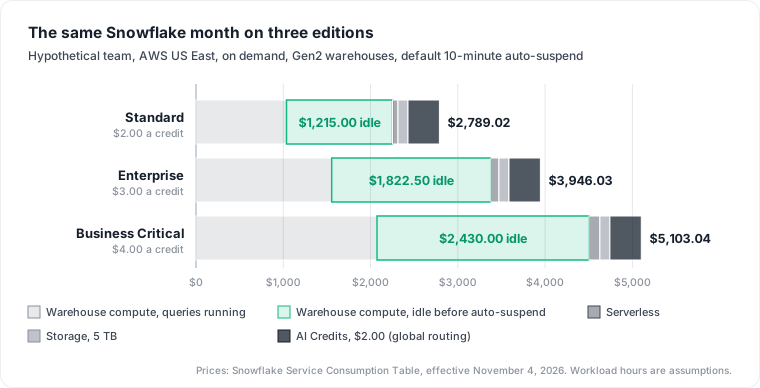
Consider a hypothetical team on AWS US East, on demand, warehouses created with default settings (Gen2, 10-minute auto-suspend):
- Transform: a Small warehouse runs a 2-hour nightly job, 30 nights, plus the 10-minute idle tail: 65 billed hours × 2.7 = 175.5 credits.
- BI: a Medium warehouse stays up 8 hours each of 22 business days because dashboards query it every few minutes; we assume 3 of those hours run queries. 176 billed hours × 5.4 = 950.4 credits.
- Serverless: Snowpipe loads 300 GB of JSON (300 × 0.0037 = 1.11 credits), and automatic clustering on one table bills 30 credits (our assumption): 31.11 credits.
- Storage: 5 TB on average, Time Travel and Fail-safe included: $115.00.
- AI: analysts send 200 million input and 20 million output tokens to
claude-haiku-4-5throughAI_COMPLETE: 120 + 60 = 180 AI Credits at the $2.00 global-routing rate, $360.00 (global routing is the default for organizations created after March 9, 2026; older accounts inherit a regional setting such asAWS_USand pay $2.20, or $396.00). - Cloud services: we assume they stay under the 10% line, so $0.
| Line | Credits | Standard | Enterprise | Business Critical |
|---|---|---|---|---|
| Warehouse compute | 1,125.9 | $2,251.80 | $3,377.70 | $4,503.60 |
| of which idle | 607.5 | $1,215.00 | $1,822.50 | $2,430.00 |
| Serverless | 31.11 | $62.22 | $93.33 | $124.44 |
| Storage, 5 TB | n/a | $115.00 | $115.00 | $115.00 |
| AI, 180 AI Credits | 180 | $360.00 | $360.00 | $360.00 |
| Cloud services | 0 | $0 | $0 | $0 |
| Total | $2,789.02 | $3,946.03 | $5,103.04 |
The idle row adds 5 BI hours a day (110 hours × 5.4 = 594 credits) and the nightly tail (5 hours × 2.7 = 13.5 credits). That is 54% of the compute credits, and it costs more than the storage, serverless and AI lines together on every edition. Moving the BI warehouse to a 60-second auto-suspend is the largest single change in this bill; data warehouse cost models how far the timeout moves billed hours on a bursty workload.
The strongest objection is that a short auto-suspend drops the warehouse cache, and Snowflake warns of "slower initial performance for some queries after the warehouse is resumed". That is real, and it is why the idle share should be measured, not guessed: WAREHOUSE_METERING_HISTORY gives CREDITS_USED_COMPUTE, all the credits the warehouse used, next to CREDITS_ATTRIBUTED_COMPUTE_QUERIES, which "doesn't include warehouse idle time usage". The difference is your idle row.
New Gen2 warehouses also get Query Acceleration enabled by default, per the Gen2 page, and any acceleration it bills is not in this model. It also leaves out data transfer (Snowflake lists $0 within the same AWS region and $20 per TB to another AWS region from US East), capacity discounts, which Snowflake does not publish, and anything a contract changes. Our run times are assumptions, not a measurement of any real account.
Read your own Snowflake bill in this order
- Find your rate: edition and region from your contract, then
SHOW WAREHOUSESfor each warehouse's generation. - Split compute into busy and idle with the two
WAREHOUSE_METERING_HISTORYcolumns above. - Check what your discount touches: the Platform Credit Discount covers Platform Credits only; AI Credits and storage follow their own tiers, and the first tier of each is the on-demand price.
- Attribute what is left to teams and jobs, with the queries in Snowflake cost optimization.
Datapace is building one map of your data estate with usage and cost attached, so each Snowflake credit traces back to the query, team and data product it served, with agents that propose changes as pull requests your team reviews and merges. If your Snowflake bill grew and nobody can say which warehouse or team drove it, book a call.
Sources
- Snowflake, Service Consumption Table, effective November 4, 2026, read November 5, 2026 (Tables 1(a), 1(b), 2(a), 2(b), 3(a), 4(a), 5, 6(a); minimum billing, cloud services, serverless, AI Credits).
- Snowflake, Snowflake AI pricing.
- Snowflake, AI_SERVICES billing breakout for implemented AI Credits services, April 6, 2026.
- Snowflake, Pricing options, read November 5, 2026.
- Snowflake, Snowflake editions.
- Snowflake, CREATE WAREHOUSE and Gen2 warehouses.
- Snowflake, Understanding compute cost and Understanding storage cost.
- Snowflake, Warehouse considerations and WAREHOUSE_METERING_HISTORY.