
TL;DR. Openflow vs Fivetran pricing comes down to two different meters: Fivetran bills rows changed per connection, Openflow bills the hours its runtimes run. For one modelled estate of six sources and about 45 million monthly active rows, at list prices read November 16, 2026, Fivetran Standard came to $4,378.04 a month and Openflow on a Snowflake Deployment to $1,224.08, including the same $438 of warehouse load credits on both and $302 for the one source Openflow has no connector for. Openflow's line does not move with rows, but it has a floor: $481.80 a month on Enterprise for the smallest always-on deployment, billed whether anything syncs or not.
Fivetran prices each connection on a curve of monthly active rows (MAR). Snowflake Openflow prices compute: instances in a Snowflake compute pool, or vCPU-hours of runtimes in your own AWS account. Neither tool's own line item includes the warehouse credits spent merging the loaded rows; in the model below we hold that line equal for both tools.
Everything below is a model: the sources and volumes are invented, every rate is a list price. Fivetran rates come from its Service Consumption Table V.11, "Effective November 1, 2026". Snowflake rates come from its Service Consumption Table effective November 9, 2026, at the AWS US East (Northern Virginia) Enterprise price of $3.00 per Platform Credit.
How Fivetran and Openflow bill: rows changed vs runtime hours
| Meter | Fivetran (Standard) | Openflow, Snowflake Deployment | Openflow, BYOC |
|---|---|---|---|
| What the tool bills | MAR per connection: $495 per million up to 1M plus a $5 base, falling to $19.70 per million from 16M to 64M | Compute pool instances: CPU_X64_S 0.11, CPU_X64_SL 0.41, CPU_X64_L 0.83 credits an hour | 0.0225 credits per vCPU per hour of active runtimes |
| Fixed part | None for a connection with no paid MAR | A management pool of one CPU_X64_S that runs as long as the deployment exists | EKS cluster and management nodes in your AWS account |
| Minimum billing | Per month | 5 minutes in Snowflake's cost guide; 60 seconds for Openflow compute in the consumption table | 60 seconds |
| Loading into Snowflake | Your warehouse | Snowpipe Streaming at 0.0037 credits per uncompressed GB, plus your warehouse for merges | Same as Snowflake Deployment |
Snowflake's Snowflake Deployment cost guide is blunt about the fixed part: the management pool "continues to run and incurs costs, even if there are no runtimes running." Runtime pools behave better: when all their runtimes stop, a pool "scales down to 0 nodes after 600 seconds (10 minutes)."
BYOC's rate looks cheaper and is not the whole bill. At $3.00 a credit, 0.0225 credits is $0.0675 per vCPU-hour. Snowflake's BYOC cost guide adds that "you directly pay your cloud provider" for compute, networking and storage, and its diagram puts the management node group on m7i.2xlarge instances.
The same six sources on both: $4,378 vs $1,224 a month
The estate reuses six of the seven connections priced in our Fivetran pricing model, so the MAR curve is not re-derived here:
| Source | MAR a month | Fivetran Standard | Openflow connector |
|---|---|---|---|
| Production Postgres (CDC) | 40,000,000 | $2,178.80 | PostgreSQL |
| Salesforce | 3,000,000 | $840.00 | Salesforce Bulk API |
| HubSpot | 1,200,000 | $534.00 | HubSpot |
| Stripe | 600,000 | $302.00 | None listed |
| Jira Cloud | 150,000 | $79.25 | Jira Cloud |
| Google Sheets | 2,000 | $5.99 | Google Sheets |
| Total | 44,952,000 | $3,940.04 | 5 of 6 |
Assumptions for the Openflow side, all stated so you can swap your own:
- Two Small runtimes, always on: one for the Postgres CDC connector, one shared by the four SaaS connectors. Forty million changed keys a month means at least 15 change events a second on average (about 30 at the two events per key assumed below), well under the "approximately 1,000 events per second" that Snowflake's CDC sizing guide calls a light workload.
- Two Small runtime nodes share one CPU_X64_S instance, the ratio in Snowflake's own example (four Small nodes on two instances). If yours do not pack, add 80.3 credits.
- Stripe stays on Fivetran, because Openflow's connector list has no Stripe connector on November 16, 2026.
- Load volume: two change events per key at 1 KiB each, about 90.8 GB a month into Snowpipe Streaming, and 20 GB of telemetry.
- Warehouse: a standard (Gen1) X-Small at 1 credit an hour, awake 4.8 hours a day for merges, 146 credits a month, on either tool.
- BYOC infrastructure: one m7i.2xlarge management node ($0.4032 an hour), one m7i.xlarge runtime node ($0.2016), the EKS cluster ($0.10), one NAT gateway ($0.045 an hour plus $0.045 per GB), us-east-1 on demand. The deployment agent's EC2 instance, the load balancer and EBS volumes are not priced, so the BYOC total is a floor.
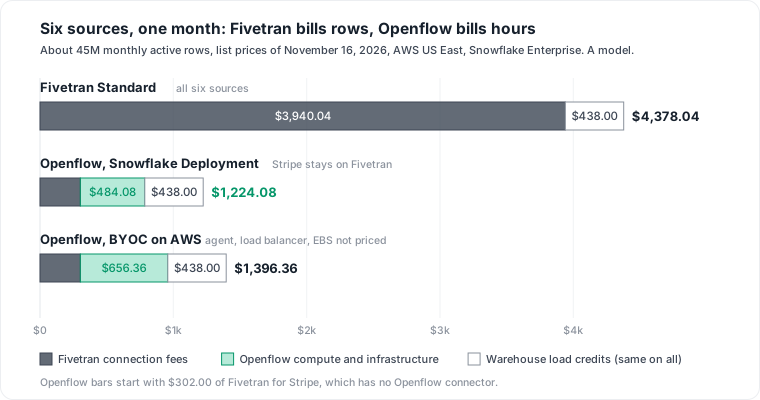
| Monthly line | Fivetran | Openflow, Snowflake Deployment | Openflow, BYOC |
|---|---|---|---|
| Fivetran connections | $3,940.04 | $302.00 (Stripe) | $302.00 (Stripe) |
| Openflow credits | $0 | $481.80 (160.6 credits) | $98.55 (32.85 credits) |
| AWS infrastructure | $0 | $0 | $555.53 |
| Snowpipe Streaming and telemetry | $0 | $2.28 | $2.28 |
| Warehouse load credits | $438.00 | $438.00 | $438.00 |
| Total | $4,378.04 | $1,224.08 | $1,396.36 |
The Snowflake Deployment line is 730 hours of the management instance plus 730 hours of one runtime instance, 0.11 credits each. The BYOC AWS line is $73.00 for EKS, $294.34 and $147.17 for the two nodes, $32.85 for the NAT gateway hours and $8.17 for 181.6 GB through it (the 90.8 GB load counted twice: in from the sources, out to Snowflake).
At list price Fivetran cost 3.58 times as much as the Openflow route, and BYOC cost $172.28 more than the Snowflake Deployment at this size, because the AWS nodes it needs cost more than the Snowflake compute pool they replace. The Postgres connection is 55.3% of the Fivetran connection fees; on Openflow it has one Small runtime to itself, which would cost the same at a tenth of the rows.
What neither price list shows
The warehouse merge. Fivetran's Snowflake setup guide says of a dedicated warehouse: "You will have to pay the cost of running the warehouse." Openflow's PostgreSQL connector has a merge schedule that decides "when warehouse cost accrues." In this model that line is 35.8% of the Openflow total and invisible in every comparison that prices only the connector.
The source with no connector. Openflow can run a custom NiFi flow for Stripe, but then someone owns that flow. Keeping Fivetran for it means paying both tools' fixed parts.
The people. Openflow connectors are "curated, versioned Apache NiFi flow definitions", and on BYOC "securing Openflow BYOC is a shared responsibility model" (about BYOC). Sizing is yours too: the CDC guide says: "Start at the lower bound, measure runtime CPU, memory, queue depth, and end-to-end replication latency in production." Fivetran's comparison page makes this the case against Openflow: "Combined with the required engineering hours, it can result in a much higher cost of ownership." It is the strongest counterargument. The model gives it a number: the $3,153.96 monthly gap pays for 26.3 hours a month at a hypothetical $120 loaded hourly cost. A team that spends more than that running Openflow has made the expensive choice.
Attribution. Fivetran reports MAR per connection and table. On Snowflake Deployments, "per-runtime cost attribution isn't available": runtimes of the same size share a compute pool, so you cannot tell which connector costs what.
Which one is cheaper for your sources
There is no single verdict, only criteria:
- One large CDC source favours Openflow. Rows drive the Fivetran curve and barely touch Openflow while the runtime stays in its sizing band.
- A few small SaaS sources favour Fivetran once anyone's time counts. HubSpot, Jira and Google Sheets alone cost $619.24 a month on Fivetran. Openflow's floor for them is $481.80 on Enterprise ($321.20 on Standard), so the saving is $137.44, about 1.1 of those hypothetical engineering hours.
- Connector coverage decides before price. Every source without an Openflow connector stays on Fivetran or becomes a flow you maintain.
- Cloud and region. BYOC is "available to all accounts in AWS Commercial regions"; Snowflake Deployments run on AWS, Azure and GCP.
- Runtimes you can stop. SaaS connectors that sync a few times a day can run on a runtime you suspend between runs; Snowflake's gen 2 docs mention scheduling "runtime suspends during off-hours." CDC runtimes stay up.
The limits of this model: list prices only, no annual discounts or capacity contracts on either side; no initial snapshot or backfill; the warehouse hours and packing ratio are assumptions; we did not run Openflow or Fivetran against these sources.
Cut either bill: stop syncing what nobody reads
On Fivetran, an unread table costs its MAR at the connection's marginal rate: blocking 10 million unread Postgres rows saves $197.00 a month in this estate, and rows on small connections save far more per row.
On Openflow, the same table costs warehouse merge credits and pipe credits, not Openflow credits. Dropping it shrinks the Openflow line only when it lets you stop a runtime: each CPU_X64_S instance you stop saves 80.3 credits, $240.90 a month on Enterprise.
Either way, start by listing landed tables nobody has read in 30 days, using ACCESS_HISTORY (Enterprise Edition and above; method in our Snowflake access history guide):
with landed as (
  select table_catalog, table_schema, table_name, row_count, bytes
  from snowflake.account_usage.tables
  where deleted is null
    and table_catalog in ('FIVETRAN_RAW', 'OPENFLOW_RAW')   -- your landing databases
),
reads as (
  select distinct upper(f.value:"objectName"::string) as object_name
  from snowflake.account_usage.access_history a,
       lateral flatten(input => a.base_objects_accessed) f
  where f.value:"objectDomain"::string = 'Table'
    and a.query_start_time >= dateadd(day, -30, current_timestamp())
    and a.user_name not in ('LOADER_USER', 'MERGE_USER')  -- the users your loads and merges run as
)
select l.table_catalog, l.table_schema, l.table_name, l.row_count, l.bytes
from landed l
left join reads r
  on r.object_name = l.table_catalog || '.' || l.table_schema || '.' || l.table_name
where r.object_name is null
order by l.row_count desc;
A table read only by your dbt user is not proven useful, so check the models it feeds before you block it. To track what Openflow itself spends, group METERING_HISTORY rows where SERVICE_TYPE is OPENFLOW_COMPUTE_SNOWFLAKE by NAME, which separates the management pool from the runtime pools.
Which connector feeds tables nobody reads, and what each one costs across the tool, the pipe and the warehouse, sits in three different places. Datapace is building one map of your data estate (databases, warehouses, pipelines and what consumes them) with usage and cost attached, and agents that propose changes as pull requests your team reviews and merges. The ingestion bill around the connectors is broken down in data pipeline cost.
Sources
- Fivetran, Service Consumption Table, V.11, effective November 1, 2026, read November 16, 2026 (connection MAR rates, base spend, formula).
- Fivetran, Snowflake destination setup guide (warehouse cost) and Fivetran vs Openflow.
- Snowflake, Service Consumption Table, effective November 9, 2026, read November 16, 2026 (Tables 1(a), 1(f), 1(h), 2(a), Snowpipe Streaming and Telemetry Data Ingest rates).
- Snowflake, Openflow: Snowflake Deployment cost, BYOC cost, about BYOC, connectors, CDC runtime sizing, PostgreSQL connector setup and Openflow generations.
- AWS Price List API, us-east-1, read November 16, 2026: EC2 on demand (m7i.xlarge, m7i.2xlarge), EKS and NAT Gateway in the EC2 offer file.