TL;DR. gp3 vs gp2 has two answers. On EBS, gp3 lists at $0.08 per GB-month against $0.10 for gp2 in US East, and stays at about 80% of the gp2 rate in all 49 locations where AWS's EBS price file lists both. On RDS for PostgreSQL, both list at $0.115, in US East and in 34 of the 36 regions that price both, so the switch saves nothing per GB. The RDS gain is IOPS: gp3 gives 12,000 from 400 GiB, which lets a database stop buying disk it only needed for speed. Large RDS volumes flip the answer: from 400 GiB gp3 includes less throughput than gp2, and above 4,000 GiB fewer IOPS, so matching gp2's baseline makes gp3 9% to 41% dearer between 4,000 and 16,000 GiB in our model.
Most gp2-to-gp3 advice comes from EBS, where the claim that gp3 offers "a 20 percent lower price per GiB" is true. The same advice carried over to RDS promises a saving the RDS price list does not contain. This post prices both, by volume size, from the price files AWS published on November 20 and 21, 2026.
gp3 vs gp2: cheaper per GB on EBS, same price on RDS
We read every gp2 and gp3 storage rate in AWS's price files on November 21, 2026. The EBS price file lists both types in 49 of its 107 locations, Local Zones included, and gp3 is 79.9% or 80.0% of gp2 in every one. The RDS price list for PostgreSQL Single-AZ covers 37 locations and carries both types in 36; only the Los Angeles Local Zone lists gp2 alone. 34 list them at the same rate, and the two Middle East regions, Bahrain and UAE, list gp3 at $0.14 against $0.1397 for gp2.
| US East list price | EBS | RDS for PostgreSQL, Single-AZ | RDS for PostgreSQL, Multi-AZ instance |
|---|---|---|---|
| gp2, per GB-month | $0.10 | $0.115 | $0.23 |
| gp3, per GB-month | $0.08 | $0.115 | $0.23 |
| gp3 IOPS above baseline, per IOPS-month | $0.005 | $0.02 | $0.04 |
| gp3 throughput above baseline, per MiB/s-month | $0.04 | $0.08 | $0.16 |
EBS bills throughput at $40.96 per GiB/s-month, which is $0.04 per MiB/s. A Multi-AZ DB instance doubles every rate, so every RDS figure below doubles for one; a Multi-AZ DB cluster with two readable standbys triples them, and the price file lists it on gp3 only. Aurora uses neither volume type; its storage and I/O meters are covered in Aurora I/O-Optimized vs Standard.
IOPS and throughput: gp2 grows with size, gp3 starts at a fixed baseline
gp2 performance is a function of size. AWS's EBS volume guide gives 3 IOPS per GiB, a floor of 100 and a ceiling of 16,000, reached at 5,334 GiB. Volumes under 1 TiB can burst to 3,000 IOPS while their I/O credits last, and a full balance sustains the burst "for at least 30 minutes". gp3 has no credits: 3,000 IOPS and 125 MiB/s at any size, more for a fee.
RDS changes both curves because it stripes larger volumes. The RDS storage guide uses four volumes from 400 GiB on PostgreSQL, MySQL, MariaDB and Db2, and from 200 GiB on Oracle:
| RDS for PostgreSQL | gp2 baseline | gp2 burst | gp3 baseline |
|---|---|---|---|
| Under 400 GiB | 100 to 1,197 IOPS, 128 to 250 MiB/s | 3,000 IOPS | 3,000 IOPS, 125 MiB/s, no add-ons below 400 GiB |
| 400 to 1,335 GiB | 1,200 to 4,005 IOPS, 512 to 1,000 MiB/s | 12,000 IOPS | 12,000 IOPS, 500 MiB/s |
| 1,336 to 3,999 GiB | 4,008 to 11,997 IOPS, 1,000 MiB/s | 12,000 IOPS | 12,000 IOPS, 500 MiB/s |
| 4,000 GiB and up | 12,000 to 64,000 IOPS, 1,000 MiB/s | none needed | 12,000 IOPS, 500 MiB/s |
Two thresholds matter for cost. From 400 GiB, gp3's included 500 MiB/s is below gp2's baseline, which AWS gives as 512 to 1,000 MiB/s up to 1,335 GiB and 1,000 MiB/s above. Above 4,000 GiB, gp3's included IOPS fall below gp2's. RDS for SQL Server has no striping: gp3 stays at 3,000 IOPS and 125 MiB/s at any size, with add-ons available at every size.
Break-even by volume size: EBS gp3 costs less, RDS gp3 costs more on large volumes
The table below holds performance equal: each gp3 volume gets the IOPS and throughput that a gp2 volume of the same size has as baseline. On EBS that is what AWS does by default (see the migration section). On RDS, the IOPS column buys the gap at $0.02, and the last column also buys gp2's throughput back at $0.08 per MiB/s: 500 MiB/s from 1,336 GiB, and between 12 and 500 MiB/s from 400 to 1,335 GiB, where AWS gives gp2 a range, so those cells are ranges too. Monthly, US East, Single-AZ; a model, not a measurement.
| Volume | EBS gp2 | EBS gp3, gp2 performance kept | RDS gp2 | RDS gp3, IOPS matched | RDS gp3, IOPS and throughput matched |
|---|---|---|---|---|---|
| 100 GiB | $10.00 | $8.12 | $11.50 | $11.50 | $11.50 |
| 500 GiB | $50.00 | $45.00 | $57.50 | $57.50 | $58.46 to $97.50 |
| 1,000 GiB | $100.00 | $85.00 | $115.00 | $115.00 | $115.96 to $155.00 |
| 2,000 GiB | $200.00 | $180.00 | $230.00 | $230.00 | $270.00 |
| 4,000 GiB | $400.00 | $370.00 | $460.00 | $460.00 | $500.00 |
| 8,000 GiB | $800.00 | $710.00 | $920.00 | $1,160.00 | $1,200.00 |
| 16,000 GiB | $1,600.00 | $1,350.00 | $1,840.00 | $2,560.00 | $2,600.00 |
Take the 8,000 GiB row. EBS gp2 gives 16,000 IOPS, so gp3 adds 13,000 × $0.005 = $65 and 125 MiB/s × $0.04 = $5 to $640 of storage. RDS gp2 gives 24,000 IOPS, so gp3 adds 12,000 × $0.02 = $240 and 500 × $0.08 = $40 to $920. Below 400 GiB the RDS columns are equal because gp3 cannot buy more there: AWS's table gives gp2 128 to 250 MiB/s at those sizes against gp3's fixed 125 MiB/s, a small throughput loss the switch cannot buy back.
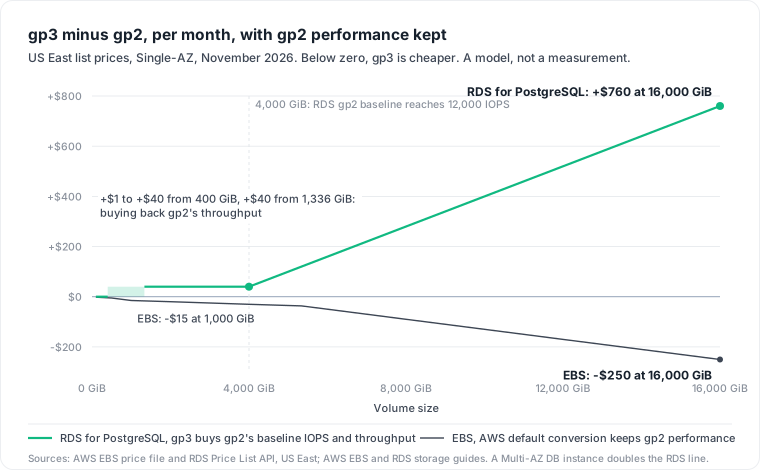
Whether gp3 costs more depends on the peak, not the size. An 8,000 GiB volume that peaks at 6,000 IOPS and 300 MiB/s gets nothing from gp2's 24,000 IOPS and 1,000 MiB/s, and moves to gp3 at the same $920. The table is the worst case: it is the price of keeping performance you might be paying for and not using.
The RDS saving is the disk you no longer buy for speed
On gp2 the only way to more IOPS is more GiB. Consider a hypothetical 300 GiB database that needs 6,000 IOPS around the clock, which burst credits cannot sustain:
| Need: 300 GiB, 6,000 IOPS | Allocation | Single-AZ | Multi-AZ instance |
|---|---|---|---|
| EBS gp2 | 2,000 GiB at 3 IOPS per GiB | $200.00 | |
| EBS gp3 | 300 GiB + 3,000 IOPS | $39.00 | |
| RDS gp2 | 2,000 GiB | $230.00 | $460.00 |
| RDS gp3 | 400 GiB, 12,000 IOPS included | $46.00 | $92.00 |
That is the RDS gain from gp3: $184 a month on one Single-AZ instance, $368 on a Multi-AZ DB instance. It only arrives if the allocated size comes down, and RDS storage cannot be reduced in place. Shrinking takes a Blue/Green Deployment onto a smaller volume, which AWS announced on November 20, 2024 for RDS for PostgreSQL 12 and higher, MySQL 5.7 and higher and MariaDB 10.4 and higher.
Moving from gp2 to gp3 without downtime
EBS keeps gp2's performance unless you say otherwise. The Elastic Volumes guide says a type change without IOPS or throughput uses "the equivalent performance of the source gp2 volume or the baseline gp3 performance, whichever is higher". A 4,000 GiB volume therefore moves to gp3 with 12,000 IOPS and 250 MiB/s, and saves $30 of $400 a month, 7.5%. Set the baseline explicitly if the volume's peak fits in it, and the saving is $80, the full 20%:
aws ec2 modify-volume --volume-id vol-0abc123 \
  --volume-type gp3 --iops 3000 --throughput 125
Check the VolumeReadOps and VolumeWriteOps peaks over a month before choosing. AWS says a 1 TiB volume "can take up to six hours" to modify, and limits each volume to four modifications in a rolling 24 hours, so a wrong guess can be corrected once the first change completes.
RDS stays available, with a caveat on volume count. The RDS gp3 guide says that after a storage IOPS change the instance enters storage-optimization, with "elevated latencies, but still within the single-digit millisecond range". A change that goes from one volume to four is different: RDS "provisions new volumes and transparently moves the data", which "can consume a high amount of IOPS, significantly increase I/O latency, and take several hours". Growing a 300 GiB gp2 database to 400 GiB of gp3 is that case, so schedule it like a migration.
aws rds modify-db-instance --db-instance-identifier orders-db \
  --storage-type gp3 --apply-immediately
Before switching an RDS volume of 400 GiB or more, read 28 days of ReadThroughput plus WriteThroughput and ReadIOPS plus WriteIOPS. If the peaks fit under 500 MiB/s and 12,000 IOPS, gp3 is free. The instance class also caps both: AWS notes an instance "might not be able to fully utilize" provisioned IOPS and throughput when its class has lower limits, so gp2's 1,000 MiB/s may never have been reachable.
Find every gp2 volume you still pay for
One call per service and Region:
aws ec2 describe-volumes --filters Name=volume-type,Values=gp2 \
  --query 'Volumes[].[VolumeId,Size,Iops,State]' --output table

aws rds describe-db-instances \
  --query "DBInstances[?StorageType=='gp2'].[DBInstanceIdentifier,Engine,AllocatedStorage,MultiAZ]" \
  --output table
Sort the RDS list by AllocatedStorage. Under 400 GiB, switch. From 400 GiB, compare peak throughput with 500 MiB/s first, and above 4,000 GiB peak IOPS with 12,000 too. On EBS, switch everything and set the IOPS from the peak, not from the old size. Unattached gp2 volumes are a separate problem, covered in AWS unused resources.
The strongest argument against this post is that gp2 is the previous generation and should be retired whatever the price. On EBS we agree. On RDS, gp2 is still the cheaper way to hold a large volume's full baseline: an 8,000 GiB database pays $240 a month more on gp3 for the same IOPS. Switch it when its measured peak fits gp3's baseline, and keep it on gp2 until then.
This model uses US East list prices for RDS for PostgreSQL and EBS. It ignores latency, which the EBS guide gives as single-digit milliseconds for both types, and it measures no workload. The RDS gp2 throughput between 400 and 1,335 GiB is a range in AWS's table, so the model gives a range there. EBS gp2 volumes between 171 and 333 GiB reach 250 MiB/s only on burst. If the default conversion keeps 250 MiB/s for them, the $5 of extra throughput makes gp3 dearer than gp2 below 250 GiB; --throughput 125 avoids it. Our RDS pricing post covers the other meters, and RDS cost optimization the order to cut them in.
The storage type is one setting per volume, set at launch and rarely read again. Datapace is building one map of your data estate (databases, warehouses, pipelines and what consumes them) with usage and cost attached, and agents that propose changes as pull requests your team reviews and merges: here, the storage change for each volume whose peak fits gp3's baseline. To go through your own RDS fleet, book a call.
Sources
- AWS, EBS price file behind the EBS pricing page, read November 21, 2026 publication of November 21, 2026 (gp2, gp3, gp3 IOPS and throughput rates; both types in 49 of 107 locations).
- AWS Price List API, Amazon RDS offer file for US East, publication of November 20, 2026, and the regional offer files for 37 regions, read November 21, 2026.
- AWS, Amazon EBS General Purpose SSD volumes and Modify an Amazon EBS volume using Elastic Volumes operations.
- AWS, Amazon RDS DB instance storage and Modifying settings for General Purpose SSD (gp3) storage.
- AWS, Blue/Green Deployments storage volume shrink, November 2024.
- AWS CLI reference: describe-volumes, modify-volume, describe-db-instances and modify-db-instance.