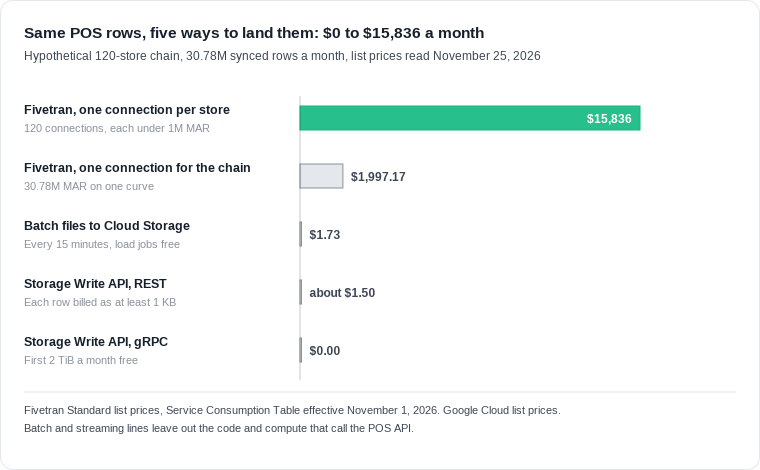
TL;DR. POS data is small and its landing bill is not. A hypothetical 120-store chain on Square writes about 30.8 million synced rows a month, 5.7 GiB. Through one Fivetran Standard connection that costs $1,997.17 a month at list price. If each store is its own Square account and its own connection, the same rows cost $15,836, about 7.9 times more. Batch files or BigQuery streaming land them for under $2 plus your own engineering. Count rows per sale and connections before you pick a tool.
POS data costs a data team almost nothing to store and a lot to land, and the price depends on how many connections carry it. A sale at the till is one ticket for the store, but a warehouse sync turns it into rows in several tables, and a per-connection price turns many small stores into many small, expensive connections. This post prices one hypothetical chain five ways from list prices read on November 25, 2026. It is a model: no pipeline ran on a real account.
The chain is the one from our retail data warehouse cost post: 120 stores, 900 tickets a store a day, 3.5 lines a ticket, 200 bytes a row. That post prices the warehouse queries and the holiday peak. This one stops at the door of the warehouse.
One POS sale becomes 9.5 synced rows across seven tables
A POS record is a header plus its children. Fivetran's Square connector schema shows the split: order keyed by id, order_line_item keyed by uid and order_id, and separate tables for order_line_item_tax, order_line_item_discount, payment, tender, card_payment_details and payment_processing_fee, each with its own primary key.
For a card sale with 3.5 lines and one tax, our model counts:
| Table | Rows per ticket (assumed) |
|---|---|
| order | 1 |
| order_line_item | 3.5 |
| order_line_item_tax | 1 |
| payment | 1 |
| tender | 1 |
| card_payment_details | 1 |
| payment_processing_fee | 1 |
| Total | 9.5 |
That is 8,550 rows a store a day, about 1.7 MB at 200 bytes a row, and 256,500 rows a store in a 30-day month. Line items, the rows analysts query most, are only 37% of what gets synced. Discounts, returns, modifiers and loyalty tables add more rows on top; we left them out.
Fivetran bills every one of those rows as MAR, per connection
MAR, in Fivetran's words, is "the number of distinct rows synced from the source system to your destination system in a given calendar month", with keys "counted separately for each account, destination, connection, table, activation, and activation sync". POS rows are mostly new rows, so nearly every row written in a month is a paid MAR that month. An order updated three times in the month still counts once.
The price is a curve, and Fivetran applies it per connection: "We apply a usage curve for each connection, meaning the more you use, the less you pay per monthly active row (MAR) per connection", says Fivetran's usage tracking page. Its Service Consumption Table, "effective as of November 1, 2026", sets each connection's price as "Base Spend per Month + (actual MAR - Monthly Active Row Threshold) * Incremental Spend per Million MAR". On Standard, the first million MAR costs $495 per million plus a $5 base, and rows from 16 million to 64 million cost $19.70 per million. The rate curve in full is in our Fivetran pricing post.
One connection for 120 stores costs $1,997.17 a month
Square lets one seller account hold many stores: its Locations API docs say "You can add more locations (up to 300 for a seller account) at any time." The connector schema carries a location table and a location_id on order and payment, so in this model one connection syncs all 120 stores.
That connection carries 120 x 256,500 = 30.78 million MAR a month:
- $1,706 base at the 16M threshold, plus (30.78 - 16) x $19.70 = $291.17
- $1,997.17 a month, about $64.89 per million rows
One connection per store costs $15,836 for the same rows
Now suppose each store is its own Square seller account, for example franchised stores that each signed up on their own. That is our assumption about the chain, not a Square rule. In this model each account gets its own connection, and Fivetran says "It is not the connector but the instance of the connection that matters" (usage-based pricing docs).
Each connection now carries 256,500 MAR, inside the first tier:
- $5 base plus 0.2565 x $495 = $131.97 a store
- 120 connections: $15,836 a month, about $514 per million rows
Same rows, same destination, 7.9 times the bill. The base charge is a small part of it: Fivetran's 2026 changes page adds "a $5 base charge" for "connections generating between 1 and 1M MAR", which is $600 of the $15,836. The rest is 120 connections paying the steepest tier.
Batch files and streaming land the same rows for under $2
Two cheaper routes skip the connector, and both move the cost to your team.
Batch files to object storage. Each store's export lands in a Google Cloud Storage bucket every 15 minutes: 120 x 96 x 30 = 345,600 uploads a month. Single-region Standard storage charges $0.005 per 1,000 Class A operations, so $1.73. BigQuery says "By default, you are not charged for batch loading data from Cloud Storage or from local files into BigQuery" (BigQuery pricing). Load all stores' files in one job per table per run, not one job per file: BigQuery's quotas cap "Load jobs per table per day" at 1,500, and one job per store file would be 11,520 a day.
Streaming. The BigQuery Storage Write API over gRPC costs $0.025 per GiB, and "The first 2 TiB per month are free" (BigQuery pricing). At 5.7 GiB a month, the chain pays nothing. The REST variant costs $0.01 per 200 MiB, but "Individual rows are calculated using a 1 KB minimum size", so a 200-byte POS row bills at five times its size. It is still about $1.50 a month. If POS events already flow through a behavioral pipeline, our Snowplow pricing post covers what that route costs.
Neither line includes the code that calls the POS API, handles its pagination and retries, maps its schema and keeps up with its changes, nor the compute that runs it. That is the price the connector charges for.
Storage is the cheapest line: about $1.35 a month after a year
A year of POS data for the chain is 12 x 5.73 = about 69 GiB. BigQuery's active logical storage in Iowa costs $0.000031507 per GiB-hour, and "The first 10 GiB is free each month" (BigQuery pricing). At 730 hours a month, the 59 GiB above the free tier cost about $1.35, before any of it ages into the cheaper long-term rate. Next to a connector, storage is a rounding error.
Block the tables nobody reads where the rows are expensive
Data blocking is supported at "Column level and table level" on the Square connector. Suppose analysts read only order, order_line_item and payment, and you block the other four tables: 5.5 rows a ticket instead of 9.5.
| Layout | Before blocking | After blocking | Saved a month |
|---|---|---|---|
| One connection, 30.78M then 17.82M MAR | $1,997.17 | $1,741.85 | $255.32 |
| 120 connections, 256,500 then 148,500 MAR each | $15,836 | $9,421 | $6,415 |
The same cut saves 25 times more on the per-store layout, because every blocked row there sits at $495 per million instead of $19.70. On many small connections, an unread table is the most expensive thing you sync.
A 50% peak month adds $303 on one connection and $7,618 on 120
Suppose tickets rise 50% in a peak month, a round hypothetical; the retail warehouse post sizes the real seasonal curve from Census data. With all seven tables:
- One connection: 46.17M MAR, $2,300.35, $303.18 more than an average month
- 120 connections: 384,750 MAR each, $23,454, $7,618 more
The single connection buys its peak rows at $19.70 per million. The per-store layout buys them at $495.
Count rows per sale in your own warehouse
To check the 9.5, count the child rows per order for one month in the Fivetran-synced Square schema. This is BigQuery SQL written against the connector's documented schema; we have not run it on a live account.
WITH o AS (
  SELECT id FROM square.`order`
  WHERE created_at >= TIMESTAMP '2026-10-01'
    AND created_at <  TIMESTAMP '2026-11-01'
)
SELECT 'order_line_item' AS tbl, COUNT(*) / (SELECT COUNT(*) FROM o) AS rows_per_order
FROM square.order_line_item WHERE order_id IN (SELECT id FROM o)
UNION ALL
SELECT 'order_line_item_tax', COUNT(*) / (SELECT COUNT(*) FROM o)
FROM square.order_line_item_tax WHERE order_id IN (SELECT id FROM o)
UNION ALL
SELECT 'tender', COUNT(*) / (SELECT COUNT(*) FROM o)
FROM square.tender WHERE order_id IN (SELECT id FROM o)
UNION ALL
SELECT 'payment', COUNT(*) / (SELECT COUNT(*) FROM o)
FROM square.payment WHERE order_id IN (SELECT id FROM o);
Then compare it with the paid MAR per table that the Fivetran Platform Connector writes, as shown in our Fivetran pricing post, and list the tables no query reads.
The objection: $2,000 a month is cheaper than an engineer
It is, and for one connection we would usually pay it. A home-built pipeline costs hours that this model does not price, and POS APIs change. The case here is narrower: the layout, not the tool, sets most of the bill. A chain that ends up with one connection per store pays $13,839 a month more than one that consolidates, for rows it already had. Consolidating accounts, or moving only the per-store sources to files, is where the money is.
What this model does not tell you
- It is one POS vendor. Other POS systems and their connectors may split a sale into other tables, so count your own rows per sale.
- Rows per ticket are assumptions. Discounts, returns, modifiers and multiple tenders raise the count; a cash sale has no card details row.
- It is list price. Annual Fivetran contracts and Google discounts change the numbers, and contracts signed before March 1, 2025 are tiered at the account level, not per connection.
- It leaves out queries. Dashboards and forecasts usually cost more than landing; see the retail data warehouse cost model, and our data pipeline cost comparison for other tools.
Find the connections that cost the most per row
POS cost hides in three places at once: the connector's usage page, the warehouse's read logs and the POS vendor's account setup. Datapace is building one map of your data estate with usage and cost attached, and agents that propose changes as pull requests your team reviews and merges. For a cross-tool view of who pays for which rows, read data FinOps.
Sources
- Fivetran, Square connector schema and Square connector, read November 25, 2026.
- Fivetran, Usage-Based Pricing, usage tracking and 2026 pricing changes, read November 25, 2026.
- Fivetran, Service Consumption Table, effective November 1, 2026, read November 25, 2026.
- Square, Locations API, read November 25, 2026.
- Google Cloud, BigQuery pricing, BigQuery quotas and limits and Cloud Storage pricing, read November 25, 2026.