TL;DR. Snowplow pricing has no public list price: paid plans are a custom quote "based on how many events you send, where it runs and where your data lands". We priced the other two bills for a hypothetical retailer at 66 million events a month. The AWS pipeline floor comes to $201.09 a month at list price, and the Snowflake lines to about $125. Against Vendr's third-party median contract of $68,000 a year, the quote is about 94.5% of the month. The lever is the event count, and page pings are 75.8% of it in this model: one tracker setting moves the count by 45.5%.
Snowplow pricing is three bills: the quote, the cloud account the pipeline runs in when it runs in yours, and the warehouse that stores and models the events. Below, the last two are priced at list price, the quote is placed with the only public contract data, and one tracker setting is shown to move the number the quote is based on.
Snowplow pricing: no list price, three bills
Snowplow's pricing page, read on November 19, 2026, lists a 14-day free trial and two paid deployments, both "Custom quote", and in its FAQ a Self-Hosted license for previous open source users:
| Deployment | Who runs the pipeline | Where it runs | Your separate cloud bill |
|---|---|---|---|
| Snowplow-hosted (CDI Cloud) | Snowplow | Snowplow's account | Warehouse only |
| Private Managed Cloud | Snowplow | Your AWS, GCP or Azure account | Pipeline plus warehouse |
| Self-Hosted license | You | Your account | Pipeline plus warehouse |
The pricing page calls the hosted option "One all-inclusive cost". The deployment docs put both the pipeline infrastructure and the data destination in your account for Private Managed Cloud, with the control plane at Snowplow. The pricing page adds: "Every deployment option lands data in your own warehouse."
So a Private Managed Cloud buyer pays three bills, and a hosted buyer pays two. Vendr says BDP contracts typically include infrastructure costs, so ask whether a Private Managed Cloud quote covers the cloud bill in your account or leaves it to you. The rest of this post prices them in that order.
What changes a Snowplow quote: events, hosting, destinations
The pricing page names three inputs: "Events per month", "Where it runs" and "Destinations". It gives no rate for any of them. The only public numbers come from third parties, and they are contract data, not list prices:
- Vendr reports a median of $68,000 a year, with a low of $39,183 and a high of $163,500.
- The same page puts contracts for 10 to 30 million events a month at $30,000 to $60,000 a year in one place and $30,000 to $70,000 in another, for 50 to 200 million at $80,000 to $200,000, and for 100 to 300 million at $100,000 to $250,000.
- Vendr also says contracts "typically include a committed event volume tier" with overage "often higher than the base per-event rate".
The free route is closed for commercial production. Snowplow moved its pipeline apps (Collector, Enrich, the loaders and Iglu Server) to the Snowplow Limited Use License on January 8, 2024, and version 1.1 (November 2024) allows them "only for Non-Production Use or Non-Commercial Use". The tracker SDKs stay on Apache 2.0 (the JavaScript tracker on BSD 3 Clause), per the licensing page. The way out, a Self-Hosted license, is for teams with "an existing Snowplow implementation" and lets you "run one pipeline in production".
The cloud bill when Snowplow runs in your account: about $200 at the floor
Snowplow's self-hosted guide says that at "around 100 events per second, the pipeline will cost around $200 per month on AWS". Vendr puts a self-managed cloud bill at $2,000 to $10,000 or more a month. Those differ by 10 to 50 times, so we priced the AWS stack ourselves.
The method: take the Terraform defaults of Snowplow's quickstart (commit ac9035d, October 28, 2026) with the Snowflake loader on, and the module defaults they pin. That is 6 EC2 instances at their autoscaling minimum of 1, 4 Kinesis streams of 1 provisioned shard, 2 load balancers (collector and Iglu), a db.t3.micro Postgres for Iglu, and public IP addresses on by default. Prices are US East list prices read on November 19, 2026 (EC2, EBS, Kinesis, Elastic Load Balancing, VPC, RDS, DynamoDB), over 730 hours.
| Line | Quantity | Rate | Per month |
|---|---|---|---|
| EC2 | 4 t3a.micro (collector, Iglu, two S3 loaders) + 2 t3a.small (Enrich, Snowflake loader) | $0.0094 and $0.0188 per hour | $54.90 |
| Kinesis | 4 shards (raw, enriched, two failed-event streams) | $0.015 per shard-hour | $43.80 |
| Load balancers | 2 ALBs, 1 LCU each (our assumption) | $0.0225 + $0.008 per hour | $44.53 |
| Public IPv4 | 6 instances + 2 per ALB | $0.005 per address-hour | $36.50 |
| RDS for Iglu | db.t3.micro Single-AZ, 10 GB gp2 | $0.018 per hour, $0.115 per GB-month | $14.29 |
| EBS | 6 root volumes of 10 GB gp3 | $0.08 per GB-month | $4.80 |
| DynamoDB | 4 KCL lease tables at 1 RCU + 1 WCU | $0.00013 and $0.00065 per hour | $2.28 |
| Total | $201.09 |
Row notes: AWS says an ALB "has one IP address per enabled Availability Zone" and needs at least two zones. DynamoDB is priced as if the account's free tier of 25 read and 25 write units is already used elsewhere; otherwise that line is $0.
Our line-by-line total lands on Snowplow's own estimate, $201.09 against "around $200". Kinesis, load balancers and public IPv4 addresses are $124.83 of it, 62.1%, and only the LCU part of the load balancer line moves with traffic. The per-event line is small: 2 Kinesis PUT payload units per event (raw and enriched) at $0.014 per million is $1.85 a month at 66 million events.
This is Community Edition sizing, which the license keeps out of production. With every autoscaling group at 2 and RDS Multi-AZ ($0.036 per hour, $0.23 per GB-month), the floor is $296.98. Left out: S3 archive storage, CloudWatch logs, NAT, data transfer and T3 surplus CPU credits. Vendr's range covers compute, storage and data transfer at an unstated volume and retention, and Snowplow does not publish its Private Managed Cloud sizing.
The warehouse bill for one month of events
On Snowflake, three lines follow the events. Prices come from Snowflake's Service Consumption Table, effective November 17, 2026: $2.00 per credit on Standard and $23.00 per TB-month of storage on demand in AWS US East.
- Loading. Snowplow's Snowflake Streaming Loader writes through the Snowpipe Streaming API. Its build pins a 4.x
snowflake-ingest-sdk(4.1.0 in release 0.5.1, the one the quickstart deploys; 4.4.3 on main), which Snowflake bills as Snowpipe Streaming Classic: "0.01 Platform Credits per client instance per hour" plus serverless compute. Counting the one loader instance as one client writing all month gives 7.3 credits, $14.60. Snowflake says it is "very difficult" to give sample costs for the compute part, so we leave it unpriced. - Modeling. Snowplow's dbt packages build page views and sessions from the events. Consider a team that runs them every hour on a standard X-Small warehouse (1 credit per hour), 3 minutes per run plus 1 minute before suspend. Over a 30-day month that is 48 credits, $96.00.
- Storage. Snowplow publishes no bytes per event. The only public numbers we found are two users' compressed Redshift
atomic.eventstables in a 2015 to 2016 GitHub thread: 400 GB for one billion rows, and 250 GB for 1.07 billion. That is 234 to 400 bytes per event, on another engine and an older schema. At 400 bytes, 66 million events add 26.4 GB a month, and 24 months hold 0.6336 TB, $14.57 a month.
Storage never stops growing, but it is the smallest line. The model runs cost more than two years of events; our data FinOps post shows how to give such runs an owner.
A retailer's Snowplow month, and its Black Friday peak
Consider a hypothetical online retailer with 2 million web sessions a month, 5 page views and 3 ecommerce events (product view, add to cart, checkout) per session. Every page is read actively for 75 seconds. The tracker uses the setting from Snowplow's page ping docs: first ping after 30 seconds, then a heartbeat every 10.
| Line | Normal month | Basis |
|---|---|---|
| Snowplow quote | $5,666.67 | Vendr median, $68,000 a year (third party) |
| AWS pipeline floor | $201.09 | Table above |
| Kinesis PUT payload units | $1.85 | 132 million units |
| Snowflake loader client | $14.60 | 7.3 credits |
| dbt model runs | $96.00 | 48 credits |
| Event storage, month 24 | $14.57 | 0.6336 TB at 400 bytes per event |
| Total | $5,994.78 |
The quote is 94.5% of the month, and the Vendr median is a placeholder for a number only Snowplow can give. The 66M month falls in Vendr's 50 to 200 million band ($80,000 to $200,000 a year), so the median may be low for this retailer, and the 36M month at a 30-second heartbeat falls below that band. What the model can show is the input the quote uses. Pings fire at 30, 40, 50, 60 and 70 seconds, so each page sends 5 pings and 1 page view:
| Events per month | Heartbeat 10 s | Heartbeat 30 s |
|---|---|---|
| Page views | 10.0M | 10.0M |
| Page pings | 50.0M | 20.0M |
| Ecommerce events | 6.0M | 6.0M |
| Total | 66.0M | 36.0M |
| Page ping share | 75.8% | 55.6% |
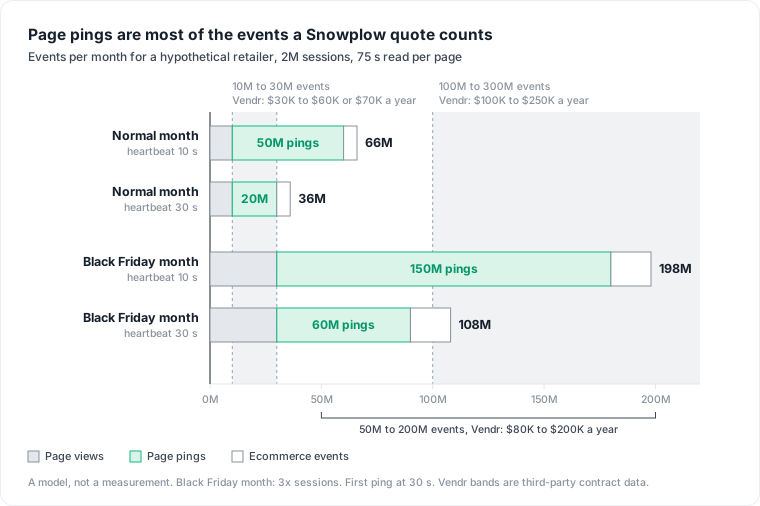
Now assume November brings three times the sessions. The month reaches 198 million events, 76.4 per second on average, and about 306 per second in an hour at four times that average. That passes the "~100 events per second" the quickstart handles out of the box, but stays under a shard's write limit of 1,000 records per second. We did not measure enriched event size, so we cannot say whether the 1 MB per second limit holds.
Priced with Enrich and the loader at 2 instances all month ($27.45, plus $7.30 of addresses and $1.60 of root volumes), triple PUT units ($5.54) and model runs three times as long ($240.00), the non-quote lines go from $328.11 to $512.16. The peak moves the cloud and warehouse by $184.04; it moves the event count by 132 million. A contract with a committed tier and overage meets that count, so ask how the quote treats a peak month before you sign.
The strongest objection to a longer heartbeat is accuracy. Snowplow's unified model computes engaged time as the heartbeat times the pings after the first, plus the minimum visit length. Our reader measures 70 seconds at a 10-second heartbeat and 60 at 30. If engaged time drives personalization or attribution, keep the 10 seconds on the pages that need it and widen it elsewhere. The package's snowplow__heartbeat variable (default 10, per its configuration docs) must match the tracker, or engaged time comes out wrong.
On cost alone, the GA4 route is the cheaper start: the GA4 BigQuery export is free, but Google caps standard properties at "a daily BigQuery Export limit of 1 million events". Without page pings, our retailer's page views and ecommerce events are 0.53 million a day (16 million a month). GA4 adds its own events, such as session_start and user_engagement, so check your property's daily count against the cap. Streaming export lifts the cap, and Google prices it at "$0.05 per gigabyte of data" in BigQuery, adding that "1 gigabyte equates to approximately 600,000 Google Analytics events", so 16 million events are roughly 26.7 GB, about $1.33 a month. For the cost of each pipeline after the events land, see data pipeline cost.
Datapace is building one map of your data estate with usage and cost attached, so event tables, the models built on them and the dashboards that read them sit beside what each costs. Agents propose changes as pull requests your team reviews and merges. To see how a retail warehouse bill behaves through its own peak, read retail data warehouse cost.