
TL;DR. Dark data is data you store and nobody reads, and what it costs depends on whether anything still writes it. We priced the same 2 TiB with no reader at list prices. Left alone, it costs $32.77 a month on BigQuery after 90 days untouched and $8.23 in S3 Intelligent-Tiering. Rebuilt every night, it costs $422.10 and $93.56: about 13 and 11 times more, because the rebuild bills compute and keeps the data out of the cheaper tier. Find the job that still writes unread data before you think about deleting anything.
Dark data is data you store, and often keep refreshing, that nobody reads. Its cost depends less on how much of it there is than on whether a job still writes it. Data that sits still gets cheaper on its own on BigQuery and in S3 Intelligent-Tiering. Data that a pipeline rebuilds every night pays for the rebuild and stays at the full storage rate.
Most writing on the term argues about its hidden value. Splunk's own guide says that "55% of an organization's data is considered 'dark'", a survey answer rather than a measurement. Our Industry 4.0 post collects the other surveys and their limits. This post prices dark data at list prices and shows how to find yours in logs you already have.
Everything below is a worked model, not a measured bill. Prices were read on November 25, 2026. The SQL below is written to the documented columns; we did not execute it on any account.
Dark data sitting still gets cheaper; rebuilt dark data never does
Two clouds already discount data nobody touches, one by default and one by choice. BigQuery switches a table or partition to its long-term rate once it "has not been modified for 90 consecutive days", and the price "automatically drops by approximately 50%". Querying a table, creating a view on it, exporting it and copying it elsewhere do not reset that timer. Loading into it, DML, streaming and CREATE OR REPLACE TABLE do.
S3 Intelligent-Tiering does the same for objects you store in that class. AWS moves objects to the Infrequent Access tier "when they haven't been accessed for 30 consecutive days", and after 90 days of no access to Archive Instant Access. Objects under 128 KB are not monitored and stay in the Frequent Access tier. A nightly job that writes new objects starts them at the top again.
So a rebuild costs twice: once for the compute, and again because it holds the data at the active rate. Nobody reads the result either way.
Worked example: 2 TiB nobody reads, left alone or rebuilt every night
Consider a team with a 2 TiB dataset that no person, dashboard or job has read in months. We priced it four ways, 30 nights in a 730-hour month, without the monthly free tiers.
| Case | Storage a month | Rebuild a month | Total |
|---|---|---|---|
| BigQuery, untouched for 90 days | 2,048 GiB × $0.016 = $32.77 | none | $32.77 |
| BigQuery, rebuilt every night | 2,048 GiB × $0.023 = $47.10 | 30 × 2 TiB × $6.25 = $375.00 | $422.10 |
| S3, untouched in Intelligent-Tiering for 90 days | 2,048 GB × $0.004 + 16,384 objects × $0.0025 per 1,000 = $8.23 | none | $8.23 |
| S3, rewritten every night by a Glue job, to S3 Standard | 2,048 GB × $0.023 = $47.10 | Glue $44.00 + PUT requests $2.46 = $46.46 | $93.56 |
BigQuery rates are Google's list prices for Iowa (us-central1), logical storage, and on-demand queries. The page gives storage per GiB-hour: $0.000031507 active and $0.000021918 long-term, which come to $0.023 and $0.016 for 730 hours. On-demand queries cost $6.25 per TiB. The rebuild is a CREATE OR REPLACE TABLE that scans 2 TiB of source each night, an assumption: yours may scan less with partitions or more with joins.
S3 and Glue rates are list prices from the AWS offer files for US East, read the same day: S3 Standard and the Intelligent-Tiering Frequent Access tier at $0.023 per GB for the first 50 TB, Archive Instant Access at $0.004, monitoring at $0.0025 per 1,000 objects, PUT requests at $0.005 per 1,000. The data sits in 16,384 objects of 128 MiB. The Glue job is a Spark ETL job with AWS Glue's default 10 DPUs, running 20 minutes a night at $0.44 per DPU-hour: 30 × 10 × 1/3 × $0.44 = $44.00. At least 16,384 PUTs a night, one per object, make 491,520 a month, $2.46.
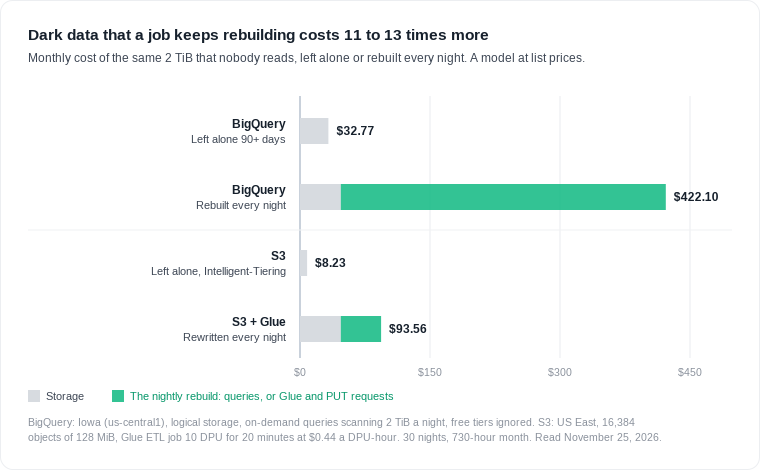
The rebuild is 88.8% of the BigQuery bill ($375.00 of $422.10) and 49.7% of the S3 one ($46.46 of $93.56). It also blocks the discount: the BigQuery table pays about $14 a month more for storage than it would untouched ($47.10 against $32.77), and the S3 data about $39 more ($47.10 against $8.23).
The model leaves things out. On the rebuilt side, it ignores the GET requests the Glue job makes to read its source, the extra requests of multipart uploads, and S3 versioning, which would keep each night's replaced objects; all three would raise the bill. On the untouched side, it ignores the one-time fee to move objects into Intelligent-Tiering. AWS's price list also carries a lower $0.308 per DPU-hour rate for Glue 6.0 and later jobs, which would cut the Glue line to $30.80. In Iowa, BigQuery's long-term rate is 30% below active, not 50%; in the US multi-region the two rates are $0.02 and $0.01, as our BigQuery storage pricing post lists by location.
Where dark data sits on a data platform, and what keeps billing
The same split applies everywhere: what the data costs to keep, and what still writes it.
| Where it sits | What bills while nobody reads | Where the reads show up |
|---|---|---|
| Warehouse tables | Storage, plus the queries or credits of the job that rebuilds them | BigQuery INFORMATION_SCHEMA.JOBS, Snowflake ACCESS_HISTORY |
| Lake files on S3 | Storage and requests, plus the job that rewrites them | S3 server access logs |
| BI extracts and models | The refresh schedule and the capacity it runs on | The BI tool's usage metrics |
| Log groups | Storage that never expires unless a retention is set | Mostly nowhere; set retention instead |
| Database tables | Provisioned storage and backups, plus the writes | Postgres pg_stat_user_tables |
| Dev and test copies | The copy's storage and the refresh that keeps it current | The same logs as the source |
CloudWatch is the plain case. In AWS's words, "by default, log data is stored in CloudWatch Logs indefinitely". Our AWS unused resources post prices that line next to nine other idle data resources. On the BI side, Power BI usage metrics shows how to find semantic models nobody opens.
Find dark data in four steps, from logs instead of surveys
- List what is stored, with bytes per table, bucket prefix or log group.
- List what was read, leaving out reads by the job that writes the same table. A loader that merges into its own target also reads it, so a table whose only reader is its loader can look used.
- List what still writes each unread table and price those writes.
- Rank by write cost first, then by storage. The table rebuilt every night outranks a bigger one nobody touches.
BigQuery: JOBS for reads and writes, TABLE_STORAGE for bytes
In INFORMATION_SCHEMA.JOBS, referenced_tables lists each table "referenced by the query", a field the docs describe as "only populated for query jobs that are not cache hits". The view keeps "job history for the past 180 days". TABLE_STORAGE gives active_logical_bytes and long_term_logical_bytes per table.
-- Unread tables in one region, with what their writes cost in 30 days (on-demand)
WITH reads AS (
  SELECT DISTINCT rt.dataset_id, rt.table_id
  FROM `region-us-central1`.INFORMATION_SCHEMA.JOBS j, UNNEST(j.referenced_tables) rt
  WHERE j.creation_time >= TIMESTAMP_SUB(CURRENT_TIMESTAMP(), INTERVAL 180 DAY)
    AND NOT (IFNULL(j.destination_table.dataset_id, '') = rt.dataset_id
             AND IFNULL(j.destination_table.table_id, '') = rt.table_id)
),
writes AS (
  SELECT j.destination_table.dataset_id AS dataset_id,
         j.destination_table.table_id   AS table_id,
         COUNT(*) AS write_jobs,
         SUM(j.total_bytes_billed) / POW(1024, 4) * 6.25 AS write_usd_30d
  FROM `region-us-central1`.INFORMATION_SCHEMA.JOBS j
  WHERE DATE(j.creation_time) >= DATE_SUB(CURRENT_DATE(), INTERVAL 30 DAY)
    AND IFNULL(j.statement_type, '') != 'SCRIPT'
    AND j.destination_table.table_id IS NOT NULL
  GROUP BY 1, 2
)
SELECT s.table_schema, s.table_name,
       s.active_logical_bytes / POW(1024, 3)    AS active_gib,
       s.long_term_logical_bytes / POW(1024, 3) AS long_term_gib,
       w.write_jobs, w.write_usd_30d
FROM `region-us-central1`.INFORMATION_SCHEMA.TABLE_STORAGE s
LEFT JOIN reads  r ON r.dataset_id = s.table_schema AND r.table_id = s.table_name
LEFT JOIN writes w ON w.dataset_id = s.table_schema AND w.table_id = s.table_name
WHERE r.table_id IS NULL AND NOT s.deleted
ORDER BY w.write_usd_30d DESC NULLS LAST, active_gib DESC;
The $6.25 assumes on-demand billing; under editions, price total_slot_ms at your slot rate instead. The SCRIPT filter drops the parent job of a multi-statement script, so its children are not counted twice. Load and copy jobs bill no query bytes, so they show up in write_jobs with a cost near zero, but they still reset the 90-day timer. An unread table with long_term_gib near its full size and no writes is the cheap kind; one with write_jobs near 30 is the expensive kind.
Snowflake: ACCESS_HISTORY, on Enterprise Edition
Snowflake's ACCESS_HISTORY "requires Enterprise Edition (or higher)" and covers "the last 365 days (1 year)", with latency "up to 180 minutes (3 hours)". Our Snowflake access history runbook has the full query, including the filter for a table's own MERGE and the credits its loads burn.
S3 and Postgres: request logs and table counters
On S3, server access logging "provides detailed records for the requests that are made to a bucket"; a prefix with PUTs and no GETs is the rewritten-for-nobody case. Our S3 storage cost post covers the inventory side: which prefixes hold the bytes.
On Postgres 16 and later, pg_stat_user_tables has last_seq_scan and last_idx_scan, "the time of the last" scan of each kind:
SELECT relname,
       pg_size_pretty(pg_total_relation_size(relid)) AS total_size,
       last_seq_scan, last_idx_scan,
       n_tup_ins + n_tup_upd + n_tup_del AS rows_written
FROM pg_stat_user_tables
WHERE GREATEST(last_seq_scan, last_idx_scan) IS NULL
   OR GREATEST(last_seq_scan, last_idx_scan) < now() - interval '90 days'
ORDER BY pg_total_relation_size(relid) DESC;
Two caveats. The counters do not say who scanned, so a loader's own lookups can make a table look read. And after "an immediate shutdown, a server crash, starting from a base backup, and point-in-time recovery", Postgres says "all statistics counters are reset", so a NULL there may mean "since the last restore", not "never".
Stop the rebuild first, and delete last
The first cut is the job, not the data. Pausing the nightly rebuild of an unread table removes the expensive line at once and is reversible: the last copy stays, and from then on BigQuery's 90-day timer or Intelligent-Tiering's 30-day one starts working for you. In the model, that alone takes the BigQuery case from $422.10 to $47.10 a month, then to $32.77 once the table has gone 90 days without a write.
Deletion comes later, after the owner has had a full cycle to object. Read a year of logs before calling a table dark: a finance job that runs once a year never appears in a 90-day window. BigQuery's JOBS keeps only 180 days, so copy it to a table of your own each month if annual readers matter.
The strongest objection: unread data may still hold value, for audits, for a model you have not trained yet, for a question nobody has asked. That argues for keeping the data. It does not argue for rebuilding it every night at the active rate while nobody looks. Keep the last copy, let it go cold, and spend the rebuild budget on data someone reads.
Where this does not apply: a table rebuilt in seconds from a small source costs little either way, and data under a legal retention rule stays whatever its readers. And a cleanup of dark data is one line of the wider cloud waste in data infrastructure, next to idle compute and oversized databases.
Dark data spreads across warehouses, buckets, BI tools and databases, and no single bill shows which part of it a job still rewrites. Datapace is building one map of your data estate with usage and cost attached, and agents that propose changes as pull requests your team reviews and merges. To look at your own unread tables and the jobs behind them, book a call.
Sources
- Google Cloud, BigQuery pricing: storage rates for Iowa (us-central1), long-term storage and what resets it, on-demand query pricing. Read November 25, 2026.
- Google Cloud, INFORMATION_SCHEMA.JOBS view and INFORMATION_SCHEMA.TABLE_STORAGE view.
- AWS, Price List API offer file for Amazon S3, US East (publication 2026-11-21) and for AWS Glue, US East (publication 2026-11-22). Read November 25, 2026.
- AWS, How S3 Intelligent-Tiering works, AWS Glue pricing, S3 server access logging and CloudWatch Logs retention.
- Snowflake, ACCESS_HISTORY view.
- PostgreSQL, The cumulative statistics system.
- Splunk, Dark Data: An Introduction.