TL;DR. Data sprawl is the same data living in more places than anyone decided, and each place bills on its own. We priced one 500 GB orders database copied seven ways at AWS and Snowflake list prices. It costs $626.25 a month in month 1 and $2,144.25 by month 12, and $1,871.05 of that (87.3%) pays for copies or bytes nobody reads. Two copies that grow every night make up $1,647.00. An S3 expiration rule on its own saves $0.00 here, for reasons in the bucket settings. Put a cost and a reader next to every copy, and retire the copies with no reader first.
Data sprawl is the same data copied across databases, replicas, landing buckets, warehouses, dev clones and BI extracts without an owner who decides which copies should exist. On the bill, data sprawl shows up as the same bytes stored, moved and refreshed several times, and in the model below, the copies that grow on a schedule cost far more than the ones people read.
The pages that define the term today come from security and storage vendors: Wiz frames it as a security risk, Palo Alto Networks as a visibility, compliance and storage cost problem with no figures, and a Pure Storage reference article (now under the Everpure name) as data a company no longer knows it has. None of them counts the copies of one dataset or puts a price on each. This post does.
Everything below is a worked model, not a measured bill. AWS prices come from the Price List API files for US East (N. Virginia and Ohio) and US West (Oregon), published between November 19 and 26, 2026, and Snowflake prices from its Service Consumption Table effective November 20, 2026, all read on November 26, 2026.
Data sprawl bills three ways per copy: storage, transfer and refresh
Every copy has up to three meters. Storage bills for as long as the copy exists. Transfer bills when a copy crosses a region or leaves the cloud. Refresh bills every time a job rebuilds the copy, in compute, export fees or per-row ingestion fees.
The meters behave differently over time. A copy that is refreshed in place costs the same every month. A copy that is appended to, like a folder of nightly exports with no expiry, costs more every month, and nobody gets an invoice line saying so. That second kind is where data sprawl gets expensive.
Worked example: one 500 GB orders database, seven places, $2,144.25 a month
Consider a team with a 500 GB orders database on RDS for PostgreSQL in US East (N. Virginia). Over the years it has picked up the usual copies, each made for a reason that made sense at the time:
- A read replica, created for reporting before the warehouse existed.
- A nightly snapshot export to an S3 landing bucket, which a loader reads into Snowflake. Nobody set an expiry.
- Cross-region replication of that bucket to US West (Oregon), set up as disaster recovery.
- The Snowflake table, fully reloaded every night, which dashboards read.
- A dev clone of that table, made for one project months ago.
- A BI extract refreshed from the table every night.
We price month 1 and month 12 of this stack, 30 nights a month and 730 hours. The primary's instance hours stay out of the model: the app needs them whatever the copies do.
| Copy | Reader | How it is priced | Month 1 | Month 12 |
|---|---|---|---|---|
| Primary RDS storage | the app | 500 GB × $0.115 | $57.50 | $57.50 |
| Read replica | nobody | 730 h × $0.225 + 500 GB × $0.115 | $221.75 | $221.75 |
| Nightly snapshot export | feeds the warehouse | 30 × 500 GB × $0.010 | $150.00 | $150.00 |
| Landing bucket, last 8 days | the load | 800 GB × $0.023 | $18.40 | $18.40 |
| Landing bucket, older exports | nobody | average GB held, minus 800, × $0.023 | $16.10 | $775.10 |
| DR copy in us-west-2 | nobody | average GB held × $0.023 + 3,000 GB × $0.02 | $94.50 | $853.50 |
| Snowflake nightly load and live table | dashboards | 30 × 20 min × 1 credit × $3.00 + 0.1 TB × $23.00 | $32.30 | $32.30 |
| Snowflake Time Travel and Fail-safe | nobody | 0.8 TB × $23.00 | $18.40 | $18.40 |
| Dev clone, retained bytes | nobody | 0.1 TB × $23.00 | $2.30 | $2.30 |
| BI extract refresh | dashboards | 30 × 10 min × 1 credit × $3.00 | $15.00 | $15.00 |
| Total | $626.25 | $2,144.25 | ||
| Read by nobody | $353.05 (56.4%) | $1,871.05 (87.3%) |
Where the rates come from. RDS: $0.115 per GB-month of gp3 storage running PostgreSQL, $0.225 per db.r6g.large Single-AZ instance hour, and $0.010 per GB of snapshot size for snapshot export to S3. AWS says read replicas "are billed as standard DB instances at the same rates as the DB instance class used for the replica". S3 Standard costs $0.023 per GB-month for the first 50 TB in both regions, and transfer from N. Virginia to Oregon $0.02 per GB. Snowflake's Service Consumption Table gives $3.00 per credit for Enterprise in AWS US East, $23.00 per TB-month of on-demand storage, and 1 credit an hour for an X-Small standard warehouse.
The assumptions are ours. Each export lands as 100 GB of compressed Parquet. Exports are kept forever, so in month 12 the bucket holds 34,500 GB on average (11 months × 3,000 GB, plus half of this month's 3,000). The Snowflake table holds 100 GB and is replaced in full every night by a truncate and reload, so each night's old 100 GB sits through 1 day of Time Travel and 7 days of Fail-safe: 800 GB of history. The clone was taken once and now holds 100 GB of old micro-partitions.
Two copies that grow every night make up 76.8% of the month-12 bill
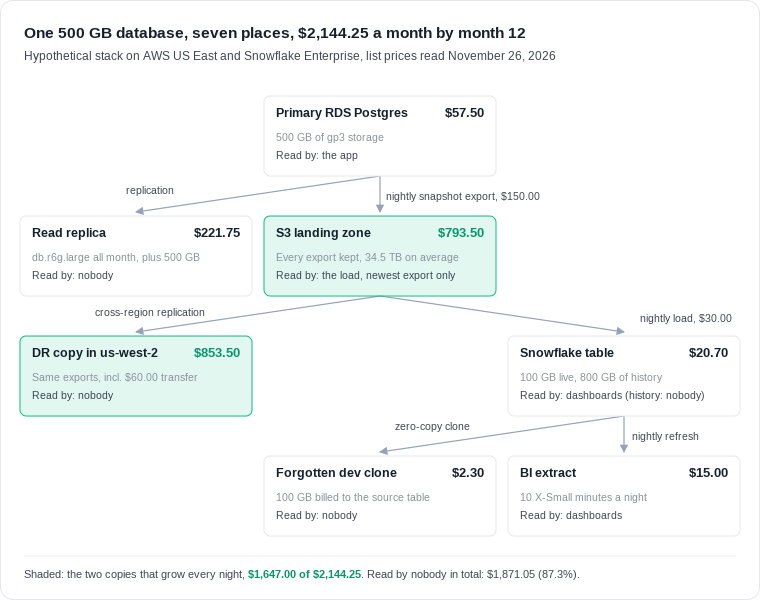
The landing bucket and its DR copy are $1,647.00 of $2,144.25 in month 12 (76.8%). Each adds 3,000 GB a month, so together they add $138.00 to the bill every month: 2 × 3,000 GB × $0.023. That is the whole gap between month 1 and month 12, 11 × $138.00 = $1,518.00.
The copies someone reads, and the jobs that feed them, cost $273.20 a month and do not change in this model: the primary's storage, the export, the last 8 days of landing files, the load, the live table and the BI refresh. By month 12 the stack costs 7.85 times that.
Neither growing copy looks wrong on its own. A landing bucket with history feels safe, and replication feels like DR. The cost comes from two settings nobody revisited: no expiry on the bucket, and a replication rule that copies every export.
An S3 expiration rule alone saves $0.00 on a replicated bucket
The obvious fix is a lifecycle rule that expires landing files after 7 days. In this stack, it saves nothing.
S3 replication requires versioning: "Both source and destination buckets must have versioning enabled." On a versioned bucket, an Expiration action keeps the bytes. Per the lifecycle examples, S3 removes current versions "by adding a delete marker", which "makes the current version noncurrent". And the versioning guide leaves no doubt: "Normal Amazon S3 rates apply for every version of an object stored and transferred." The landing bucket keeps billing $793.50 in month 12.
The DR copy does not even see the delete markers. Among the things S3 does not replicate, AWS lists "Actions performed by lifecycle configuration": with lifecycle "enabled only on your source bucket, Amazon S3 creates delete markers for expired objects but doesn't replicate those markers." The Oregon bucket keeps every export, 360 by the end of month 12, and bills $853.50.
The rule that works sets both actions, on both buckets:
<LifecycleConfiguration>
  <Rule>
    <ID>landing-keep-7-days</ID>
    <Filter><Prefix>exports/</Prefix></Filter>
    <Status>Enabled</Status>
    <Expiration><Days>7</Days></Expiration>
    <NoncurrentVersionExpiration>
      <NoncurrentDays>1</NoncurrentDays>
    </NoncurrentVersionExpiration>
  </Rule>
</LifecycleConfiguration>
AWS's replication guide says the same in its own words: after enabling versioning, "add a NonCurrentVersionExpiration policy to maintain the same permanent delete behavior". With it, the landing bucket settles at 8 days of exports, the $18.40 line in the table.
The 360 exported copies cannot be restored to a database directly
The DR copy is the largest line, and it protects the least. AWS is plain about snapshot exports: "You can't restore exported snapshot data from S3 to a new DB instance or import snapshot data from S3 into an existing DB instance." The way back AWS describes runs through AWS Glue and DMS or custom scripts. The database is restored from its own snapshots; the Parquet files in Oregon are a copy of the warehouse feed.
If the team wants the warehouse feed to survive a region outage, a short copy does that. Keeping the last 8 days in US East (Ohio) costs $48.40 a month: 3,000 GB of transfer at $0.01 per GB to Ohio plus 800 GB at $0.023. AWS's own guide notes that choosing Oregon over Ohio as the destination of a N. Virginia bucket means "you pay more".
Smaller copies follow the same pattern in the warehouse and the database
The rest of the sprawl is smaller here, but it is the same mechanism: a copy made for one reader, still billing after the reader left.
- Warehouse history. Snowflake's default Time Travel retention is 1 day, after which "the historical data is moved into Snowflake Fail-safe", and permanent tables keep 7 days of Fail-safe. Storage fees apply to both periods. Snowflake's storage guide prefers permanent tables for most high-churn tables, since their history is usually small, and, for high-churn tables whose history gets excessive, suggests transient tables with zero Time Travel retention, copied periodically into a permanent table. Transient tables have no Fail-safe, and they keep 1 day of Time Travel unless retention is set to 0. Here the history costs $18.40 a month, so retiring it saves little. Our Snowflake cost optimization post prices permanent against transient storage on a larger table.
- Clones. A zero-copy clone is free on the day it is made. Snowflake's storage guide says the shared micro-partitions are owned by the oldest table in the clone group, and they show up in the
RETAINED_FOR_CLONE_BYTEScolumn ofTABLE_STORAGE_METRICS. When the source is reloaded in place, the old micro-partitions the clone still references stay owned by the source table, where nobody looks for them. ACREATE OR REPLACEdrops the source instead, and ownership moves to the clone once the dropped table's Time Travel period ends. - Read replicas. They bill like any instance. A replica with no connections for a month is a $221.75 copy of the database in this model.
- Ingestion. A tool that bills per synced row charges again for every copy it lands. Our Fivetran MAR pricing post works out what that meter adds per connection.
Retire the copy with no reader first, largest first
The security framing of data sprawl leads to an inventory of where sensitive data lives. For the bill, the inventory needs two more columns: a monthly cost and a reader for every copy. A copy with a cost and no reader is the first to go.
- List the copies of each dataset: replicas, buckets and their replicas, warehouse tables and their history, clones, extracts.
- Price each copy on its own meters: storage, transfer and refresh.
- Find each copy's reader in logs, not in memory: S3 server access logs for GET requests, the warehouse's access history, the replica's connections. Our dark data post has the queries.
- Retire in order of cost, after the owner has had a cycle to object. Here that is the DR copy ($853.50), the old exports ($775.10), the replica ($221.75), the table history ($18.40), then the clone ($2.30).
With every unread copy gone, the stack costs $273.20 a month, 87.3% less than at month 12. With the 8-day Ohio copy kept for the warehouse feed, it costs $321.60, 85.0% less.
The strongest objection: some copies exist for reasons that never show up as reads, such as an audit retention rule or a recovery plan. That is true, and those copies should stay. It argues for pricing them as insurance and deciding how much to buy, not for keeping 360 exports in two regions that cannot be restored directly into a database anyway.
What this model leaves out
The model omits S3 request charges, including the PUTs that replication makes, which would raise the bill. It omits RDS automated backups and the warehouse's idle time after each job, and the 1:5 Parquet ratio is an assumption; your exports may be larger or smaller. Prices are list prices with no discounts. We did not run this stack on an account. And where a team streams changes instead of exporting snapshots, the export line changes shape, though the copies downstream pile up the same way.
Idle compute and oversized databases are the other half of waste on a data platform. For the dataset you have, our data pipeline cost post shows how to put a cost on each job, and data FinOps covers who that cost belongs to.
Copies spread across databases, buckets and warehouses, and no single bill shows which of them anyone reads. Datapace is building one map of your data estate with usage and cost attached, and agents that propose changes as pull requests your team reviews and merges. To count the copies of your own largest dataset, book a call.
Sources
- AWS, Price List API offer files for Amazon RDS, US East (publication 2026-11-26), Amazon S3, US East, US West (Oregon) and US East (Ohio) (publication 2026-11-25), and AWS Data Transfer, US East (publication 2026-11-19). Read November 26, 2026.
- Snowflake, Service Consumption Table, effective November 20, 2026, downloaded November 26, 2026 (853,805 bytes): Tables 1(a), 2(a) and 3(a).
- AWS, Working with DB instance read replicas and Exporting DB snapshot data to Amazon S3.
- AWS, Requirements and considerations for replication, What does Amazon S3 replicate?, Examples of S3 Lifecycle configurations and S3 Versioning.
- Snowflake, Time Travel, Storage costs for Time Travel and Fail-safe and Data storage considerations.
- Wiz, What is data sprawl?; Palo Alto Networks, Data sprawl; Pure Storage, What is data sprawl?.