TL;DR. A data historian is a time-series database built for plant data: it stores readings by change rather than by clock, buffers them when the network drops, and bills by tag. A hypothetical 5,000-tag plant fits Canary's 5,500-tag tier at $5,840 a year, or $486.67 a month. Copying the same data to Snowflake costs $0.35 a month through Snowpipe, $36.50 with an hourly load, and $1,460 with a load every minute, because a warehouse woken every minute never suspends. The historian licence is the predictable line. The load schedule of the cloud copy is the line that moves.
A data historian answers one question for a plant: what did every sensor, valve and motor do, second by second, for the last ten years? This post explains what a historian does that a general database does not, how it bills compared with a time-series database and a cloud warehouse, and then prices one 5,000-tag plant with its historian and a warehouse copy for analysis.
The finding that matters for the budget: the data is small. Canary's sizing example puts 1,000 tags at 10.4 GB a year; scaled to five thousand tags, that is about 52 GB. What costs money is how often something wakes up to move it.
A data historian stores plant signals by change, buffers them, and bills by tag
Three features separate a historian from a general-purpose database.
- It stores changes, not samples. AVEVA describes the goal of PI's exception and compression filtering as "minimize storage of time-series events while maintaining information content of the data". The same deck describes a "Simple deadband to filter noise" on PI Interfaces, then a "swinging door" algorithm that drops points "that can safely be recreated with interpolation."
- It does not lose data when the network drops. Canary's Store and Forward service, in its help centre's words, handles "buffering data in the event that it cannot connect" to the receiving side: "Buffered data is cached to disk until the connection between the two SaF services is established."
- It is organized and licensed by tag. A tag is one named signal, such as a temperature on line 3. Canary's licensing guide counts "the number of tags within the last file of each DataSet." AVEVA's PI license schedule offers licensing by node and data streams, or an Aggregate Tag model in which the customer commits "to a minimum number of PI Server tags" for the term.
The first feature is why historian storage stays small. Canary's disk space guide estimates "1 Year Archive - 10.4 GB" for 1,000 tags of mixed types with an average sample rate of 5 seconds and an average change rate of 30%. Scaled to 5,000 tags, that is 52 GB a year.
Historian, time-series database or cloud warehouse: each bills a different meter
The usual comparison asks which tool is fastest or most open. For the bill, the question is what each one meters.
| Data historian | Managed time-series database | Cloud warehouse | |
|---|---|---|---|
| Example | Canary, AVEVA PI | Amazon Timestream for InfluxDB | Snowflake |
| What you pay for | Tags (a tier) or nodes and data streams, plus client and connector licences | Instance hours and allocated storage | Warehouse seconds, stored TB, loaded GB |
| Published price | Canary yes; PI no | Yes | Yes |
| Buffering at the collector | Part of the product (store-and-forward) | Depends on the collector you add | Depends on the pipeline you add |
| What makes the bill grow | Crossing a tag tier | Running the instance, whether or not anyone reads | Waking compute often |
Two notes on the meters. On Timestream for InfluxDB, AWS bills "per DB instance-hour consumed from the time a database instance is launched until it is stopped or deleted", so a database behind live plant screens bills every hour of the month; our AWS Timestream pricing post prices that for a plant. On Snowflake, each start or resume of a warehouse "is billed for 1 minute's worth of usage", then per second while it keeps running.
A 5,000-tag plant: the historian licence is $5,840 a year
Consider a hypothetical plant with 5,000 tags, sampled every 5 seconds on average, 30% of samples stored as changes, using Canary's mixed data types. That is 86.4 million samples a day and 25.9 million stored values a day. At 52 GB a year, the historian stores about 5.5 bytes per value.
Canary's pricing page, read on November 22, 2026, puts 5,000 tags in its 5,500-tag tier:
| Plan | Year one | Each later year | Per month, year one |
|---|---|---|---|
| Subscription, CustomerCare included | $5,840 | $5,840 | $486.67 |
| Perpetual licence plus 18% CustomerCare | $17,228 | $2,628 | $1,435.67 |
Canary's page adds: "All pricing is subject to change at any time." Our Canary historian pricing post covers the 12 tiers and when perpetual overtakes subscription.
AVEVA PI cannot be priced the same way: AVEVA publishes its meters but no list prices. Under the Aggregate Tag model in the AVEVA PI System schedule v1.5, June 2026, days above the committed tier are "charged Daily at the pre-set Overage Daily Rate," and "Under no circumstances may Customer decrease or downgrade the Aggregate Tag Tier Benchmark during the Term." Our OSIsoft PI pricing post works through a term with those rules.
The cloud copy costs $0.35 or $1,460 a month, and the schedule decides
A plant that also lands historian data in a warehouse, for analysis across sites or AI work, pays for that copy separately. Assume the plant exports every stored value as one CSV row, about 60 bytes each:
Line3.Press07.Temp_PV,2026-11-22T07:00:05.000Z,182.4375,192
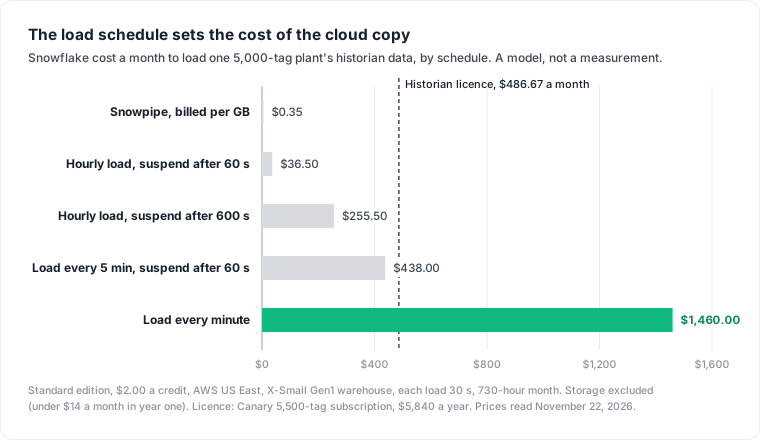
That is 25.92 million rows times 60 bytes, 1.56 GB a day, or 47.3 GB in a 730-hour month. Snowflake's Service Consumption Table (effective November 20, 2026) bills Snowpipe at "0.0037 Platform Credits per GB", counting text files such as CSV "for their uncompressed size", and an X-Small standard warehouse at 1 credit an hour. A Standard edition credit costs $2.00 in AWS US East.
Here is the same 47.3 GB loaded five ways, each load assumed to take 30 seconds on an X-Small Gen1 warehouse:
| Load design | Billed per run | Credits a month | Standard ($2.00) | Enterprise ($3.00) |
|---|---|---|---|---|
| Snowpipe, per GB | 47.3 GB x 0.0037 | 0.175 | $0.35 | $0.53 |
Hourly load, AUTO_SUSPEND = 60 | 90 s, 24 runs a day | 18.25 | $36.50 | $54.75 |
Hourly load, AUTO_SUSPEND = 600 | 630 s, 24 runs a day | 127.75 | $255.50 | $383.25 |
Every 5 minutes, AUTO_SUSPEND = 60 | 90 s, 288 runs a day | 219 | $438.00 | $657.00 |
| Every minute (or every 5 minutes at 600) | never suspends, 730 h | 730 | $1,460.00 | $2,190.00 |
The billed time per run is the load plus the idle wait before suspend. Snowflake's CREATE WAREHOUSE reference sets that wait to 600 seconds unless you change it. Once the gap between loads is shorter than the load plus the suspend wait, the warehouse never stops, and the copy bills all 730 hours. At one load a minute, that is three times the Canary subscription on Standard and 4.5 times on Enterprise.
Storage barely registers. Even if Snowflake stored the CSV with no compression at all, 12 months of it (568 GB) would cost $13.06 a month at the $23.00 per TB on-demand rate for AWS US East. The real figure is lower, but we did not measure Snowflake's compression on this data.
If a one-minute schedule exists to make a warehouse dashboard live, it duplicates what the historian's own clients already do: Canary's plans include "Unlimited Axiom Clients."
Why plants copy historian data anyway, and what that copy should cost
The copy is not going away. On May 19, 2026, AVEVA and Snowflake announced a partnership that "will enable direct, zero-code integration between CONNECT and Snowflake." The release gives no pricing. Manufacturers also say data is what holds back their AI projects. A vendor survey run for Augury by its research partner, Endeavor Business Intelligence, of 501 manufacturing professionals in the US, Germany, France and the UK, reports in Augury's June 9, 2026 press release: "Data quality is now the leading barrier to AI maturity, cited by 47% of respondents."
So the question is not whether to copy, but who decides how. Set the copy's schedule from its slowest acceptable reader, not its most eager one. For analysis, an hourly batch or per-file Snowpipe ingestion fits; for anything an operator watches live, the historian already serves it.
The case for replacing the historian, and why it rarely pays on cost
The strongest counterargument comes from vendors selling the alternatives. InfluxData warns that "per-tag licensing can escalate quickly" as sensors are added, and Actian titles its case against them "It's Time for Data Historians to Become…History". Drop the historian, the argument goes, and put everything in one time-series database or warehouse.
For a 5,000-tag plant the arithmetic does not support it. The licence is $486.67 a month, while the replacement needs compute running all month for live screens, plus the collector buffering and signal filtering that come with the historian, assembled and maintained by your team. The case gets stronger on a large PI estate with fast tag growth, where the tier cannot go down mid-term and overage accrues daily. We cannot price that case, because AVEVA publishes no rates; it needs your own quote.
Check the copy before you buy the next tier
- Read the tag count and the next tier boundary. Our Canary post shows where Canary reports the licensed count and how to clear tags nobody reads.
- List every copy of the historian data and its schedule: each task, pipe or integration job that loads it, and the warehouse it runs on.
- Measure what each loading warehouse burns by hour. Snowflake's WAREHOUSE_METERING_HISTORY view keeps 365 days, with up to 3 hours of latency:
-- Idle share per warehouse over the last 30 days; loading warehouses near the top
-- are the ones a schedule keeps awake.
SELECT warehouse_name,
       ROUND(SUM(credits_used_compute), 1) AS compute_credits,
       ROUND(100 * SUM(credits_used_compute - credits_attributed_compute_queries)
             / GREATEST(SUM(credits_used_compute), 0.001), 1) AS idle_pct,
       COUNT_IF(credits_used_compute > 0) AS hours_running
FROM snowflake.account_usage.warehouse_metering_history
WHERE start_time >= DATEADD(day, -30, CURRENT_TIMESTAMP())
GROUP BY warehouse_name
ORDER BY idle_pct DESC;
The view's reference notes that "Warehouse idle time is not included in the CREDITS_ATTRIBUTED_COMPUTE_QUERIES column," so a loading warehouse with a high idle share is one that the schedule keeps awake. hours_running near 720 (30 days of 24 hours) means it never suspends. 4. Move frequent loads to Snowpipe or a slower batch, and set AUTO_SUSPEND to 60 on any warehouse that only loads. Our Snowflake warehouse size post covers the idle tail in more detail.
What this model does not cover
- The plant is hypothetical. The 60-byte row and the 30-second load are our assumptions. A slower load raises the hourly and 5-minute rows, wider rows raise Snowpipe and storage, and neither changes the always-on ceiling of 730 credits a month on an X-Small.
- Queries are excluded. Dashboards and models reading the copy add their own compute; our data warehouse cost post prices one workload across four platforms.
- Gen1 only. Gen2 X-Small warehouses on AWS bill 1.35 credits an hour, which raises every warehouse row.
- No PI prices, and no Canary Private Cloud, ODBC or ancillary-server licences.
- Serverless tasks run on Snowflake-managed compute at a 0.9 multiplier in the same consumption table; we did not price them.
Datapace is building one map of your data estate (databases, warehouses, pipelines and what consumes them) with usage and cost attached, and agents that propose changes as pull requests your team reviews and merges. For a plant, that map would show both copies of the same tags and which one anyone reads. To go through your own historian and its warehouse copy, book a call.
Sources
- Canary's pricing page (prices from the page source, read November 22, 2026) and Help Center: How to License the Canary System (v26), Store and Forward Tile (v26), Estimating Historian Disk Space (v24).
- AVEVA, AVEVA Software Schedule PI System v1.5, June 2026, section 3.3(a)(iii); Exception, Compression and their Impacts on PI System Performance, AVEVA World San Francisco 2023.
- Snowflake, Service Consumption Table, effective November 20, 2026, downloaded November 22, 2026 (853,805 bytes, etag
6b007616-d072d), warehouse Tables 1(a) and 1(b), credit Table 2(a), storage Table 3(a), Snowpipe in Table 5; Understanding compute cost; CREATE WAREHOUSE; WAREHOUSE_METERING_HISTORY view. - AWS, Amazon Timestream pricing, Timestream for InfluxDB section.
- AVEVA, AVEVA and Snowflake Forge Strategic Collaboration, May 19, 2026.
- Augury press release on Manufacturing Dive, Augury report: industrial AI reaches a tipping point, June 9, 2026 (vendor survey, 501 respondents).
- InfluxData, What is a data historian; Actian, It's time for data historians to become history.